
wrestling / Columns
Ask 411 Wrestling: How Many Times Did Steve Austin & Undertaker Wrestle Each Other?
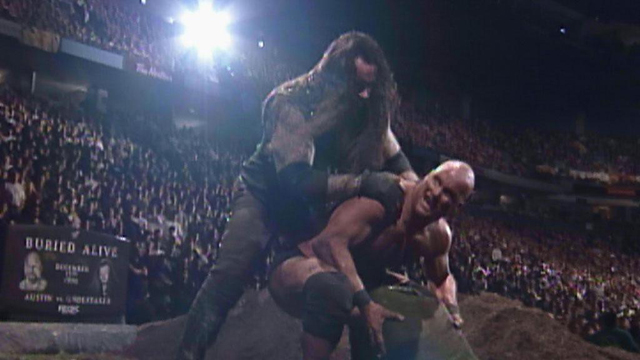 Image Credit: WWE

Welcome guys, gals, and gender non-binary pals . . . through Hel Stryer and brimstone, it’s Ask 411 Wrestling!
I am your party host, Ryan Byers, and I am here to answer some of your burning inquiries about professional wrestling. If you have one of those queries searing a hole in your brain, feel free to send it along to me at [email protected]. Don’t be shy about shooting those over – the more, the merrier.
Hey, ya wanna banner?

Jase the master and the ruler of the something or other:
What happened to Sid in the WWF in 1997? He was one of their top stars until about the middle of that year, when he just seemed to vanish.
He left to deal with some neck issues.
Bryan‘s assets have been purchased out of bankruptcy by The Onion:
Did Sean Morley suffer some kind of head injury in wrestling?
I’m just wondering how he went from being the WWE’s version of TT Boy (don’t ask how I know that name) to pro wrestling’s Alex Jones.
What happened to Val? Because I don’t recall him being like that in the early 2000s.
I assume what Bryan is referring to here is Venis’s far-right wing political views. That’s nothing new. Even when he was on the WWE roster there were stories about his being a Libertarian and largely falling in line with the opinions of fellow conservative wrestler Glenn “Kane” Jacobs. The difference now is that fans can get a lot more direct insight into how exactly Mr. Venis moves about in the world, thanks to social media, YouTube, and so on.
HBK’s Smile has some real longevity in this column:
Has a wrestler or tag team ever come within a month of breaking the record for the longest reign for a particular title, only to lose that title before breaking the record?
Sure, that’s happened. One example that I was able to find relatively quickly related to the WWF Intercontinental Championship. When “Macho Man” Randy Savage held the belt between 1986 and 1987, the record for the longest reign was held by Pedro Morales at 425 days. Savage dropped the championship with a 414-day reign, eleven days shy of Morales.
There wasn’t any kind of storyline based around the Macho Man chasing this record, though. If it was commented on it was only in passing. If you think about it, a storyline based around a wrestler failing to break a record wouldn’t make a ton of sense, because it buries the guy who can’t get the job done.
One notable exception to the above is Santino Marella, who launched an active campaign to break the Honky Tonk Man’s Intercontinental Title record in 2008 and missed the mark. Of course, Santino was a comedy act, so the rules apply a bit differently to him. He also didn’t come within anywhere near 30 days of outlasting Honky, so he doesn’t qualify as an answer to Mr. Smile’s question.
Michael just isn’t that into you anymore:
Have you noticed a trend where popular wrestlers are chasing titles and they have the fans behind them and, when they finally win, the fan reactions seem to dwindle?
It happened with Misterio when he won the title in honor of Eddie, it happened when Kofi beat Bryan, and again when Owens and Zayn beat the Usos, and I’m sure I’m missing others. Why do you think this is? It seems odd they get such support and, when they finally win, it feels the reactions change the next day.
Typically when something like this happens, it doesn’t happen immediately and instead occurs over a period of time – albeit sometimes a short period of time – due to how the wrestlers in question is booked.
Let’s use Rey as an example. He won the Royal Rumble in a bit of a surprise. Then, his Wrestlemania championship match was taken away from him, and there was an organic groundswell of support from fans who had always been into him combined with fans who felt that he had been wronged in some way. Fans supported him to the point that the company did pull the trigger and give him the championship . . .
. . . but then the company lost all interest and booked him like a goof, even though he was holding one of their primary titles. Though there are some people who have an ability to remain “more over than their push” and lose only minimal momentum when the booking isn’t behind them, fans do tire of most wrestlers if it’s clear that they’re not going to be booked as the focus of the show.
Bruce is gearing up his Mr. Peabody-style time machine:
What wrestlers active before 1980 do you think could have been successful today? This could possibly be a lot of them or just a few. I have my own opinion but no one reads this for my opinion. What is your take?
I assume that we’re talking about wrestlers who had most if not all their careers before 1980, as picking somebody like Hulk Hogan who wrestled a couple of years in the 70s but then carried on through the 2010s seems to go against the spirit of the question.
With that established, I’ve got a couple of answers.
The first person I’ll select is Maki Ueda. She was one half of the tag team the Beauty Pair, which was the top attraction of All Japan Women in the 1970s. (I’m leaving out her partner, Jackie Sato, because she continued to wrestle in the 80s.) Joshi has a reputation for being ahead of its time in terms of in-ring product, and deservedly so. If you watch just about anything Ueda did, it is just as good as if not better than 90% of women’s wrestling in 2026, though obviously it doesn’t contain all the modern moves like dives out of the ring.
Choice number two is Ricki Starr. I’ve mentioned Starr in the column before, but for those who don’t recall, he was a wrestler active from the 1950s through the 1970s who had a background as a ballet dancer. He incorporated dance into his style of wrestling and used a style where he would infuriate his more serious opponents with flips, pirouettes, and other comedic spots. He was highly athletic, and he could actually wrestle, but he also worked in an early version of what today might be called sports entertainment. There is a direct through line from Ricki Starr to Orange Cassidy, and what’s why I think Starr would still work today.
Tyler from Winnipeg is crunching the numbers:
How many times, including all promotions, have Steve Austin and The Undertaker been in a match AGAINST each other; including battles royale or Royal Rumbles or Elimination Chambers or House Shows, etc.
By my count, there were 117 instances of the Undertaker and Steve Austin acting as opponents to one another, in any kind of match on any kind of show.
Interestingly, of those 117 matches, 114 of them were in the WWF, beginning in 1996 and continuing through 2002. The three matches outside the Federation were all held in the USWA, where the Undertaker wrestled under a mask as the Punisher. Punisher defeated Steve Williams (a.k.a. Steve Austin) on November 4, 1989. Then, on January 8 and January 10, 1990, two identical tag team matches occurred, featuring Dutch Mantel teaming with Austin to defeat the Punisher and the Soultaker. The Soultaker would go on years later to be known as the Godfather.
DAP is, well, dapping up:
What are the pros/cons of the various bookers/booking committee over the years?
I’ve read online about Dusty Rhodes’ ability of creating gimmick matches (e.g., War Games, Lethal Lottery, etc.) and his overuse of disqualifications in title matches (the “Dusty Finish”, if you will). I also heard about Jerry Lawler and Jerry Jarrett booking Memphis for 6 months or so, before they trade duties between each other.
Yet, no one can specifically say what was good or bad abut these guys. Therefore, If you can, will you please provide bullet-points of what they’ve done that was great, and what they did that was not-so-great.
For the sake of clarity and time, I’d like (if possible) to get a general idea, of the following people:
-George Scott (I know he was the booker for Mid-Atlantic back in the mid-1970s/early 1980s before he booker for WWF/WWE during the “Rock N Wrestling” era before he went to World Class and back to Jim Crockett in 1989)
Scott is given a ton of credit for not only keeping Mid-Atlantic on the rails after the death of Jim Crockett Sr. but also kicking off a boom period very shortly after by bringing in wrestlers like Johnny Valentine and the Destroyer (Don Jardine) to feud with Nelson Royal and Johnny Weaver, respectively. He did so well that he remained in the position for roughly a decade.
Though Scott was, in fact, booking in the WWF during the ascension of Hulkamania, I’ve always questioned how much credit he really deserves for it. I’m sure he had some role, but when you’re talking about the WWF, you’re talking about Vince McMahon’s promotion and his vision.
After the Fed, Scott didn’t last anywhere for an extended period of time, bouncing around because he seemingly couldn’t recapture whatever it was he had in the 70s. His last go in wrestling was trying to found his own regional promotion in the Carolinas in 1990, called the North American Wrestling Association. He was bounced from even that after only a few months and replaced by a new group that rebranded the company as South Atlantic Pro Wrestling.
-Jim Cornette (I know about Smoky Mountain, but I’d like details, specifically what he did in WCW, WWE, Ring of Honor, TNA, OVW)
First off, it’s worth noting that Cornette’s career in creative started with him attending a handful of booking meetings in 1985 in World Class Championship Wrestling. He’s said on his podcast that it was only four or five meetings, so there’s not much good or bad he can be credited for, but this is where it all began for Corny.
He was on the WCW booking committee in 1989 and 1990 after being invited to join by Ric Flair, who was heading things up at the time. It was a large committee and, again, a relatively limited time so you’re not going to have a ton of ideas that bubbled up from Cornette individually as much as it was him collaborating with others, helping to refine finishes, and so on.
Probably one of his more interesting WCW ideas – which was developed jointly with Flair – never came to fruition. In 1990, Arn Anderson and Tully Blanchard were due to rejoin the company and reform the Four Horsemen, but the deal fell apart when Jim Herd rescinded Blanchard’s offer, allegedly due to a failed drug test. With Tully no longer available, a plan was hatched to create a new version of the Horsemen consisting of Flair, Anderson, and the Midnight Express of Bobby Eaton and Stan Lane. However, Herd 86’ed this as well.
Cornette has noted that he’s the guy who brought “Mean” Mark Callus, a.k.a. the Undertaker, into WCW when they were looking for a replacement for Sid Vicious in the Skyscrapers tag team with Dan Spivey. He got Callus off of a recommendation from Dutch Mantell, who was working with him in Memphis . . . in the same matches we talked about in an earlier answer in this very column.
In the WWF, Cornette was a key part of the creative team in 1996 and 1997, mapping out all the television with Vince McMahon, Bruce Prichard, and Vince Russo. During that period of time, James E.’s primary contributions would have been the creation of the Hell in a Cell match and the finish of the inaugural match which introduced the character of Kane. He was also the guy who put the idea for he Montreal Screwjob into Vince McMahon’s head, as Vinnie Mac knew Cornette had a vast knowledge of pro wrestling history and asked him how he would get a title off of a champion who didn’t want to lose it in the ring.
In both ROH and TNA, Cornette was more involved as a television producer than a booker or a member of a creative team, so I think his work there falls outside the scope of this question. I do feel the need to note, though, that he does get a lot of the credit for connecting Ring of Honor with Sinclair Broadcasting. (Substitute the word “blame” for “credit” depending on how you felt about that particular relationship.)
OVW is really his crowning achievement, as he participated in training and booked the territory in such a way that laid the foundation for all the biggest WWE stars of the past twenty-five years. There’s a pretty good argument that we don’t have John Cena, Dave Batista, Randy Orton, Brock Lesnar, and many more without the promotion that Jim Cornette and Danny Davis built and booked.
-Kevin Sullivan
In my opinion, the best stuff that Kevin Sullivan booked was what he came up with for himself when he was doing his satanist run in Championship Wrestling from Florida. Granted, it was a little goofy and veered into soap opera territory more than most wrestling of the day did, but it worked very well from a business perspective and got some people to believe that he was legitimately a devil worshiper.
Sullivan’s worst stuff has to be when Hulk Hogan first came to WCW. He was responsible for the Dungeon of Doom and all the childish, cartoonish antics that happened with that crew. Granted, he was likely just trying to endear himself to Hogan as a means of self-preservation, but that doesn’t mean the product was any good.
-“Playboy” Gary Hart (for both World Class and elsewhere)
Hart was the man behind the Freebirds/Von Erichs feud, which is one of the most successful rivalries of the territorial era. Though the war between the two factions went on well beyond his tenure as booker, he is the one who originally set it up with the remarkably hot heel turn of Michael Hayes, Terry Gordy, and Buddy Roberts after they had initially been introduced as allies of the Von Erich boys.
-Gabe Sapolsky (what he did specifically in ROH)
I don’t think of Gabe Sapolsky as a great creative mind as much as do a guy who had an eye for good in-ring talent and the willingness to let them demonstrate what they could do in between the ropes with very few restrictions. The significant exception which proves that rule is the ROH vs. CZW feud in 2006, which may be my favorite faction warfare-type storyline in history.
-“Hot Stuff” Eddie Gilbert
Gilbert’s work behind the scenes with the Universal Wrestling Federation (f/k/a Mid-South) in 1987 and 1988 was pretty heavily lauded, in particular an angle referred to as the “Battle of New Orleans,” which involved a wild concession stand brawl with Gilbert himself and Rick Steiner on one side and Sting and Chris Adams on the other. This event and the aftermath elevated all four guys but particularly Sting, who would obviously use it as the jumping off point for many greater things.
Some also claim that Hot Stuff’s brief run as booker of ECW in 1993, back when it was still Eastern Championship Wrestling, helped set the stage for what it would later become as Extreme Championship Wrestling. Personally, I think that claim is a bit overplayed, as most of the things we associate with early ECW like Shane Douglas throwing down the NWA Title belt, Sandman turning heel, and the ascension of Sabu happened on Paul Heyman’s watch, not Gilbert’s.
-Gedo and Jedo of “Team No Respect” (I heard they booked New Japan Pro Wrestling, so tell me, what did they emphasize in their booking or what angles they created)
Though Jado has a hand, NJPW booking is really more Gedo’s baby and has been since 2010 or so. Like Sapolsky, a lot of what he does is picking talented wrestlers for the main event and then getting out of their way.
That said, Gedo has demonstrated a talent for booking complex angles based on stories told in the ring and presenting wrestling as though it were a legitimate sport. The best examples of this come in New Japan’s annual G1 Climax, where twenty wrestlers have a round robin tournament, usually culminating in playoff finals and semifinals. The booking of who beats who to set up future matches and provide intrigue in the standings so there is not a clear-cut winner right up until he end takes quite a bit of brain power, particularly in years where a legitimate injury takes down a participant while the G1 is ongoing and things have to be rebooked on the fly.
Unfortunately, in more recent years of his regime, Gedo has started to use a lot of western-style outside interference as a crutch, particularly with the House of Torture stable. Though I have no problem with using interference under the right circumstances, in contemporary New Japan it is overdone.
-Ken Mantell (booker for World Class before he went to Mid-South/UWF)
Ken Mantell was handed a hot territory with hot stars, and he didn’t screw it up for a while. He wasn’t awful. He wasn’t great. He was really more of a custodian. There were some poor decisions made during his tenure that largely related to how the Von Erich tragedies were handled , though I question how much of that originated with Mantell and how much of it originated with Fritz Von Erich.
– Eric Bischoff (I know he “created” Nitro and took the NWO idea from an angle from New Japan, but what else did he do that was successful)
Bischoff is the guy who created and pushed the cruiserweight division as an integral part of WCW’s programming. Though ECW had previously given a lot of the folks in that division breaks in the U.S., WCW introduced them to a much wider audience and helped revolutionize wrestling as a result, greatly altering the in-ring styles throughout the profession.
Really, aside from 1990s WCW, Bischoff has not had a lot of creative successes in the wrestling business. He was almost exclusively an on camera talent during his time in WWE, and we know how well his stint in TNA went.
He also co-created and produced Hulk Hogan’s Micro Championship Wrestling, which I guess counts for something.
-Paul Heyman (I’d like to know what else did he do besides WWE Smackdown/Smackdown 6, ECW, OVW, etc.)
You’ve hit most of the instances of Heyman booking the entirety of a promotion. In more recent years, he’s not been a booker for a formal part of a creative team, but he’s been heavily involved in shaping the creative direction for wrestlers that he considers to be his pet projects. This would include Brock Lesnar, Ronda Rousey, and Roman Reigns during the Bloodline era.
That does it for this week. We’ll return in seven-ish days, and, as always, you can contribute your questions by emailing [email protected]. You can also leave questions in the comments below, but please note that I do not monitor the comments as closely as I do the email account, so emailing is the better way to get things answered.
More Trending Stories
- Rey Mysterio Announces Traditional Survivor Series Tag Match For WWE Survivor Series: WarGames 2026
- Eric Bischoff Says Hulk Hogan Didn’t Think Bret Hart Understood the Business Side of Wrestling
- Jim Duggan Thinks He Could Have Been World Champion If Not For 1987 Arrest
- Update On Broadcast Logistical Plans For WWE Crown Jewel


