
wrestling / Columns
Ask 411 Wrestling: When Did Undertaker’s Streak Become a WrestleMania Selling Point?
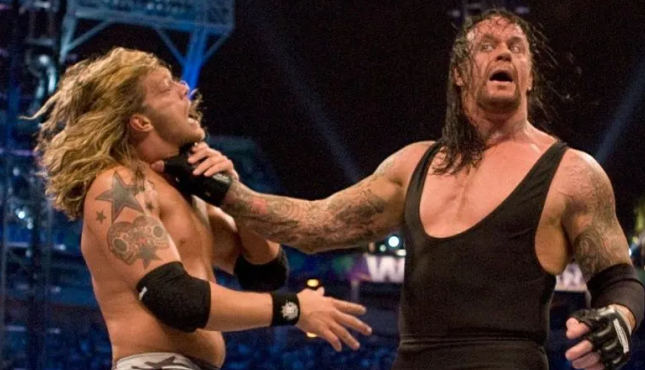 Image Credit: WWE

Welcome guys, gals, and gender non-binary pals . . . through Hel Stryer and brimstone, it’s Ask 411 Wrestling!
I am your party host, Ryan Byers, and I am here to answer some of your burning inquiries about professional wrestling. If you have one of those queries searing a hole in your brain, feel free to send it along to me at [email protected]. Don’t be shy about shooting those over – the more, the merrier.
Hey, ya wanna banner?

Jon keeps rollin’, rollin, rollin’:
When did Undertaker’s WrestleMania streak begin in terms of it being a plan/part of a storyline? I remember the WWE acknowledging it around 2005 for the Undertaker’s match with Randy Orton at that year’s show.
As far as WWE building a match around “The Streak” is concerned, you’re correct. The first time was Taker’s match against Orton at Wrestlemania XVIII in the SkyDome.
The fact that the Dead Man was undefeated on the company’s largest show had been mentioned previously, but it was never much more than a passing reference. Vince McMahon, during commentary on Wrestlemania XI, mentioned that he had never been beaten at Mania, and things start to pick up at Wrestlemania XVII. On that show, after Undertaker beats Ric Flair, a fan in the front row holds up a sign stating that Taker’s Mania record is now 10-0 while UT himself holds up ten fingers while standing on the ring apron.
For what it’s worth, the Undertaker during an appearance on Steve Austin’s Broken Skull Sessions talk show said that the Flair match was really the first time he himself realized he was undefeated, which goes to show you that oftentimes fans will care about this sort of thing far more than the wrestlers themselves do.
Andy is our lobster:
A Facebook post got me thinking. The question I saw was, “Can you be considered a great if you only wrestle in one promotion?”
And that got me wondering if there has ever been a prominent wrestler who has only ever wrestled in one promotion? The first two that crossed my mind – Cena and Orton – both spent time in small promotions before moving to WWE. So has anyone been a one-company fixture?
We are in an era where there are probably going to be more one-company wrestlers than there have been at any point in history, because WWE is creating a system in which they endeavor to build wrestlers’ entire careers, from the point of their first-ever training session to their retirement as main event stars.
Current WWE stars like Oba Femi and Trick Williams have only ever wrestled for the company, and there’s a non-zero chance (though not a guarantee) that they’ll stay put for the remainder of their careers.
This is one of the big differences between current WWE and the company of even just five or ten years ago, because developmental is now totally in house. When the E had companies like Ohio Valley Wrestling, Deep South Wrestling, the Heartland Wrestling Association, or Florida Championship Wrestling as developmental territories, those were not part of WWE. They were independent companies that had close working relationships with WWE. This would mean a guy like Roman Reigns, who has only ever wrestled in FCW and WWE, still doesn’t count as a one-promotion star because of those FCW matches.
Even before the current developmental system fully took hold, there were instances of wrestlers who had their entire careers within the confines of WWE from training through present day. This mostly consisted of “diva” type wrestlers who were recruited into the company with no wrestling experience and then didn’t have any interest in wrestling once their time with the biggest company in the world was over. Eva Marie is an example of this. So is Ashley Massaro. So is Alexa Bliss.
That said, I’m guessing Andy wasn’t interested in the sorts of answers given above. Though he doesn’t come right out and say it, I’m guessing he wants examples of wrestlers from a bit further back in wrestling history.
There aren’t a ton of historic examples, because the entire wrestling business during the territorial days was built around wrestlers, particularly wrestlers of any note, cycling through territories as a means of keeping things fresh. Even moving into the Monday Night War, you had a wrestling boom and competition for talent that kept people jumping back and forth.
I did find at least one example of a fairly high profile professional wrestler who only wrestled for one promotion:
Steve “Mongo” McMichael
The former NFL defensive tackle was trained to wrestle by WCW and, after making his debut in 1996, he was exclusive to the promotion through his final match in 1999.
Triple T Ticking Timebomb Taz is picking gum out of his fuzzy boots:
When the Berzerker said “HUSS,” what did this actually mean? What is some ancient tongue commonly used by Vikings? Did the Berzerker have speech issues? Was it simply nonsense? Any light you can shed on the meaning of “huss” is greatly appreciated.
The Berzerker chanted “huss” during his matches because he was emulating Bruiser Brody.
Brody was known for making that noise during his fights, and if you watch John Nord (a.k.a. The Berzerker) wrestle, he is taking basically everything from Brody, including his mannerisms, facial expressions, and style of movement. It’s even more obvious before he was given the viking gimmick, because back in the AWA he would even dress like Brody.
I suspect that TTTTT’S follow-up question will be, “Well then why did Bruiser Brody say ‘huss’ during his matches?”
The answer is that it doesn’t men anything. Brody’s gimmick was that of an uncontrollable wild man, and the “huss” sound just made him seem like more of an oddball.
APinOZ takes us to the heyday of the New World Order:
During the dramatic Nitro episode where Kevin Nash lawn-darts Rey Mysterio against the side of the production truck, in the aftermath, Eddie Guerrero is clearly heard saying “there were 4 of them,” which was even picked up by the commentators. However, that was never followed up and it was then just assumed Hall and Nash were the only two attackers. So, was the angle originally meant to include 4 men attacking WCW, and if so, who were they meant to be?
And to follow the NWO theme (even though it hadn’t been named that as yet), who WAS the 4th member of the NWO, after Hall, Nash and Hogan?
The episode of Nitro in question aired on July 29, 1996 from Disney MGM Studios in Orlando, Florida. At that time, Hulk Hogan had already turned heel and joined the nWo (on July 7), and when four men were referenced the idea was that you were supposed to think the third was Hogan, even though he wasn’t actually present for the show. The reference to a fourth was supposed to fuel speculation that a new nWo member would be debuting in the near future.
And debut he did.
On the August 26, 1996 Nitro from Palmetto, Florida, Ted DiBiase appeared in the crowd during a match between Jim Duggan and the Giant and became the fourth member of the New World Order. Not only did he become the fourth man, but he also warned everyone that a fifth member would be debuting the following week. That turned out to be the aforementioned Giant, who turned to the nWo after being one of their early victims.
Lee in Liverpool starts the fire in me:
What finishing maneuver did Bret Hart use to achieve victory in each of his successful singles bouts on WWF PPV?
In all, the Hitman had 25 singles victories on WWF pay per view shows. Of those, he won with the Sharpshooter in nine of them, that being 36% of the time. Those matches were against Mr. Perfect at Summerslam 1991, Skinner at This Tuesday in Texas, Shawn Michaels at Survivor Series 1992, Razor Ramon at Royal Rumble 1993, Jerry Lawler at King of the Ring 1995, Jean Pierre Lafitte at In Your House 3, Steve Austin at Wrestlemania XIII, The Patriot at In Your House 17, and Vince McMahon at Wrestlemania XXVI.
Bret’s second most frequent means of winning on pay per view was actually via disqualification. He has three DQ victories on PPVs (12% of his matches), those being against Doink at Summerslam 1993, Isaac Yankem DDS at Summerslam 1995, and the Undertaker at One Night Only 1997.
There are four different finishes that Bret used twice in his PPV matches, each accounting for 8% of his PPV wins. The first of those is a cradle after running up the ropes while in a sleeper hold, which he did to Roddy Piper at Wrestlemania VIII and Steve Austin at Survivor Series 1996. The second is escaping the cage in a steel cage match, which he did with Owen Hart at Summerslam 1994 and Diesel at In Your House #6. The third is a small package, utilized against Mr. Perfect at King of the Ring 1993 and Diesel at Survivor Series 1995. The fourth and final is the victory roll, which did in Bam Bam Bigelow at King fo the Ring 1993 and Hakushi at In Your House #1.
Finally, there are five individual finishes that were only used one time by the Hitman on PPV. Those are: 1) reversing a back superplex into a pinning combination against Razor Ramon at King of the Ring 1993; 2) a lateral press after a missed Banzai Drop against Yokozuna at Wrestlemania X, 3) a crossface chicken wing against Bob Backlund at Wrestlemania XI, 4) an Oklahoma roll against the British Bulldog at In Your House #5, and 5) a chairshot delivered by Shawn Michaels at Summerslam 1997.
Just compiling these stats has me longing for the days when there was more variety in wrestling and, though you knew what everybody’s finisher was, they didn’t have to win 99% of the time using it.
The other thing that compiling these stats did was remind me of just how lousy wrestling fans have become at knowing or remembering the names of holds. In looking at online recaps of shows to verify what moves Bret used, a lot of the writers didn’t know the difference between things like an Oklahoma roll, a victory roll, and a small package, choosing to refer to all of them as “rollups.” Come on, guys. Words matter.
Night Wolf the Wise is gonna have one more fight about your leadership:
I follow this WWE page on Facebook. They posted a video of the build up to Stone Cold vs. Rock at WM 17. They called it the greatest WM main event build up of all time. The reason they gave was it featured two of the biggest stars of the Attitude Era who were both at their peak and popularity during this time. The My Way video hyping the build towards this clash. Stone Cold’s “I need to beat you Rock” during his sit down interview with the Rock and JR. the stakes of the match and the fact the match didn’t need to have the traditional Face vs Heel match. It was two baby faces with everything to lose.
Do you agree that this is the greatest WM main event build or is there another WM Main event build that will give this a run for its money?
Yes, I agree. In fact, going back to an installment of this column I wrote last month, I called it not just the greatest WM build of all time but one of the greatest PPV/PLE builds of all time.
I’m not sure what Tyler from Winnipeg is getting at:
Is Stone Cold vs Scott Hall at Wrestlemania better than any Drew McIntyre match at Wrestlemania?
God, no.
McIntyre had at least one great, great, great match at Wrestlemania when he faced Gunther and Sheamus for the Intercontinental Championship at Mania XXXIX. Steve Austin versus Scott Hall was really rough around the edges and probably one of the weakest big match shows that the Rattlesnake had during his career.
Basti works both sides of the aisle:
Who are your top five wrestlers who were both beloved as a face and hated as a heel? Who could play both roles equally good? Obviously, Hulk Hogan has to be in there.
Yes, I can definitely give you Hogan for a list like this one.
Chris Jericho belongs in my book, given where he was at with a heel during his feud with Shawn Michaels and given where he was as a face following his initial WWF turn in the Attitude Era.
Jerry Lawler has given master class level performances in both roles.
Bret Hart deserves credit because not only did he play face and he equally well, he also played them equally well at the same time when he went back and forth between Canada and the United States with the Hart Foundation in 1997.
Randy Savage may actually be the best of the lot, given that he did some absolutely despicable things to Miss Elizabeth but still managed to be one of the most popular babyfaces in history when the situation called on him to do so.
Kyle (he/him) has no problem holding up his pants:
Championships are represented by title belts, and the two hands on the waist motion remains the pantomime for “I’m coming for your title” but the standard placement of the belt has been on the shoulder for a long, long time now.
How and when did the title belt migrate from waist to shoulder? Is this something where they took their cue from boxing or is it specific to wrestling? If nothing else it makes for cleaner images on posters, billboards, etc. since they can show both wrestlers closer up but still have the belt in the picture.
Like many things in wrestling, this changed over the course of the 1990s and has never fully reverted back. Really, there are two factors at play. One is that when the practice first began, it seemed “cool” and anti-authoritarian. The other is that, as Kyle alludes to in his question, keeping the belt on your shoulder makes sure that it is visible at almost all times, not just in promo photos but also when a wrestler is cutting a promo in the ring, as some shots would result in the belt being blocked by the ring ropes if it were worn around the waist.
Big Al reeks of arrogance:
I didn’t start watching wrestling until they were individual performers, but why did Strike Force break up? And why was Tito Santana turned into a complete jobbers where Rick Martel got to become the “Model” and at least get some good feuds?
According to an interview that Tito did with the Wrestling Then and Now podcast, he did not realize it at the time but in retrospect he believes that Martel turning on him to end Strike Force had been planned from the beginning as a means of getting Martel over as a heel. He’s also said in multiple interviews that Strike Force only came to fruition because Tom Zenk, who had been teaming with Martel as the Can Am Connection, left the WWF and Santana was effectively a replacement. According to Tito, Vince McMahon originally wanted the Martel/Santana team to be called the “Border Patrol” since they were from the other sides of U.S.’s northern and southern borders, respectively. However, Santana was able to convince Vince not to go with that name because Mexican immigration into the United States was already a controversial topic at the time and he was afraid that the Border Patrol name would turn the team heel with the Mexican-American population.
After Strike Force broke up, Santana was cycled down the card simply because McMahon didn’t have much else for him. On the Monte & The Pharaoh podcast, Tito claimed that after Strike Force broke up he asked Vince about the possibility of him turning heel, though this was nixed by the boss.
That does it for this week. We’ll return in seven-ish days, and, as always, you can contribute your questions by emailing [email protected]. You can also leave questions in the comments below, but please note that I do not monitor the comments as closely as I do the email account, so emailing is the better way to get things answered.
More Trending Stories
- WWE Reportedly Considered Delaying 2027 Royal Rumble By Two Weeks
- Hacksaw Jim Duggan Believes Vince McMahon May Start a New Wrestling Company, Describes His Relationship With Former WWE Boss
- Injury Update on Wrestlers Who Competed in AEW Men’s & Women’s Blood & Guts Matches
- Backstage Update on Rumored Superstar Comeback to WWE


