
wrestling / Columns
Ask 411 Wrestling: Who All Pinned Roddy Piper in the WWF?
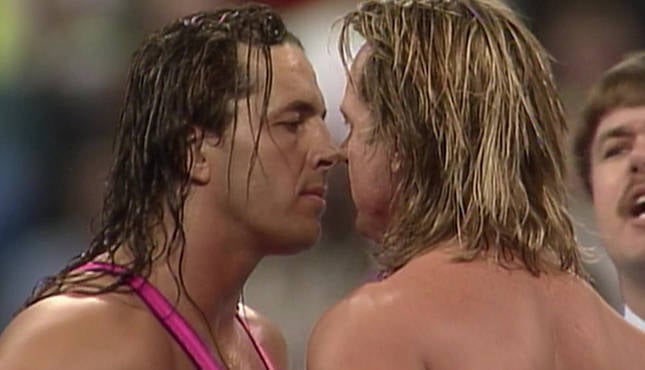 Image Credit: WWE

Welcome guys, gals, and gender non-binary pals . . . through Hel Stryer and brimstone, it’s Ask 411 Wrestling!
I am your party host, Ryan Byers, and I am here to answer some of your burning inquiries about professional wrestling. If you have one of those queries searing a hole in your brain, feel free to send it along to me at [email protected]. Don’t be shy about shooting those over – the more, the merrier.
Hey, ya wanna banner?

Redmond lays down for nobody:
Who pinned Roddy Piper? Even if we’re just looking at WWF/WWE? We always hear about how Piper wouldn’t job for anyone, which was mostly true, but not always. I know he was pinned by Bret, and then also by Mr. Perfect, pretty sure Flair went over on him regularly during late ’91/early ’92, and I might recall him dropping some pinfalls to DiBiase as well. Of course there was Mr. America in 2003 as well… anyone else joining the list?
As near as I can tell, the following folks pinned Roddy Piper in the WWF:
Jimmy Snuka. On July 20, 1984, the two men had a Fijian Strap Match in St. Louis, and this was before strap matches included the rule that you had to drag your opponent to all four corners to win. Snuka just straight up pinned Piper for the victory.
Ivan Putski. Thanks to special guest referee Billy Red Lyons, the Polish Hammer downed Piper on a card at Toronto’s Maple Leaf Gardens on October 7, 1984.
Andre the Giant. In Sacramento, California on October 17, 1984, the Eighth Wonder of the World held Piper to the mat for a three count.
Mr. Perfect. In a dark match following a Wrestling Challenge taping in 1990, the Hot Rod fell to the PerfectPlex.
Rick Rude. On a February 17, 1990 house show in Dayton, Ohio, Rude pinned Piper after hitting him with the ring bell. There are other house shows in this timeframe that list a Rude over Piper result but don’t have specifics as to the finish, so it is possible that this happened multiple times.
Ric Flair. The two men had previously been friends and rivals in the Mid-Atlantic territory, which made Piper a natural opponent for Flair upon his WWF debut. They hooked it up on the house show circuit, and the Nature Boy actually eked out several pinfall wins, usually by placing his feet on the ropes.
Bret Hart. At Wrestlemania VIII, as noted in the question.
Mr. America. Following botched interference by Piper’s second, Sean O’Haire, the masked Mr. America pinned him at the 2003 Judgment Day pay per view.
Eddy Guerrero. On the June 26, 2003 episode of Smackdown, Guerrero and Tajiri retained their WWE Tag Team Titles over Piper and O’Haire thanks to some green mist from Tajiri and a frog splash from Guerrero.
Chris Jericho. This occurred at Wrestlemania XXV as part of a Jericho vs. WWE Legends gauntlet match that built off of promotion for the movie The Wrestler. Y2J’s enzuigiri did Piper in.
I believe that’s everyone, but we also have to keep in mind that, as alluded to above, house show results from the 1980s are not always complete and don’t always record how somebody won. Given how rarely Piper was pinned, for purposes of this question I didn’t list someone unless a result clearly said that a pinfall occurred, but there’s a chance of more having occurred.
Jason pays tribute:
It’s almost an expectation now, but who was the first wrestler to get an on air “in memoriam” video when they passed away? Gorilla Monsoon or someone earlier?
I’m inclined to say it was Andre the Giant. On the February 1, 1993 episode of Monday Night Raw that immediately followed his passing on January 28, Howard Finkel announced the passing to the live audience, which was followed by a ten bell salute as a series of still images flashed across the screen. Obviously that’s not an in memoriam video, but on March 22, 1993, Andre became the first-ever inductee into the WWF Hall of Fame, at which time there was no ceremony but rather a video package on the promotion’s television shows that had all the earmarks of the tribute videos that would later become standard operating procedure in WWF/WWE.
If you don’t want to count Andre, the first memorial video package that I was able to find record of wasn’t Gorilla Monsoon . . . it was actually his son.
Gorilla’s son, Joey Marella, was a referee for the Federation for roughly eleven years. During that time, he was the ref for the match that drew the company’s largest live attendance up to that time, Bret Hart versus Davey Boy Smith at Summerslam 1992. He was also the referee for the legendary Hulk Hogan versus Andre the Giant bout at Wrestlemania III.
Joey tragically passed away on July 4, 1994 as a result of an automobile accident at the age of 31. On WWF television immediately following his passing, the company ran a tribute video narrated by Todd Pettengill.
If I Todd Pettengill outlives me, I expect the same treatment.
Tyler from Winnipeg is union jacked:
What are some of your favorite moments from Davey Boy Smith, The British Bulldog?
It seems that Davey Boy was always at his best when he was in there with other members of the Hart family. Obviously his match at Summerslam 1992 against Bret is the highlight of his career, not only from an in-ring performance standpoint but also from a business standpoint as it drew the company’s largest largest crowd in history up to that point in time (which we’ve already mentioned once in this column, weirdly enough). His In Your House 5 rematch with the Hitman isn’t as well-remembered but is almost as good in the ring and has the distinction of being a rare-for-the-era bloodbath.
I also thoroughly enjoy his Monday Night Raw bout against Owen Hart to crown the first ever WWF European Champion, and he was a key part in the epic ten man tag at In Your House: Canadian Stampede.
Christopher Regal takes this column in a direction it hasn’t gone before:
First, I want to say thank you for all of the work you put in on the weekly Ask 411mania columns and all of the work you have done for the Internet Wrestling Community over the years. I am a long-time (embarrassed to say 20+ year) fan of 411mania and am a lifelong wrestling fan.
Last summer, I started writing a book about two of my favorite things in the world — politics and wrestling. I recently finished my debut novel, Red Equals Green, about what could happen if a political campaign was steered via lessons from professional wrestling.
As I have consumed hundreds of hours of your content over the years, I would like to offer my appreciation and send you a copy for your enjoyment.
Writing the book was one of the most fun things I have done in a long time. I want to share it back with those who inspired me and perpetuated my love of the sport. I hope you enjoy it.
Normally, I only deal in answering questions in this column, but the fact that a reader had written a book about professional wrestling – or at least adjacent to professional wrestling – intrigued me enough that I decided to take Mr. Regal up on his offer.
And, because I’m a columnist on 411mania, I can’t just consume a piece of media for the sake of having fun. If I’m going to read, watch, or listen to something, I need to get CONTENT out of it, baby!
So, with that, a few thoughts on Christopher Regal’s debut novel, Red Equals Green.
Chris is no doubt hoping that this goes better for him than the last time I reviewed a book on this website.
I have to admit, the book is not what I thought it might be prior to cracking it open. Hearing that this was a novel about the overlap between professional wrestling and politics, I braced myself for a narrative involving a political candidate being backed by a fictionalized version of WWE, populated by wrestlers invented for the story whose names and gimmicks are somehow more eye-roll-inducing than the ones on NXT. After all, that is what we see so often when people who aren’t wrestling fans decide that they’re going to spin a yarn about our favorite pseudo-sport.
That’s not what this book is, though. From the first page through the epilogue, it is clear that this is written by a long-term wrestling fan, something that I think would be evident even if the author hadn’t identified himself as such in his introductory email to me.
Perhaps because he is a fan, Regal seemingly realizes that wrestlers and wrestling promotions created for books and television often come off as phony in a way that kills the suspension of disbelief. He avoids that trap by not writing a story about wrestlers or wrestling. Instead, he writes a story that is steeped in wrestling fandom and references while covering a different subject matter. When characters in Red Equals Green talk wrestling, they’re not talking about flimsy stand-ins for the nWo or Hulk Hogan. They’re reminiscing about actual angles and actual stars, mostly of the 1990s. This makes the world that Regal creates feel much more genuine and lived in than it would otherwise.
The story is by a fan, and it’s about a fan. The book’s chief narrator and protagonist, Mike Hayes, bears more than passing biographical resemblances to Regal, which is openly admitted in the book’s acknowledgments section. That’s not to say he’s a “Mary Sue,” though, as Hayes is depicted as a fully-realized person with many flaws.
(And, yes, the character’s name really is “Michael Hayes.” I cringed when I first read that, thinking it was just an inside reference by an author who was trying to be too cute for his own good. However, the fact that the character shares a name with a wrestler is eventually acknowledged in the text and even becomes a plot point, which made it acceptable rather than goofy.)
The main narrative of Red Equals Green centers on Hayes, a young, fairly directionless man with an encyclopedic knowledge of all things wrestling, backdooring his way into a position in the inner circle of a novice politician running for the U.S House of Representatives. Eventually, Hayes’ wrestling fandom is interjected into the campaign to surprising results.
If I have one criticism of that narrative, it’s that it reminded me of Gorilla Monsoon’s stock comment on a Greg “The Hammer” Valentine match, “It takes the Hammer 15 minutes just to get warmed up!” The book is a bit heavy on exposition for my taste, and a more seasoned author might have had more tricks that allowed him to advance the plot while giving the character’s background rather than doing those two things in what at times felt like two totally separate silos.
That one drawback did not totally ruin my enjoyment of Red Equals Green. Far from it, in fact. This is because, though the windup is a bit lengthy, when this book kicks it into high gear, it REALLY kicks it into high gear.
Without pulling back the curtain too much, there is a plot twist about three-quarters of the way through the novel. Long-term wrestling fans like myself will probably see the twist coming a mile off, but just like a well-executed heel turn in wrestling, the fact that you see the twist coming doesn’t dull your enjoyment. You see it coming and know it is going to have bad consequences for the characters whose lives you’ve been following, but you still can’t look away from it, like the voyeurism attendant to a car crash. You also don’t know exactly what those consequences will be and are drawn in to see them play out.
It is Red Equals Green‘s exploration of what happens after its plot twist that is the book’s greatest strength. Though, as noted above, wrestling fans will be able to see the broad strokes of the twist coming, the particulars of how it was all set up which come out after the fact are cleverly devised by Regal. The fallout of the twist for all the characters is also compelling, written in such a way that the it consists of high drama but is never totally unrealistic, particularly because nobody gets a truly happy ending.
In short, Red Equals Green isn’t high literature, but if you’re somebody who grew up with pro wrestling and has at least a passing interest in U.S. political campaigns, you’ll have an entertaining couple of hours with it which more than justify the $10 price tag.
Again, go check the book out, should you be so inclined.
If I could make one final suggestion for Mr. Regal, it would be a pitch for his sophomore novel. I’m thinking something about a long-suffering internet wrestling columnist whose life is thrown into disarray when a Canadian reader (let’s call him “Trevor from Saskatchewan”) constantly emails him and ultimately turns out to be a bloodthirsty stalker.
Big Al says, “Let’s talk about sets, baby”:
What are the top five Wrestlemania sets of all time?
If I have to be perfectly honest, I’m a bit of a minimalist when it comes to this sort of thing. The massive digital screens with absurd fireworks shooting off of them that have become the norm these last several years have never really resonated with me. They all feel like slight variations on the same theme and don’t stand out.
Instead, I’m all about a more analog approach, which means my favorites are:
(TIE) Wresltemania III and VI: “But Ryan!” I hear you exclaiming, “There were no sets for Mania III or VI!” Technically, you’re right. However, they did have the ring-shaped carts that ferried wrestlers to and from the ring between matches, and I loved those little things so much that I’m willing to stretch the definition of the word “set” so that they are included here. Bring those carts back!
Wrestlemania XIII: Mania XI, XII, and XIII basically all had the same entrance setup, just with different graphics on it to match each event’s logo. XIII stands out from the pack, though, because somebody there had the brilliant idea of adorning the entrance pod that was part of the set with a pane of black glass prior to Steve Austin’s entrance, with the glass shattering at just the right time in his theme song. Chef’s kiss.
Wrestlemania X: It’s a door shaped like a big roman numeral “X,” and when wrestlers head to the ring, the two crossed lines of he “X” pull apart to create the entryway. It is simple, but it is brilliant in its simplicity. It also gets bonus points because, much like early Star Trek, you could tell that these doors were in no way automated and were manually being pulled apart by stagehands every time they needed to move.
Wrestlemania XX: This crosses into to the “LCD Screens EVERYWHERE” era, which I said above as not my favorite. However, I have to give them kudos for fitting what they did into Madison Square Garden, which is a very small venue by Wrestlemnia standards. Plus, I appreciated the screens being shaped like towers to evoke the NYC skyline.
That does it for this week. We’ll return in seven-ish days, and, as always, you can contribute your questions by emailing [email protected]. You can also leave questions in the comments below, but please note that I do not monitor the comments as closely as I do the email account, so emailing is the better way to get things answered.
More Trending Stories
- AEW Reportedly Considered Elimination Chamber-Style Match
- Backstage Details on Original Plans for a Big Cass & Enzo Amore in WWE, Why Cass Returned as a Solo Act
- Eric Bischoff On Steven Borden’s Injury, Says He Shouldn’t Be Wrestling on TV Yet
- Kevin Nash Calls The Bloodline vs. 946 Brawl the ‘Best Schmozz’ He’s Ever Seen


