
Movies & TV / Reviews
TRON: Ares Review
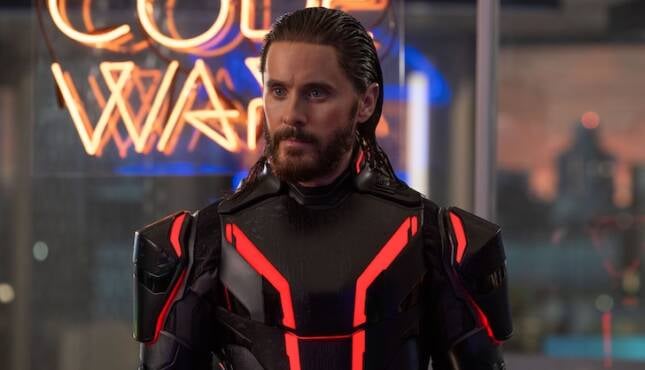 Image Credit: Disney Enterprises, Inc.


 Loading...

Directed By: Joachim Rønning
Written By: Jesse Wigutow and David DiGilio; Based on characters created by Steven Lisberger and Bonnie MacBird
Runtime: 119 minutes
MPA Rating: PG-13
Jared Leto – Ares
Greta Lee – Eve Kim
Evan Peters – Julian Dillinger
Gillian Anderson – Elisabeth Dillinger
Jodie Turner-Smith – Athena
Cameron Monaghan – Caius
Arturo Castro – Seth Flores
Hasan Minhaj – Ajay Singh
Jeff Bridges – Kevin Flynn
Walt Disney Studios and filmmaker Joachim Rønning take another cyber dive into the TRON franchise with its third outing in TRON: Ares. Unceremoniously abandoning all the angles and characters introduced in 2010’s entertaining TRON: Legacy, TRON: Ares mainly serves as an uninspiring navel-gazing vehicle for Jared Leto as an advanced A.I. program who gains sentience. Unfortunately, despite some admittedly impressive visual elements and an impressive soundtrack composed by Nine Inch Nails, TRON: Ares amounts to far too little and much too late.
Disney ultimately opted against a sequel to TRON: Legacy years ago since the franchise revival did not become the blockbuster the studio hoped, much like the original 1982 cult classic. Regrettably, history has a way of repeating itself in Hollywood, and the same mistakes are made over and over again. The most frustrating aspect of Ares is how writer Jesse Wigutow’s script frustratingly shunts aside Sam Flynn (Garrett Hedlund) and Quorra (Olivia Wilde) from Legacy, instead opting to focus on new, more boring characters.
A cyberspace-set digital montage depicts events that happened in the last fifteen years, showcasing ENCOM splitting off into Dillinger Systems, now headed by the draconian tech-bro CEO Julian Dillinger (Evan Peters), the grandson of the original film’s villainous Edward Dillinger Sr. (David Warner). What happened to Edward Dillinger Jr., the ENCOM programmer, notably portrayed by Cillian Murphy in Legacy? How is he related to Julian and Elisabeth Dillinger (Anderson), Julian’s mother? Is Edward Jr. the father of Julian, or is he the uncle? Is he Elisabeth’s husband or brother? The film never explains what happened to the other member of the Dillinger clan and Edward Jr.’s role in Dillinger System’s uprising, which is annoying.
Essentially, Julian is locked in a digital arms race with the more benevolent ENCOM, headed by the film’s secondary protagonist Eve Kim (Lee). Both companies desperately seek to perfect the technology that brings digitally programmed beings and constructs from the digital realm into the physical world. Using particle laser technology similar to the devices that digitally atomized people into the computerized Grid in the first two films, ENCOM and Dillinger Systems have already created the technology that can 3D-print digital programs and autonomous beings into the corporeal world. Julian specifically develops Ares (Leto) as the Master Control Program of his security systems and the flag bearer of his project for private military sales.
Unfortunately, the particle laser tech contains a fatal flaw. Any vehicles or digital soldiers rendered into the physical world using the tech can only last for 29 minutes before they disintegrate. Long MIA former ENCOM CEO Kevin Flynn (Bridges) reportedly already discovered the “permanence code” that can apparently stabilize digital beings in the real world, which is something Julian desperately wants to sell his tech to investors. Julian is willing to commit any unsavory act to do so, even if it means kidnapping and murdering Eve Kim. However, despite apparent fail-safes, Ares appears to grow beyond his programming, developing his own unique sense of self and an altruistic benevolence that Julian never baked into his coding. Ares ultimately rebels against his corporate masters, seeking to help Eve obtain the permanence code, which he hopes will help him discover life in the real world as well.
TRON: Ares fails to properly build and execute Ares, forging his own identity and developing a unique sense of self against Dillinger Systems. Based on the haphazard plot, Ares reviewing Eve’s text messages is enough to convince the digital A.I. that Julian is a bad guy who cannot be trusted with the permanence code technology. The film’s annoying tech-babble surrounding the permanence code as the designated plot McGuffin becomes equally frustrating as it utterly ignores the existence of Quorra and the ISO programs from the previous movie. The Isomorphic Algorithms, aka ISOS, were autonomous and self-aware digital A.I. programs that were plainly born and evolved on their own in the second Grid system.
Quorra is literally a digital ISO program who lived in the physical world without issue for over a decade. Wouldn’t she easily hold the key to the whole permanence debacle? The way the plot haphazardly jettisons both Sam and Quorra, while simultaneously dangling their existence as potential sequel bait, induces anger. Basically, TRON: Ares teases the sequel fans genuinely wanted, but instead, delivers something more mediocre. The only way to get the desired sequel and return of the favorite characters is by watching this one. But then, it begs the question: Why not just make that sequel to begin with?
Unfortunately, that answer lies in the film’s star and eponymous hero, Ares, as portrayed by Jared Leto. Leto has shepherded and pursued the project, where he would star in a new TRON film in the Ares role, for the better part of a decade. It’s clear to see why the role interests Leto as he gets to portray a stoic digital hero who gains sentience and philosophizes over the finer points of Mozart versus Depeche Mode. Unfortunately, despite the movie’s clear indulgence in Leto’s sensibilities, the plot positions Ares as the inheritor of Kevin Flynn’s hopes and dreams, but Ares never truly comes to life as a compelling, intriguing character. Ares becomes the new digital avatar of justice who fights for the users, but he’s no Bruce Boxleitner.
The other new characters who make up the cast are uneventful, cookie-cutter archetypes. The film does not delve deeply enough into Eve Kim and her relationship with Ares, other than the fact that it’s another boring Hollywood pseudo-romance. Eve’s recollections convince Ares that corporate altruism is the right path, but the narrative fails to adequately depict Ares’ shift in motivation. Additionally, what about the supposed fail-safes Julian hardwired into Ares’ coding? Doesn’t he have any “Prime Directives” that would prevent him from acting against Dillinger Systems? Besides the Dillingers, Jodie Turner-Smith eventually becomes the villainous face of the evil A.I. programs, Athena. She certainly looks striking and intimidating, but she’s not given much to work with as a bad guy. Her late third-act turn also lacks sufficient buildup.
TRON: Ares is not a complete loss because it does have some positives, specifically a sleek, cool soundtrack by Nine Inch Nails. Daft Punk definitely stole the show in TRON: Legacy, and Trent Reznor nearly does the same here, providing a futuristic, exotic, and digital electronica soundtrack that mixes well with the TRON universe.
Also, the other main selling point of Ares is the film’s promise of depicting famous vehicles and digital technology from the digitized Grid entering the real world. The visuals of Ares, from the immersion of the digital realms, and the incorporation of digital beings and tech in the physical realm, look gorgeous, including the sequence where a Recognizer takes flight and lays siege upon an unnamed cityscape. Ares at least maintains the franchise’s tradition of groundbreaking visual effects. The way Ares visually renders the digital beings and tech in the real world looks genuinely impressive. If only there were a better story to go with it.
Ultimately, TRON: Ares mildly delivers with cool visual ideas and an exciting soundtrack, but the sequel arrived far too late to matter, dumping all the promising plot angles from the previous sequel. Leto’s Ares is not the digital savior he purports himself to be. Ares might think, therefore, he is, but TRON he is not.


