
Movies & TV / Reviews
Street Fighter Review
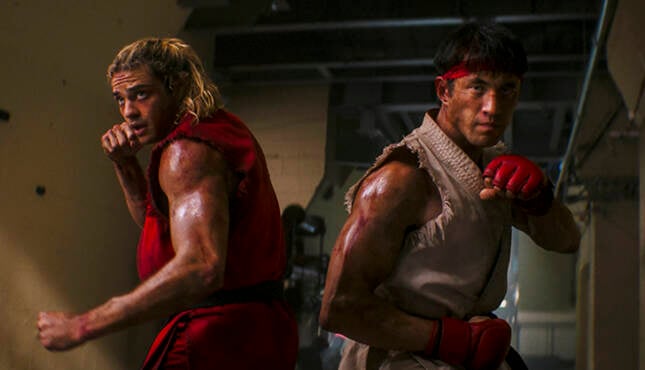 Image Credit: Paramount Pictures & Legendary Pictures


 Loading...
Directed By: Kitao Sakurai
Written By: T. J. Fixman and Kitao Sakurai; Based on the video games by Capcom
Runtime: 120 minutes
MPA Rating: Rated PG-13 for violence/action, bloody images, strong language, sexual references, partial nudity, and brief smoking.
Noah Centineo – Ken Masters
Andrew Koji – Ryu
Callina Liang – Chun-li
Joe “Roman Reigns” Anoa’i – Akuma
David Dastmalchian – M. Bison
Andrew Schulz – Dan Hibiki
Cody Rhodes – Guile
Eric André – Don Sauvage
Mel Jarnson – Cammy
Vidyut Jammwal – Dhalsim
Orville Peck – Vega
Jason Momoa – Blanka
Olivier Richters – Zangief
Hirooki Goto – E. Honda
Rayna Vallandingham – Juli
Kyle Mooney – Marvin
Alexander Volkanovski – Joe
Curtis “50 Cent” Jackson – Balrog
Don Lee – Gouken
The iconic fighting game series, Street Fighter, makes a long-awaited return to the big screen with a new live-action theatrical reboot. Despite a clear love for the source material and some appealing kitschy-meets-campy attributes, director Kitao Sakurai can’t quite pull off the epic video game event movie feat.
Street Fighter strongly opens with an anime-style prologue, adapting the finale of the original Street Fighter arcade game from the 1980s. The exceptional sequence recontextualizes Ryu’s (Koji) defeat of Sagat in the original World Warrior tournament. Although Ryu wins the tournament, the darkness in his heart takes hold: the malignant, corrupting energy force known as the Dark Hadou.
Ryu and his dojo brother Ken Masters (Centineo) had a falling out following the tragic death of their beloved sensei, Gouken (Lee), and six years later they are no longer on speaking terms. Ryu walked away from martial arts to keep the darkness within him at bay. Meanwhile, Ken has become a martial arts performance artist, wrecking cars or fighting wild bears for opulent wealth, with Dan Hibiki (Schulz) acting as his manager.
The visibly Caucasian Andrew Schulz portrays the Hong Kong-born, Japanese-descended comic relief. How does the movie explain this? Guile (Rhodes) claims Dan pretends to be Asian, while Dan professes that he’s 1/18th Honshu. That’s a swing and a miss for that lazy attempt.
Meanwhile, the dastardly despot M. Bison (Dastmalchian) is developing a Psycho Power weapon that he’s using to siphon the energy of formidable martial artists, but it’s never strong enough. Bison needs Ryu and his Hadou power, so he organizes a new World Warrior tournament to lure Ryu out of hiding.
Chun-Li (Liang), an Interpol agent working undercover to bring down Bison, recruits the world’s strongest fighters, including Ryu and Ken, to compete in the tournament in Metrolao. Ryu ultimately decides to enter the tournament, seeking to protect his childhood friend. Meanwhile, Ken finally wants to step out of his former friend’s shadow by proving he’s the best fighter in the world.
Unfortunately for the competitors, the tournament is merely a facade so Bison can get what he wants. Meanwhile, the malevolent Akuma (Reigns) awaits the winner of the tournament, seeking his next opponent, goading Ryu into unleashing the darkness he’s been fighting back for years.
As an adaptation, Street Fighter gets a lot of things right and almost pulls off a solid video game movie. It embraces the source material. Characters resemble their game counterparts. Sakurai adapts the outlandish signature moves, and the movie features a type of 1990s comic book movie aesthetic. The sets, production design, and costumes look hyper-realistic rather than gritty and grounded, which works for a Street Fighter movie.
Unfortunately, sloppy editing detracts from the movie. The narrative structure suffers from some horrendously disjointed storytelling. Characters drop in and out of the story at a moment’s notice, without much thought about what’s unfolding around them. As fun as it is to see so many characters from the game adapted into the movie with such visual fidelity, the story becomes too overstuffed with characters and subplots.
Guile barely has anything to do at all in this plot. The plot feigns setting up a bigger role for him down the line, but it lacks sufficient payoff. Guile amounts to little more than a throwaway character, and Cody Rhodes fails to impress with his performance.
Sakurai, co-writer T. J. Fixman, and Legendary Pictures act way too overconfident about the movie’s potential success. The movie lacks a satisfying third act as it’s mainly focused on a sequel hook. As a result, the movie ends in a deeply unsatisfying fashion.
It runs as if the movie is about to take a breath and have one more big action-packed sequence that ties together all the subplots, characters, and narrative threads set up throughout the entire story. Instead, the movie ends on an abrupt and disappointing note.
David Dastmalchian is a tremendous actor, but unfortunately, he’s miscast as Bison. Movies need more charismatic, unrepentant villainy, but Dastmalchian can’t quite pull off the campy megalomaniacal supervillain persona.
Dastmalchian looks deeply uncomfortable as Bison, as if his collar is choking the life out of him. His major quirk is an odd foot fetish, as he’s weirdly obsessed with soles.
Based on what was required of the WWE Superstars, Roman Reigns surprisingly outperforms Cody Rhodes. Reigns’ Akuma is not a thespian masterclass tour de force, and it’s a very limited role. However, Reigns at least transforms into Akuma fairly convincingly, surpassing Rhodes’ role as Guile, which resembles Halloween party cosplay more so than a genuine performance. However, the movie’s best acting performance by a pro wrestler comes from former IWGP Heavyweight Champion Hirooki Goto.
As a relatively new feature director, Kitao Sakurai’s style lacks finesse and polish. The narrative generously utilizes anime-style flashback sequences, which stand out as the movie’s best moments. The anime scenes work because they possess a visual strength, cohesion, polish, and finesse that the rest of the movie sorely lacks.
At times, it looks like Sakurai genuinely tries to combine sincerity with the plot thread of Ryu and Ken’s fractured brotherhood. However, the movie frequently leans into awkward schlock, with characters suddenly screaming or acting unhinged for no reason.
Mel Jarnson’s Cammy is the worst offender of this style, and it unfortunately results in the character just being “extra” for no reason. Cammy is another in the narrative who suffers from a lack of payoff, especially in how the movie seeds her rivalry with Chun-Li.
Since this is a video game adaptation, Sakurai might have desired to lean into schlock. The Street Fighter video games are undeniably campy and goofy, but Sakurai fails in his attempt to pay homage to 1990s bargain-bin martial arts movie schlock with genuine depth and sincerity.
True, a Street Fighter adaptation should be comedic, and at times silly, outrageous, and over-the-top, but not to the point of incoherency. That is where Street Fighter errs.
Nevertheless, Street Fighter has its moments and cool factor, and it visually succeeds where so many video game adaptations failed in the past. That might be enough for longtime fans who want to see their favorite characters in live-action on the big screen. Unfortunately, the new Street Fighter movie never lands that well-timed K.O.
Where To Watch Street Fighter
Street Fighter arrives in theaters on October 16. Ticket and showtime details are available at the movie’s website.


