
Movies & TV / Reviews
Whalefall Review
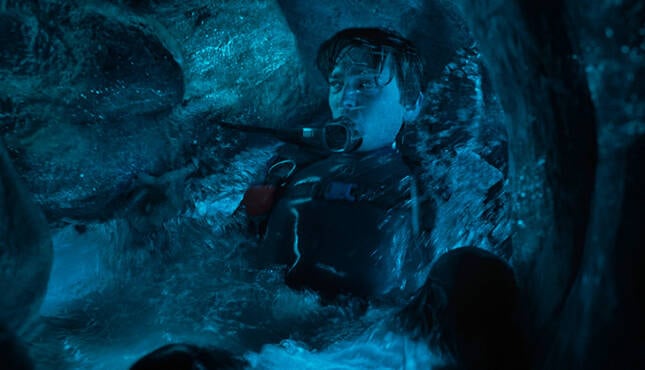 Image Credit: 20th Century Studios


 Loading...
Directed By: Brian Duffield
Written By: Brian Duffield & Daniel Kraus; Based on the book of the same name by Daniel Kraus
Runtime: 98 minutes
MPA Rating: Rated PG-13 for peril, violent content, bloody images, some strong language, and thematic content
Austin Abrams – Jay Gardiner
Josh Brolin – Mitt Gardiner
Elisabeth Shue – Zara Gardiner
Jane Levy – Eva Gardiner
Emily Rudd – Nan Gardiner
John Ortiz – Hewey
A young diver endures a living nightmare in the new aquatic-themed survival-thriller Whalefall. Brian Duffield’s new feature, based on Daniel Kraus’ book, hinges on its high-concept premise and delivers a lean, intense, and visceral experience.
The plot concerns young college student Jay Gardiner (Abrams), who returns to his hometown for the funeral of his recently deceased father, Mitt (Brolin). The dark prologue depicts Mitt’s fate, as he chooses his final resting place due to his late-stage mesothelioma.
Jay and Mitt had a difficult relationship. They grew more estranged as Mitt’s illness took hold, with Jay wishing to move as far away as possible from his domineering, overly strict, and disciplinarian father.
Jay feels emotionally compelled to search the ocean for his father’s remains. Perhaps Jay hopes to finally achieve some closure in his father’s death that they could never achieve while he was still alive.
Unfortunately, Jay runs afoul of a sperm whale chasing a giant squid for its next meal. The squid ensnares Jay with its tentacles before the sperm whale swallows them whole in a pulse-pounding sequence. Now, Jay has less than an hour of oxygen before the sperm whale digests the kid. Good luck!
The science and likelihood of the premise aside, Brian Duffield, who also co-wrote the movie with the book’s original author Kraus, directs the movie with an appealing solemnity. Although Whalefall does get very self-serious at times, that elevates the experience and imbues it with a charming sincerity.
Abrams, whose onscreen characters continue to suffer the worst luck imaginable, brings a strong, commanding performance to the role. For much of the runtime, the narrative heavily relies on Abrams’ apt performance, showcasing Jay desperately struggling to survive an insanely nightmarish scenario. The plot’s immersion and suspension of disbelief hinge on Abrams’ performance, and he pulls it off believably well.
Imprisoned in the belly of the beast, Jay dreams about key moments in his past with his father. He attempts to use the diving lessons his father so overbearingly and uncomfortably drilled into him during his youth to survive this seemingly insurmountable predicament. In the process, Jay also seeks to rectify their tumultuous relationship.
Whalefall runs at a very lean 98 minutes and a strong pace that nearly unfolds in real time. Jay’s terror and screams during his ordeal sound brutally real, rather than ridiculously over-the-top and comedic.
While the movie features a relatively lean runtime, it would have been beneficial if Whalefall fleshed out Jay and Mitt’s relationship more to really dig in and underscore their estrangement. Jay’s family, featuring strong casting with Elisabeth Shue as his mother and Jane Levy as one of his sisters, also would have benefited from further development.
One scene hints that Mitt was much harder on Jay than his sisters. Mitt wanted to toughen up his son, while he behaved much more gently and playfully with his daughters. A few more flashback scenes that better showcase the family’s dynamic and Jay’s resentment could have improved the story. It’s great to see Elisabeth Shue and Jane Levy here, but they feel a tad wasted.
The movie’s overall sense of gravitas is part of its charm, but Whalefall gets too heavy-handed in some aspects in the second half. Other predators lurking in the ocean attack the whale. The sequence is resolved by the type of well-timed deus ex machina that could only happen in a movie.
Additionally, despite the fact that Jay is literally trapped in the guts of a sperm whale, he comes off as remarkably cognizant of everything happening to the creature. This is where Whalefall overplays the protagonist’s awareness far too much.
There are moments when Jay emotionally connects to the whale, perceiving it as his late father. These scenes work because Jay’s perceptions could be symptoms of his mental state and physical conditions. He’s suffering inhuman levels of stress, horribly injured, and breathing in toxic methane in a whale’s stomach while running out of oxygen. Such narrative perceptions work from that perspective, along with his mental flashbacks.
Duffield brings a strong visceral realism to the underwater sequences. Jay’s terror, when Jay gets swallowed, as well as when he must contend with the still-living giant squid inside the whale’s bowels, feels downright palpable.
Ultimately, Whalefall delivers exactly as advertised and provides a strong emotional thread throughout the man-versus-nature plot.
Where To Watch Whalefall
Whalefall arrives in theaters on October 16. Ticket and showtime information are available at the movie’s website.


