
Movies & TV / Reviews
The Last Voyage of the Demeter Review
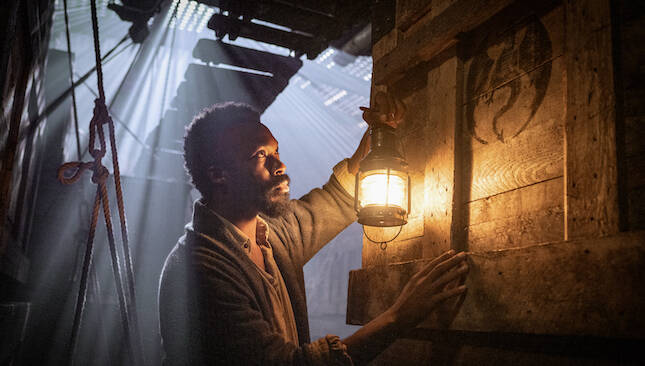 Image Credit: Rainer Bajo/Universal Pictures


 Loading...

Directed By: André Øvredal
Written By: Bragi F. Schut and Zak Olkewicz; From the chapter “The Captain’s Log” of Dracula by Bram Stoker
Runtime: 119 minutes
MPA Rating: Rated R for bloody violence
Corey Hawkins – Clemens
Liam Cunningham – Captain Elliott
David Dastmalchian – Wojchek
Aisling Franciosi – Anna
Woody Norman – Toby
Jon Jon Briones – Joseph
Stefan Kapicic – Olgaren
Chris Walley – Abrams
Martin Furulund – Larsen
Javier Botet – Dracula
The basic gist of The Last Voyage of the Demeter is that it takes one chapter from the famous 1897 novel, Dracula, by Bram Stoker and transforms a single chapter into its own standalone horror adventure. However, it is obvious that it was difficult to create an entire story about a group of nautical logs by the captain of a doomed ship that transports something of pure evil from Wallachia to England. True, the logs tell their own story, depicting what began as a routine shipping journey that descends into utter, sheer terror as a monster picks off a group of unsuspecting sailors one by one. The Last Voyage of the Demeter struggles to make the doomed journey of the Demeter into a separate movie, and it fails to pull that off.
While the film’s opening text crawl specifically sets up the Demeter as a “Russian” vessel, it’s made up of a crew who doesn’t appear to be Russian; specifically, its Irish and not Russian captain, Elliott (Cunningham). Captain Elliott is ready to sail his last journey and hand over the mast of the ship to his first officer, Wojchek (Dastmalchian), and retire with his grandson Toby (Norman), to the Irish countryside. Toby is also part of Elliott’s crew, more than likely a necessity, as Elliott is the boy’s primary guardian and caretaker. Before the ship’s voyage, it receives boxes of mysterious cargo with the mark of an ominous dragon of Wallachian origin.
Seeking passage back to England is the educated doctor, Clemens (Hawkins), whose initial attempt to join the crew is denied by Wojchek. He manages to get a seat aboard the crew after saving young Toby from nearly getting crushed by one of the unsavory cargo crates. Captain Elliott, Clemens, and the rest of the crew do not realize that the Demeter is transporting something unearthly and dangerous, a creature that defies all logic and explanation. One of the boxes is the coffin of the vampire lord, Dracula (Botet). With arrival to England several weeks away, a vampire needs blood to survive, and the crew soon becomes the creature’s top food source.
The Last Voyage of the Demeter has its moments where it almost becomes a compelling horror picture and new entry of the Dracula mythos. Unfortunately, Bragi F. Schut and Zalk Olkewicz fail to elevate the flimsy premise into something truly terrifying and worthwhile. Øvredal manages to build some moody atmosphere at times, and the Demeter does make for a haunting extended setpiece. It raises the question of what could have been possible if the cast and crew had a superior script.
Javier Botet does not play around much with the identity of the creature onboard the Demeter. The film stages the vampire lord as little more than a one-note, predatory monster who wants to stalk and feed on its prey. There are only small hints of the creature’s higher intelligence and cunning, which is disappointing. That said, the film does feature some decent practical creature effects and costume work for Dracula. The practical creature work, combined with some strong cinematography by Roman Osin and Tom Stern, and great music by the always reliable Bear McCreary, almost succeed in pulling off a worthy creature feature.
Hawkins as the conflicted Dr. Clemens fails as a compelling lead. His melancholy journey and character arc do not quite gel with the film’s unfolding plot. The Last Voyage of the Demeter picks out Clemens to become its designated hero and hunter character, but the execution is significantly clumsy. Clemens espouses tired monologues on his disenchantment with the world’s irrationality and cruelty. The film is repeatedly setting Clemens up for dramatic breakthroughs that never pan out. Not to mention, whenever it appears Clemens plans to act out something heroic or significant, it generally fails poorly. Hawkins is not a bad actor but struggles with an overly hackneyed script and dialogue.
Soon after the Demeter embarks, one of Dracula’s victims, Anna (Franciosi) is found, having spilled out from one of the damaged crates. Anna was acting as an interim food source or blood bag for the creature. Anna adds little more than convenient exposition, to give the rest of the crew, and by proxy the audience, some idea of what’s going on. Otherwise, this would have been a much shorter cinematic journey. While Franciosi attempts to display courage in standing against the creature after serving as his unwilling victim and food source, her performance amounts to very little other than exposition.
Dastmalchian and Cunningham are the biggest standouts here, and they do the most with what they are given. Dastmalchian brings realism and believability to his character — a sailor who calls the ship his home and knows no other life but sailing aboard a merchant vessel. Cunningham looks aptly cast for the role of a 19th-century ship captain, and he brings his one-of-a-kind, baritone, unique voice, which adds some much-needed gravitas to some perfunctory voice-over lines. However, for all of Cunningham’s talent, he’s never quite able to capture that incessant, growing dread the story requires as these average sailors are pitted against an unspeakable terror.
The biggest problem of The Last Voyage of the Demeter is that the whole adventure comes off as rather pointless. Expanding one transitionary chapter from the original novel into a standalone story is ambitious, but the execution merely proves to be a flawed exercise. From the outset, the movie tells the audience exactly what will unfold, which lowers the stakes and suspense. The terror and dread of the doomed crew never feel palpable and unbearable.
Despite showing exactly how the movie ends, Øvredal still tries to set up a major climax that flaps like Dracula after he grows wings but eventually flops face first on the ground. With the way the film peppers in Easter eggs from the original novel, its one saving grace is avoiding some inane twist to tie back into the Stoker novel it tries so painfully to expand upon. Ultimately, The Last Voyage of the Demeter leaves an underwhelming impression.


