
games / Reviews
Hades 2 (PC) Review
 Image Credit: Supergiant Games


 Loading...
Hades 2 is a bit of an odd game to review when I think about it. It is Supergiant Games first direct sequel to one of their prior games. It also takes the approach of “bigger and bolder” with a lot of expanded ideas. Most of these work but there are one or two small issues that crop up.
Hades 2 has a lot of similar elements with Hades 1 but the nuts and bolts are a bit changed. For example, in Hades 1, the main goal was to escape your father, Hades, house to try and meet your real mother and see a bit of the world. Hades 2 kind of knocks this on its head.
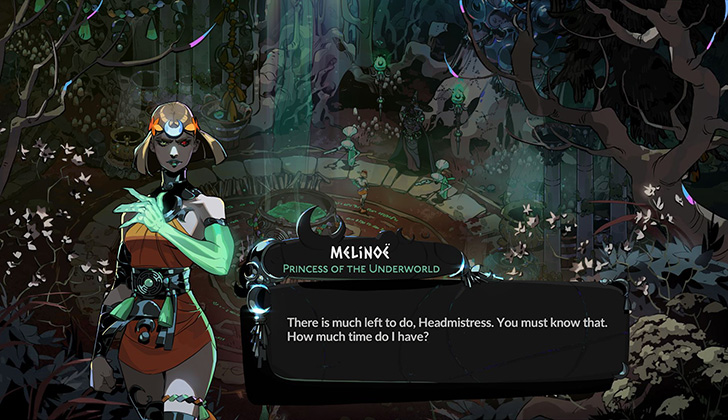
For one, you’re not playing as the Hades 1 hero, Zagreus, any more. Instead, you are playing his sister Melinoë, who plays a lot differently than he did. I’ll get into the actual gameplay changes below but Melinoë has far different motivations than Zagreus did.
In the original game, Zagreus was basically a prisoner within the underworld. His main quest was trying to best Hades to escape from said underworld and explore the world outside. Sure, there’s a pesky curse that makes it so when he hits the surface world, he is almost instantly killed, but that’s no bother.
Within Hades 2, Melinoë has a far different quest. When she was a baby, Hades, his wife Persephone, Zagreus and most of their house was frozen in time by Hades grandfather, the Titan Chronos. He has taken over the underworld and uses his power to wage war against the Olympians above and to further his control of the underworld. Melinoë has been raised by Hecate, a witch, to try and put down Chronos and restore the underworld to what it once was.
As a general rule Melinoë plays a bit different than Zagreus did, both due to her weapons and own abilities. She can attack, dash, dash-attack and has a special attack. However, she has a “cast” move that is a circle attack that can slow enemies down around her. It lasts about four seconds and ensnares enemies that are within it, but you can only have one active. Once the cast dissipates you can use it again, with it costing no mana.
The other big change to Melinoë is with her Omega moves. Because she is trained by a witch, she has witch powers that change her abilities, basically becoming charge moves.
Melinoë’s initial weapon is a witch staff and with the basic attack, you can do a three-hit combo. If you hold the button down though and let it charge, she’ll do a line-based attack that comes out either side from her. You can turn the line around as it charges and it fires off when it is done charging.
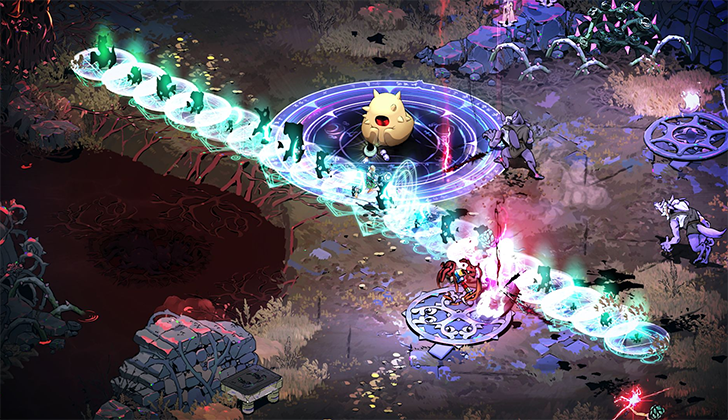
The special attack fires off a quick, arrow-like ranged attack from the staff. But if you hold the button down, you’ll shoot out a bigger, ball-like sphere which are slower but deals more damage. If anyone remembers the Shock Rifle from Unreal Tournament, it’s a bit like that.
Melinoë’s cast move is a more universal attack, regardless of weapon. If you just press it, the circle will go out, but if you hold it down until it is charged, enemies that are caught in the cast will be damaged when it expires.
Omega Moves, however, have their own resource, which is mana. Most Omega Moves use between 10-20 mana per usage, so you can’t just spam them over and over. Generally speaking, once you use all your mana in a room, that is it, outside of a few specific conditions. Mana doesn’t regenerate in rooms, but the second you move onto a new area, it’ll be refreshed.
There are 6 weapons for you to unlock and use. The Witches Staff is the first, but you’ll eventually gain access to a huge axe, two-short ranged daggers, two long-ranged staffs that pump out a lot of projectiles, to even weapons that are damaging skulls that deal damage when they hit enemies and need to be collected to use them again. I have to imagine this is a nod to Morte from Planescape: Torment but don’t quote me on that.
Like with the prior game, Hades 2 is a run-based, roguelite game. It’s not, “Well, I’m going to descend into the Underworld on my first time and slay Chronos”, no, it’s going to take you dozens, if not hundreds of tries to be able to best him.
To start with, while there is only the initial, Underworld, path open, eventually you’ll unlock a second path that has you going through Mount Olympus to help out above the surface. Each path has four, distinct, areas for you to traverse, each with their own distinct enemies, bosses, settings and gameplay hooks. One level has you traversing through ghost ship decks, and another has you plunging through the Underworld sewers.

The basic formula is, you enter a room, kill the enemies in the room, pick up the reward and then make a choice on where you want to move on next. Now, this is all randomized, from the rooms to the choices, to the rewards. Sometimes a room might only have one path to go through and sometimes it might have three. Or, the reward can be a boon (upgrade) from one of the Gods, to materials for your base, or just cash. There are a lot of variable that can happen on a run.
The boons are largely the same as from the first game, though they obviously have different effects and such. They basically break down into Olympus/God boons, or non-God boons. The non-God boons are stuff that increase your health, Daedalus Hammers to increase your weapon, or Poms of Power, which increase other boons by one level.
God Boons are ones you get when you pick them up from Gods or other mythical characters. So boons from Zeus, Demeter, Ares, etc. would fall under this group. You’ll also gain some from other characters you meet like Icarus, Medea, Narcissus and so on, so it’s not just boons from the big gods.
Both sets of boons, aside from the pure upgrade ones like giving you more life/mana, typically give you three options to pick from. They can enhance your main attack, your special attack, cast attack, increasing your dash speed or attack or do a dozen other things. Boons also have rarity gradients, so the more powerful a boon, the higher in level it will be. Boons also have elemental affinities with them, Earth, Air, Fire and Water, but sadly no Heart, so you cannot summon Captain Planet. Occasional boons might have elemental requirements like “Must have 4 Earth boons to activate”, so there is a bit of preparation involved.
The one more unique boon you can occasionally get is from Selene. The boon gives you a Hex power that is a bit of an ultimate attack, that charges based on mana usage. With a Hex might need 60 mana to trigger, you’ll need to spend that in the room for it to activate, but like with mana, it resets when you enter the next room. The unique part is that after the initial Hex choosing, if you pick up more Selene boons it unlocks a Selene tech tree for the hex itself. It is meant to power up the Hex, usually by more damage or reducing the cast time, but it is the only boon that has this feature.
All of what I’ve said above accounts for about 90% of the game. The other 10% is either before or after a run, when you are at the Crossroads, which is basically your home base. Here is where you can pick/upgrade your weapons, spend the various currencies you collect, and make permanent upgrades via the cauldron.
Being a witch, you have access to various incantations and spells to upgrade future runs. These typically require plants and resources that you’ll find in the world above and below. The plants will have to be grown, so it becomes a habit to check the cauldron, see what incantations you can do, or what you are missing, plant the required seeds (if you have them), do a run, come back, harvest your plants and complete the spell. These incantations provide more passive bonuses like allowing shops to occasionally pop up in rooms, occasionally provide rest rooms during runs, provide more soil for you to plant stuff and so on. The cauldron is where you’ll also do more plot-required spells, but I won’t get into that, not wanting to spoil things.
One unique ability that Melinoë has is her right arm can be infused with Arcana cards. These are passive abilities you can unlock, upgrade and swap out at the Crossroads and these provide even more passive buffs for your runs. These cards include things like giving you more “Death Defiance” (extra lives), restoring mana every second, or increasing the rarity/type of God boons when you draw them. This is all based on a points system, initially you only have 10 Grasp points, but you can upgrade it all the way to 30, with different Arcana cards requiring different point totals. It’s another system designed to give you more choice and freedom for how you want to approach your runs.
Another system in the Crossroads is that of Keepsakes. Like with the first game, you can form relationships with the various characters you meet. On the first interaction, after you’ve given them a gift of Nectar, they’ll give you their own specialized Keepsake, which provides a bonus to you. The God keepsakes typically allow you to have an increased chance for that specific God boon and let you upgrade it once. Other Keepsakes give you more starting money, restoring your health once upon death, or letting you do more damage against the enemy that killed you in the previous run. Keepsakes will only last for the area you are on, but you’ll eventually gain the ability to swap them out between floors, during runs.
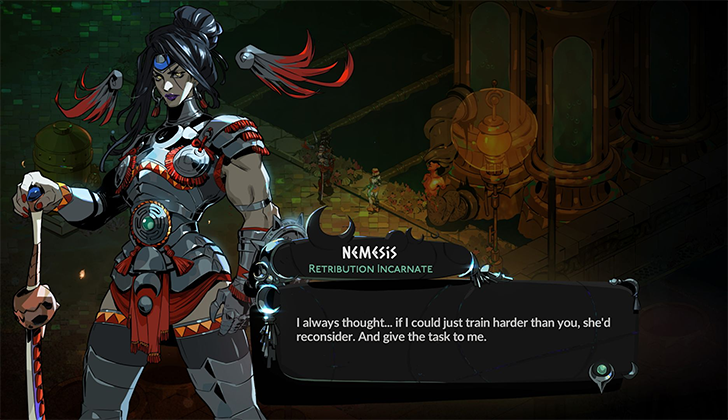
A key part of Hades 1 returns in spades in Hades 2 and that is the writing. All the characters have distinct personalities and opinions. No one is ever really short-changed and everyone has their own angle for dealing with the events of what is going on. Melinoë is as-good a protagonist as Zagreus was with a very fleshed-out character that makes you root for her.
So, everything about Hades 2 is damn near great, except for three small annoyances, though two are somewhat related.
The two related snags are some of the levels have a problem where the background can really blend into the active level. This actually occurs a bit in The Crossroads, it’s a somewhat big area with not a lot of defined paths, so it can be hard to orient yourself at first. Don’t worry, this does go away by about your 70th time there, but the first few runs is a bit disorienting.
On that point, there is one level in each the Underworld and “Live” side that this issue kind of crops up in as well. Both the levels are bigger than the normal ones with slightly different mechanics. Both levels also have upgrades from the cauldron to mitigate this issue as well, one has just a map you can check and the other has waypoints pointing out where key items are. I have to imagine this was some later-development solution, or they realized it was a bit too late that this was an issue.
The unrelated problem is with some of the goals in the game. Both games have a “Fated List of Prophecies” mechanic, where it is a list of goals for you to accomplish as you play them. Hades 2 one is longer and more involved, some goals are simple like “Bond with 3 Animals” or “Wear all of the outfits from Arachne”, which is fine. But some of the goals have very esoteric descriptions or it’s unclear of what you’re supposed to do. An example is “Gather item (tears) with intent, boil them & give to Medea.” How does “with intent” function here? I have 7 or 8 of the tears item, but either didn’t notice the “boil them” prompt or maybe I didn’t have the right intent. Regardless, you’ll probably look up how to do some of this stuff on a FAQ or a Wiki, just to make it easier on yourself.
One last thing I’ll mention and this is actually to Hades 2’s credit: there is just a toggle in the game for “God Mode”. I guess Hades 1 also had this but I never noticed it, but toggling it on gives you a 20% boost in damage resistance. That percentage goes up more and more, if you keep dying, making the game easier if you are having problems with it. This is a good move, it makes the game actually sporting for people, I know there is a huge draw to make the game as hard as possible, but some people either just aren’t great with games like this or have stuff to do. This makes it for a more approachable experience, if you are needing it.


