
Movies & TV / Columns
david j. moore On Co-Writing Hard Redemption, Reveals Original Title
 Image Credit: Jino Kang and Christine Lam

The 411 Interview: david j. moore

david j. moore is an author and film historian who has written the books The Good, the Tough, and the Deadly: Action Movies & Stars 1960s-Present (2016), Beauty Among the Ashes: An Artist’s Quest to Bring Hope to a Town That Lost Everything (2021), and World Gone Wild, Restocked and Reloaded 2nd Edition: A Survivor’s Guide to Post-Apocalyptic Movies (2024). moore has also written articles for such publications as Fangoria, Filmfax, The Phantom of the Movies Videoscope, Black Belt, and Kung Fu Magazine. moore’s latest project is the new low-budget indie martial arts action flick Hard Redemption, starring Jino Kang, Lou Ferrigno, and David Kurzhal and co-directed by Jino Kang and Christine Lam. moore co-wrote the screenplay for Hard Redemption with Dustin Leimgruber. In this interview, moore talks with this writer about writing the screenplay for Hard Redemption, the experience of actually making Hard Redemption, and more.
**

Bryan Kristopowitz: How did you come up with the initial idea for the script for Hard Redemption?
david j. moore: After writing my book The Good, the Tough, and the Deadly: Action Movies and Stars, which is my all-encompassing encyclopedia about action stars, I developed some relationships with some of the subjects I covered and interviewed, namely Don “The Dragon” Wilson and Jino Kang. There were some others with whom I became friendly with, some filmmakers such as Sam Firstenberg and Isaac Florentine, just to name a few, and I suppose the intention with these friendships and relationships was to expand my career to include public relations and perhaps even the development of my own projects in some way or another. I always figured my best way into the movie making business was to become an asset to some of these still-active actors and filmmakers.
At one point, I found myself pitching some of these folks some ideas I had, which didn’t really get anywhere, but with Jino I could sense that he was getting close to considering his next project to star in and direct. Over the course of a few years, Jino became one of my very first clients; I became his publicist and manager for a little while and I think he was impressed at the outset that I was able to drum up some interest for his past projects Fist 2 Fist (2011) and Weapon of Choice (2014), but my attempts to be his manager / agent were a little less impressive. I was able to get him his first articles in Kung Fu Magazine and some other martial arts magazines, and as I got to know him better I kept having thoughts about how to position myself as the writer or producer of his next possible project.
In the meanwhile, I had written several other spec scripts with Dustin Leimgruber, a friend and colleague. Dustin has always been very hungry to break into the business and he’s humble and we had a pretty reasonable working relationship. After writing two spec action scripts that got around the market a little bit, we were a little flummoxed about the process because how hard can it actually be to get a movie made? The thought hit me: What if we pitch Jino some ideas for his next movie? I gauged the waters, and he was open to hear some ideas. So, Dustin and I came up with five or six basic outlines for him.
Ultimately, what I wanted to see Jino do was a stripped-down role of a hard luck ex-con whose first day as a teacher to last-chance kids over the summer turns into the worst day ever as the run-down school gets “locked down” after a gang breaks in to hunt down a kid they’re trying to either kill or capture. Jino liked the concept and gave Dustin and I the green light and a cash advance to proceed with a script based on that concept, and Dustin and I wrote a script that made Jino happy enough to let us do one rewrite, and then that was the impetus for Jino to consider it as his “next project.” The concept was always “The Substitute– meets-Die Hard” or something of that nature. One location, limited cast, but ultimately a vehicle project for Jino. Lots of action.
BK: Was Hard Redemption always titled Hard Redemption or did it have another title at any point in its development?
djm: No, our original title was Hard Lockdown. We were going to shoot it in 2020 and were all set to go, but then the COVID shutdowns / lockdowns made us rethink our title. Hard Redemption was Jino’s idea. It’s a good title.
BK: What sort of changes, if any, were there to the plot or story during the development of Hard Redemption?
djm: Well, that’s a sore subject for Dustin and I. We wrote a pretty “fool-proof” script, but when the film was given a green light, it was rewritten and had to be even more streamlined for its budget, which means that the movie you see on screen isn’t necessarily the one that Dustin and I were confident in. I say this as not only one of the writers, but also as one of the producers. We had a different opening act involving the whole reason why the kid was being hunted down, and that involved a subplot about him witnessing a murder, but that was eliminated. The final showdown was supposed to be with Jino’s old mentor, who is the head of the Goblin gang. We had Jino’s character as one of the aged-out Goblin gang members, and that got changed. The actor I had in mind for Jino’s mentor / master unfortunately passed away in 2020, but he would have been ideal for a showdown scene with Jino. As a result of that tragedy, the connection to the Goblin gang was changed, and we found a younger actor for that role.
BK: Describe your working relationship with Hard Redemption co-directors Jino Kang and Christine Lam.
djm: I love Jino, and have known him for years. To me, he is completely untapped potential and should be a much bigger name. All I want is for Jino to succeed. That’s always been my wish for him. He’s very easy to work with as far as him being a grateful client, and vice-versa. Dustin and I always championed him from the very beginning, and at one point Jino showed that he had true honor when he was willing to relinquish the script to another filmmaker to make with someone else, but fate kept the script in his court, and when he moved forward with it, it was his decision to keep Dustin and I involved as co-producers. He always kept us in the loop, even still to this day. He has given us an extraordinary amount of leeway and “say” regarding the film, which is a very rare thing in this business. I still believe the movie isn’t finished, and I have a feeling we’re going to see some changes to the film before it is released … because he trusts us and believes in us, as we do in him. He insisted that both Dustin and I visit the set and be a part of the process. For writers to be included in the making of the film – especially a small film such as this – is virtually unheard of.

BK: Describe your working relationship with co-writer Dustin Leimgruber.
djm: Dustin found me as a result of my first book World Gone Wild: A Survivor’s Guide to Post-Apocalyptic Movies. He was a fan, and fate brought us together because we live in the same town. Once we became friends, I realized he is a good writer, and I invited him to contribute to my book about action stars. After that, we wrote two spec action scripts, and our rapport is pretty good. I’m a much better prose writer than a script writer, and so when we sat down to write those scripts, we divvied out scenes, and I would turn in those sections, and he would turn my stuff into script form. That’s a good process for us, I think. That’s how we did Hard Redemption, but much quicker. I think from start to finish we did the whole thing in less than three months. It was super-fast. And it was a good script! I swear!
BK: You are also credited as a co-producer on Hard Redemption. What was that experience like?
djm: Well, I’ve had several filmmakers tell me I would make a good producer. They might be right, but one thing I can tell you is that I really hate being on movie sets. If you don’t have an active role or function on set, it’s torture just standing around and watching things. I get bored really easily, so the more I have to do, the better. In this case, I was the catalyst for getting Lou Ferrigno and making sure that seed was planted in Jino’s head. I had a connection and had worked on something with Lou before, so that was an easy thing for me to just be a connecting element for that. I also got David Kurzhal on board. So, in a casting sense, I “produced” them. I also made sure I had a journalist on set and insisted on him conducting interviews on site. That made me a Unit Publicist, and that role includes handling all the publicity on the film. Producing the film with Dustin also entailed us giving lots of notes after the fact and voicing our concerns with elements of the edit, which is still ongoing. Luckily, we have Jino’s ear. I believe that makes us responsible producers because the film still needs us.

BK: What was it like working with Lou Ferrigno?
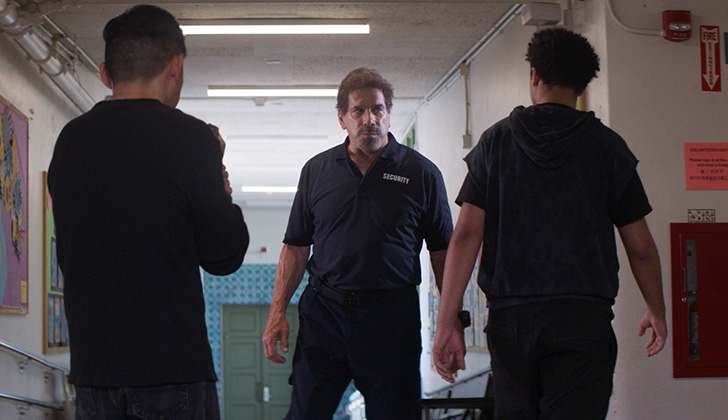
djm: Lou is a pro. He shows up, knows his lines, ad-libs when he can, and he was very physically capable in his fight scenes. We didn’t need to double him at all. He was game for anything. He also happily greets fans and does all the stuff that a famous dude like him should, which is to be warm and embracing. We never had a bad moment with him. We’d certainly consider him for another project.
BK: What was it like working with David Kurzhal?
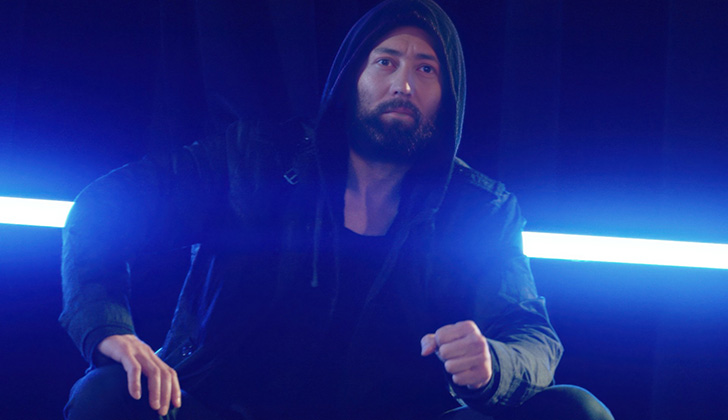
djm: I like David. He’s super hungry, is willing to do anything, and if he’s careful I believe he can cultivate for himself a nice body of work, which would potentially lead him to bigger and better things. I communicate with him regularly. I found him and befriended him because of his YouTube channel. I could tell he’s a guy who should be on my team, and so far he’s been nothing but grateful. If he becomes famous – which I have a feeling will happen at some point – I hope he remembers the little people who propped him up.
Even if he doesn’t, I’ll still be one of his cheerleaders. He’s got tons of potential, David does. He did everything that was required of him for this film, and he has that valuable thing that many of his peers do not: screen presence. He has the right look, doesn’t he?
BK: What was the hardest part of making Hard Redemption for you as a co-producer? What was the easiest?
djm: Well, they’re kind of the same thing, in a way. I’ve taken sort of a passive role as a producer up till now. The hard part is fighting for it now. I want the film to be released in the best possible version. The movie Dustin and I see as the “best” version is still to come. We’re fighting for the movie’s success, which means the movie must be released in its best possible edit. It’s a huge thing to have a movie made of something you wrote, but it’s still a battle to make sure that everyone else who helped make it happen sees that there’s always room to improve it. It’s tricky. My job as a producer on this isn’t over.
BK: Do you have a favorite scene in Hard Redemption?
djm: There are little moments in it that shine. I like some of the banter between the Goblins. I like some of the casting choices. It’s easy to say that the action is the “best” part of the film, but I prefer the dialogue … when it’s “good.”
BK: Any upcoming projects you can tell us about?
djm: Encyclopocalypse Publishing is going to publish my debut men’s adventure novel Chance & Gamble: The Mark of the Maharaja this year. I’m super excited about that. The sequel Chance & Gamble: The Cursed Crown is completed and ready to go, as well. That’s what’s next, and I guarantee maximum satisfaction from those. These books are all me, no shared credit, no compromises. Out of everything I’ve ever done, I’m proudest of these novels. No filters, just raw adventure. I loved writing them.
BK: What do you hope audiences get out of Hard Redemption?
djm: You know, I just hope its intended audience gives it a chance. For me, it’s all about Jino. The entire point is to give Jino another shot at collecting a fan base. We think the world of Jino, and he has a beautiful persona that I truly believe audiences will connect with. At the very least, I’m hoping this movie will point to his earlier films Blade Warrior (2001), Fist 2 Fist (2011), and Weapon of Choice (2014). The fact that Lou Ferrigno is in this with him is just a little icing on the cake.
BK: What sort of release do you hope to get for Hard Redemption?
djm: I expect it will be one of these direct-to-streaming titles. Originally, I was hoping for a theatrical release, but its extended life will be on streaming. I just hope it finds an audience. It’s tough these days with titles such as this.
BK: Any interest in a potential Hard Redemption 2?
djm: Absolutely. I have an idea for a second one that will expand on the concept and would give Jino more room to fight and give his character more to do. If we get Lou in there again, Lou would have plenty of opportunity to flex and do his thing. It’s up to Jino.
BK: Hard Redemption is your first produced screenplay as a writer. Overall, how would you rate the experience of making an indie action/martial arts movie? Is it something that you would want to do again?
djm: For most of my life, this experience was all I ever wanted, and now that I’ve lived it and “survived” it, I have a point of view about it that I never thought I’d have. I would be perfectly content to never do it again, but if I have another chance at it, I want more control over the script that gets produced. That’s a lot to ask for, but otherwise I’m not sure it would be worth it to do this again. It’s a heartbreaking process. All the rumors and clichés are true about moviemaking. It can be soul crushing, or it can be a triumphant experience. I didn’t particularly enjoy the process, but that doesn’t mean it wasn’t worth it on some level. I crossed it off my list, that’s for sure.
BK: Do you think you could take on a martial arts gang by yourself in real life?
djm: One at a time! Not like Jino, but I’m like one of those Vikings in The 13th Warrior (1999) or Conan in Conan the Barbarian (1982). No one will remember what happened on that day. All that matters is that few fought against many!

**
A very special thanks to david j. moore for agreeing to participate in this interview.
Check out the official Hard Redemption Facebook page here!
Check out my review of Hard Redemption here!
Check out david j. moore’s Tik Tok page here!
World Gone Wild, Restocked and Reloaded 2nd Edition: A Survivor’s Guide to Post-Apocalyptic Movies is available here, and The Good, the Tough, and the Deadly: Action Movies & Stars 1960s-Present is available here!
david j. moore and david j. moore, Jino Kang, and Dustin Leimgruber images courtesy of david j. moore. All other images courtesy of Jino Kang and Christine Lam.


