
Movies & TV / Reviews
The Odyssey Review
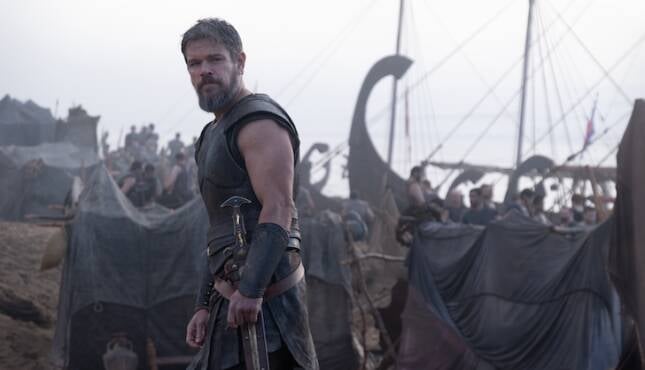 Image Credit: Melinda Sue Gordon/Universal Pictures


 Loading...
Directed By: Christopher Nolan
Written By: Christopher Nolan; Based on the poem by Homer
Runtime: 173 minutes
MPA Rating: Rated R for violence and some language
Matt Damon – Odysseus
Anne Hathaway – Penelope
Tom Holland – Telemachus
Robert Pattinson – Antinous
Charlize Theron – Calypso
Zendaya – Athena
Samantha Morton – Circe
John Leguizamo – Eumaeus
Jon Bernthal – Menelaus
Benny Safdie – Agamemnon
Lupita Nyong’o – Helen/Clytemnestra
Himesh Patel – Eurylochus
Andrew Howard – Polites
Mia Goth – Melantho
Ryan Hurst – Mentor
Elliot Page – Sinon
Christopher Nolan brings Homer’s archetypal adventure to the screen with The Odyssey. Boasting a nearly three-hour runtime, plus a gargantuan IMAX 70 mm format, Nolan certainly achieves an impressive cinematic spectacle with his version. However, the movie proves lacking and flawed in various areas.
Before Odysseus begins his fraught journey across land and sea, Nolan’s plot establishes the present status quo. Odysseus, king of Ithaca, is missing in action for years from his beloved homeland, following King Agamemnon’s (Safdie) victory in the Trojan War due to Odysseus’ bold strategy.
Ithaca grows ever more unstable in its lord’s absence. Due to the rites of Zeus’ law, various suitors, led by the treacherous Antinous (Pattinson), seek the hand of Odysseus’ wife Penelope (Hathaway) and receive rein of the royal palace. Odysseus’ son and heir, Telemachus (Holland), seeks to maintain his family’s fragile rule, but the time for Penelope to choose a new king grows closer. Telemachus ultimately sets out to ascertain his father’s whereabouts and fate.
Meanwhile, Odysseus lives in a lost, idle haze with Calypso (Theron) on her island, gorging himself on lotus flowers. In his brief moments of clarity, Odysseus recalls the perilous journey that brought him to his current state, but his mind is weary and his spirit at odds.
Nolan utilizes Homer’s Odyssey as a vehicle for crafting a harrowing story of penitence and absolution. It’s arguably his boldest and most ambitious story to date, but not completely successful in what it sets out to do.
Nolan’s take on the more fantastical and magical elements from the original tale is interesting in some ways, but frustrating in others. Certain aspects are disappointingly ambiguous, such as the Greek pantheon.
The Gods are depicted more as primal forces, rather than literal sentient beings. Their roles have been marginalized as ideas, and it’s frustrating that Nolan won’t commit to the source material. Nolan’s commitment to grounded realism is commendable, but in the case of The Odyssey, removing some of the story’s most important characters causes frustration and disappointment.
The story opens with a subtitle that reads “A time of apparent magic,” and Nolan leans heavily on the “apparent” part. Monsters and creatures are present, but they may simply be products of an older world and age that time has forgotten, rather than beings of myth and magic.
At other times, Nolan’s grounded, tactile approach to ancient fantasy serves him well, such as Odysseus’ encounter with the earthy witch, Circe (Morton). Morton delivers a brief yet impactful performance during her moments with Odysseus. The way Nolan interprets her magic induces terror, as if mortal men are clay that she molds into animals.
However, there’s another stretch of the movie where Nolan almost seems to include certain moments from the source material out of begrudging obligation. Nolan appears at odds with Homer, as the director struggles to find a middle ground between the text and his realistic sensibilities.
Matt Damon delivers a fairly strong, emotionally hefty performance as Odysseus, albeit a very idealized, virtuous, and heroic version of the character. Nolan generally bleaches Odysseus of many of his flaws. Even his gravest mistakes come more from a compassionate origin, where fate forces Odysseus’ hand, and he’s constantly forced to choose between the lesser of two evils. However, with that perspective in mind, Damon portrays the role exceedingly well.
Tom Holland also takes command quite well as Odysseus’ wayward progeny, Telemachus. Holland portrays the role with strong poise and surprising charisma, especially through his relationship with his mother, Penelope. Telemachus and Penelope skillfully showcase the story’s emotional stakes throughout the narrative. Anne Hathaway delivers a strong, quietly dignified performance as Penelope, who exhibits grace under pressure, minding her husband’s throne and kingdom in his absence, not out of royal obligation, but true love.
Nolan brings his usual strong sense of cinematic spectacle to The Odyssey, with the entire movie presented in the IMAX 70 mm format, which presents exceptional immersion and scope. Hoyte van Hoytema also provides some beautiful camerawork, plus a strong unorthodox score by maestro Ludwig Göransson.
Despite a runtime of nearly three hours, Nolan keeps the plot’s pacing fairly brisk, as the story shifts from multiple perspectives, from the state of unrest in Ithaca to Odysseus’ overall journey. That said, Nolan repeats an unusually bad habit of showing his hand too early. He telegraphs major reveals, rather than allowing them to unfold more naturally. Nolan’s version of narrative foreshadowing lacks finesse and subtlety.
Additionally, while the IMAX 70 mm format provides singular scope and stunning immersion, the sound mix lacks crispness. Character dialogue sounds undercooked — a recurring issue with Nolan’s films in that it’s hard to hear large swaths of the dialogue.
The other major flaw of The Odyssey also showcases Nolan’s weakness as a screenwriter. Nolan takes sole writing credit on his feature, and in a story like The Odyssey, he certainly could have benefited from another voice to punch up the dialogue and style.
At times, Nolan oddly modernizes the characters’ dialogue and language, while at others the syntax sounds more poetic and Shakespearean. It lacks consistency, resulting in the dialogue sometimes coming off as rather stiff and flat.
Thankfully, when the story reaches its final act, the narrative picks up, and Nolan nicely homes in on the emotional stakes, leading to an overall satisfying finale. Ultimately, The Odyssey amounts to a relatively entertaining, yet flawed, Nolanized take on Homer’s source material, rather than a definitive one.
Where To Watch The Odyssey
Christopher Nolan’s The Odyssey opens in theaters on July 17. Ticket and showtime information are available at the movie’s website.


