
Movies & TV / Reviews
Thunderbolts* Review
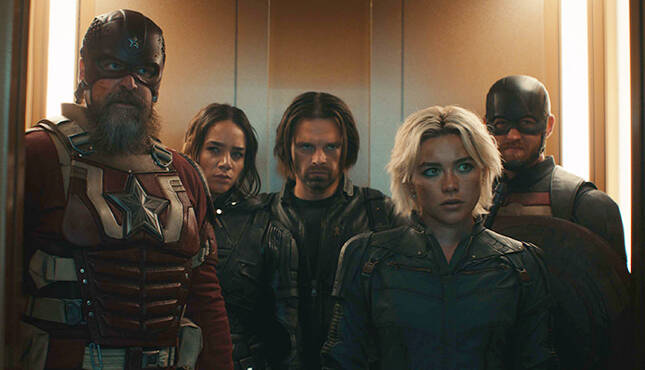 Image Credit: Marvel Studios


 Loading...
Directed By: Jake Schreier
Written By: Eric Pearson and Joanna Calo; Based on the Marvel comics and characters
Runtime: 126 minutes
MPA Rating: Rated PG-13 for strong violence, language, thematic elements, and some suggestive and drug references.
Florence Pugh – Yelena Belova/Black Widow
Sebastian Stan – Bucky Barnes/Winter Soldier
Lewis Pullman – Robert Reynolds/Sentry/Void
Julia Louis-Dreyfus – Valentina Allegra de Fontaine
Wyatt Russell – John Walker/U.S. Agent
Hannah John-Kamen – Ava Starr/Ghost
David Harbour – Alexei Shostakov/Red Guardian
Geraldine Viswanathan – Mel
Wendell Edward Pierce – Congressman Gary
Olga Kurylenko – Antonia Dreykov/Taskmaster
The Marvel Cinematic Universe continues with its latest chapter, Thunderbolts*. The new comic book superhero adventure sees a team of unconventional team of antiheroes and ex-villains thrust together in an unlikely scenario where they must rise to the occasion to stop an unimaginable terror. Unfortunately, Thunderbolts* hides its lack of a compelling storyline through attempts at witty banter, amounting to a two-hour title gimmick. Yes, the movie makes it clear why there’s an asterisk in the title, constituting little more than a groan-inducing bait-and-switch scenario.
Thunderbolts* picks up with characters from previous MCU adventures. CIA Director Valentina Allegra de Fontaine (Louis-Dreyfus) is on the chopping block, with Congressman Gary (Edward Pierce) heading up a committee to bring her to justice for her extralegal activities. Meanwhile, Gary’s fellow freshman congressman, Bucky Barnes (Stan), aka the former assassin The Winter Soldier, seeks to get Valentina’s conflicted assistant Mel (Viswanathan) to flip on her draconian boss.
With the Federal Government breathing down her neck, Valentina is looking to run cleanup on her unsavory human experiments, calling on her black ops agents to wipe the slate clean, including former Black Widow assassin Yelena Belova (Pugh); U.S. Agent John Walker (Russell); the Ghost Ava Starr (John-Kamen); and Antonia Dreykov, aka the Taskmaster (Kurylenko). However, Valentina’s agents don’t realize that they are all loose ends, and she sets the shadow operatives against each other to do her dirty work. Eventually, the group realizes Valentina’s betrayal, forcing them to band together, along with the unassuming recovering drug addict Bob Reynolds (Pullman), a young man with manic-depressive tendencies, mysteriously stashed in Valentina’s test facilities.
Eventually, some members of the group reconvene with Bucky, seeking a truce to rescue Bob and bring Valentina to justice. However, while Valentina has higher goals of transforming Bob into a new vision of “superherodom,” the unwitting human test subject harbors a dark secret that threatens all of existence. It’s now up to this unlikely group of would-be heroes to save the day.
Thunderbolts* exemplifies Marvel Studios’ struggles to find any solid footing with The Multiverse Saga, where it feels noncommittal regarding any choices and characters. The plot kicks off with Congress seeking to bring down Valentina for her crimes, a plot development that utterly falls apart in the second half. The film wastes the talents of Wendell Edward Pierce in a throwaway role to that end. Why Bucky made the transition into politics is an absolute mystery. Bucky isn’t a politician and appears utterly bored and uninterested in politics throughout the film.
While Valentina Allegra de Fontaine acts as the chief antagonist for most of the movie, she’s not a significantly compelling adversary to the would-be heroes. It’s unclear why the federal government is now targeting her for actions freely allowed in previous MCU installments.
Thunderbolts* introduces another prominent Marvel Universe character through Bob Reynolds. The film reimagines the character as a timid individual suffering from manic depression and dissociative identity disorder. In moments of extreme stress, his darker half leaks out and threatens to engulf him. In a film overstuffed with characters, the Bob Reynolds aspect does not receive nearly enough development, as his dual identities and entire character arc are undercooked. The narrative showcasing Bob Reynolds as a seemingly weak and unintimidating individual at first is a wise choice to let the audience see him as a character. Unfortunately, a complex character, such as Bob Reynolds, requires his own movie or miniseries for a more resounding introduction.
Florence Pugh represents the lone bright spot of the movie as Yelena Belova. Pugh’s character arc nicely picks up from her previous appearances and complements the film’s central theme of fighting depression and despair. Yelena feels utterly lost with the death of her sister, Natasha Romanoff, in Avengers: Endgame. Natasha’s death and Yelena’s unsavory work as Valentina’s black ops attack dog are eating away at Yelena’s soul. Pugh delivers the strongest performance in Thunderbolts*, and the thespian does her best to hold the flimsy plot together, becoming a figurehead of the unlikely heroes.
Other characters are underdeveloped, especially Hannah John-Kamen’s Ghost. The presence of Taskmaster goes as expected, wasting an all-time great Marvel character in a throwaway role. The awkward father-and-daughter dynamic between Yelena and David Harbour’s Alexei Shostakov, aka the Red Guardian, is weird, considering his passive role for years in Yelena’s torture, captivity, and brainwashing in the Red Room. Yet, Yelena strangely continues seeking Red Guardian to step up to provide guidance and fatherly wisdom. Wyatt Russell, somewhat decently, pulls off U.S. Agent’s emotional pathos, hiding John Walker’s bottled-up pain and anguish behind a bold, braggadocious type of military machismo and swagger. However, the film fails to properly show the curmudgeonly cadre growing into a properly bonded team.
The big reveals for Bob Reynolds do not have sufficient narrative breathing room, and they lack significant impact. What’s worse, the entire movie comes off as little more than a joke in service of a one-note gag. A trick like Thunderbolts* might have worked over ten years ago with more compelling characters. Now, it comes off as an overly laborious slog. The film relies heavily on goofy humor, jokes, and dialogue, as the movie attempts to assert itself as a sardonic comedy. While there are some humorous bits from time to time, the MCU’s emphasis on comedy, which was once so appealing, has lost its edge.
The film plays out like a huge missed opportunity to adapt the original Thunderbolts comic storyline, where the Masters of Evil disguise themselves with fake superhero identities under the leadership of Baron Zemo. Instead, Thunderbolts* plays out as Marvel Studios attempting to be cute, but the joke isn’t all that funny or applause-worthy. Thunderbolts* tries to rehash past MCU successes without truly understanding why they worked in the first place. The resulting MCU adventure does not serve justice, like lightning.


