
wrestling / Columns
The Magnificent Seven: The Top 7 Survivor Series Performers

As difficult as it may be for my non-wrestling enthusiast friends and family to understand, since childhood I’ve had a mental connection between the Thanksgiving holiday and elimination tag team wrestling. I suppose it shouldn’t be all that surprising when my earliest Thanksgiving memories coincide with the inception of the Survivor Series event, back when it occurred on Thanksgiving night or Thanksgiving eve. The format has remained a November fixture ever since.
The event has changed over time. In its earliest incarnations, Survivor Series was all about elimination tag team matches, but there have been years without any such contests, and, more commonly now, just one main event elimination tag, or just one or two cursory ones thrown together for the sake of tradition.
Regardless, Survivor Series, particularly in its original format, remains one of my personal favorite events of the year and this week I’m taking a look back at the seven individuals whose performances on screen have contributed the most to the show.

#7. Hulk Hogan
Without Hulk Hogan and his license-to-print-money program opposite Andre the Giant, there may not have been a Survivor Series. But after the angle caught fire and delivered arguably the biggest money-making match of all time at WrestleMania 3, the WWF was all too eager to cash in on further returns and thus pitted the two against one another again for the initial Survivor Series in 1987, to air opposite the NWA’s Starrcade super show. Make no mistake about it—Hogan was the key drawing card for the show, but perhaps more importantly, he was not a winner on that particular night. Rather, in a masterstroke, Andre the Gian won the match to keep him a legitimate world title challenger and last eliminated Bam Bam Bigelow—at the time, a valiant young face who battled against the numbers game in the late stages of the match only to succumb to the Giant’s unbeatable size. Thus the WWF established one of the best themes of Survivor Series shows to follow for years to come—putting over multiple talents—the survivors, the people who achieve multiple eliminations, and the people who survive long past the odds only to succumb to understandably long odds.
Hogan would go on to sell more Survivor Series shows—he and Randy would stand tall as co-captains and the two last men standing in their 1988 main event; Hogan fronted a team with Demolition and Jake Roberts and emerged as the sole survivor against The Million Dollar Team a year later; he celebrated with The Ultimate Warrior after not only surviving his match, but coming out on top in the first and only Grand Finale Match of Survival; finally, in 1991, he put over fresh-faced heel The Undertaker in a shocking upset that went a long way toward legitimizing ‘Taker and setting him on a course for the legendary career he would go on to enjoy.

#6. John Cena
Similar to Hogan as the WWF’s definitive main event star of the late 1980s and early 1990s, John Cena has been the man in the current decade. The Doctor of Thuganomics made his first appearance at Survivor Series in 2003. He made a major face turn when he declined Brock Lesnar’s invitation to participate on his team of heel monsters, and instead sided with Kurt Angle’s crew that also included Chris Benoit, Hardcore Holly, and Bradshaw. This opportunity arguably started Cena’s key push—he opened the show with a free-style rap and proceeded to survive alongside Benoit. Cena would add another Survivor Series win to his resume the following year as part of Team Guerrero before arriving as a true main eventer. Over the years to follow he would get the better of Kurt Angle, Chris Jericho, Alberto Del Rio, and the pair of Triple H and Shawn Michaels in world title scenarios, and drop main event level matches to Booker T and CM Punk. He would play the morally conflicted guest referee for Randy Orton-Wade Barrett in 2010. Ultimately, Ceja may have had what may have ended up being his highest profile appearance of all in 2011, main eventing in a tag team with The Rock.
Cena gets the Hogan-esque rub of having many a pay per view built around him, and gets to climb one notch higher in the countdown for better overall match quality, plus longevity.

#5. Bret Hart
Bret Hart’s initial Survivor Series runs weren’t exactly inspiring, getting pinned by Jim Brunzell and Tully Blanchard in his first two outings—supersized teams-of-tag-teams affairs—and succumbing to a late elimination via Randy Savage in his first conventional Survivor Series match in 1989. The Hitman would take a step in the right direction when he was at least a featured performer as part of Dusty Rhodes’s squad that challenged The Million Dollar Team—the last man eliminated in a losing effort against Ted Dibiase who was still well above Hart on the card at that point. Hart would fall victim to a massive DQ-inducing brawl in his 1991 effort.
Like so many aspects of Hart’s career, 1992 would mark a turn for Hart’s fortunes at the Survivor Series PPV. He would main event this show as the new world champion in a match that foretold the direction of the WWF for years to come, forcing Shawn Michaels to submit to the Sharpshooter. While he’d be back in team action in 1993, he did far better for himself then, too, surviving a challenge from Shawn Michaels and a group of Knighs originally casted to back Jerry Lawler and, in the process, kicking off his iconic feud with his brother Owen. 1994 would see Hart drop his world title to Bob Backlund in a performance that probably would have been crowd-killingly boring in the hands of most performers but that was made by Bret’s killer selling and connection in the crowd, plus Owen’s theatrics at ringside in which he manipulated his parents into forfeiting the match for The Hitman. Hart remaind in the world title picture, winning his third title off of Diesel at Survivor Series 1995, and then started a passing of the torch phase of his career, winning a hotly contested one-on-one bout with Steve Austin in 1996.
And then there was Hart’s final Survivor Series performance in 1997. It’s unfortunate that he’s probably best remembered for this outing, which culminated in the infamous Montreal Screwjob. In all of the drama of Vince McMahon calling for the bell, Shawn Michaels feigning innocence, and Hart departing for WCW, it’s worth pointing out that Hart put on a solid wrestling match prior to the historically important climax.
All that said, I’ve long felt that Bret Hart’s career can be defined as one in which an underappreciated grand master made the most of the cards dealt to him. Such is the story of Hart’s career at Survivor Series. As a tag team performer, he delivered perfectly competent performances in limited minutes; he shone in the mid-card, and given the ball to run with, he spent five years putting on some of the Survivor Series’ better matches.

#4. The Rock
Just as his all-too-brief career as a full-time wrestler might lead you to expect, The Rock has fewer Survivor Series matches under his belt than anyone else on this countdown. And, just as the electricity of his short tenure would suggest, he made the most possible out of that limited time.
The Rock made his Survivor Series debut in 1996 as part of Marc Mero’s team and, perhaps foreshadowing the big things to come, the WWF booked him as the sole survivor of that bout. A year later, he would make the final two in his match again, dropping the final fall for his Nation of Domination team to Ken Shamrock, representing The Legion of Doom. Rock would take his game to the next level in the years to follow, winning the vacant WWF World Championship in a masterful riff off of the Montreal Screwjob from the year before. In the years to follow, he’d be involved a triple threat world title match with Triple H and Big Show, then best newly heel Rikishi in a one-on-one match. Finally, The Rock would be the last man standing for the WWF in 2001, putting the final nail in the coffin of the mismanaged Invasion angle.
Rock looked to be gone from Survivor Series and, indeed, the WWF on the whole, only to make his dramatic return to the event in a special tag team appearance, siding with John Cena against The Miz and R-Truth in 2011. The performance more than lived up to The Great One’s legacy, adding a meaningful new chapter to his Survivor Series resume and adding an important wrinkle to his long-range program with John Cena when The Great One planted The Champ with a Rock Bottom just after they had teamed up for the victory.

#3. The Undertaker
It’s a testament to The Undertaker’s legacy that he can be considered not only one of the most iconic figures in WrestleMania lore, but also synonymous with WWE’s second oldest PPV, Survivor Series.
The Dead Man made his debut at Survivor Series 1990, a surprise firs- time appearance, joining Ted Dibiase’s team of heels and promptly eliminating Koko B. Ware with a Tombstone piledriver, then, seven minutes later, dispatching of the opposing team’s captain, Dusty Rhodes. ‘Taker would only be eliminated on account of count out schmozz when he went after Rhodes post-elimination outside the ring. A year later, ‘Taker would prove he was for real when he scored a shocking upset victory over Hulk Hogan to win his first world title.
The years to follow would be less noteworthy, but not unimportant as The Undertaker shored up his spot as a fringe main eventer beating Kamala and Yokozuna in casket matches, teaming up with Lex Luger and the Steiners to defend American pride against a band of heel foreigners, leading a team to victory over King Mabel and other royal heels, and besting Mankind one-on-one. As The Attitude Era took flight, ‘Taker made it to the semifinals of the Deadly Game world title tournament, only to lose by DQ to the eventual tournament winner, The Rock; he’d come up short in his next Survivor Series appearance, too, putting over Kurt Angle in a world title match in 2000, only to come back to the winning side of a match as a featured player on Team WWF opposite The Alliance in 2001. In 2003, he would get the dubious honor of a one-on-one feud with Vince McMahon, which the two blew off in a Buried Alive Match; the next year he’d seemingly take a step back, more firmly into the upper mid-card to settle his rivalry with Heidenreich.
‘Taker took an unlikely starring role in Survivor Series 2005, with a surprise return at the end of the show to haunt Randy Orton, and though he’d spend the next year in the quagmire of a First Blood match opposite Mr. Kennedy, in the years to follow he’d more firmly re-establish his place as a main eventer on the Survivor Series stage in a World Heavyweight Championship Hell in a Cell match with Batista, a Casket Match with Big Show, and his final appearance at the show to date, a successful defense of the World Heavyweight Championship in a Triple Threat match against the reigning tag team champs, JeriShow.
As the summary above attests, The Undertaker is worthy of recognition first for longevity, and secondarily on account just how much time he spent at or around the main event level—winning his first title at the show in 1991, and retaining a world title there eighteen years later. He captained teams, competed for world titles and participated in memorable attraction matches (even interacting with Chuck Norris!). Few men can rival The Undertaker’s Survivor Series resume, and I have the number two man in this countdown just barely edging him out.
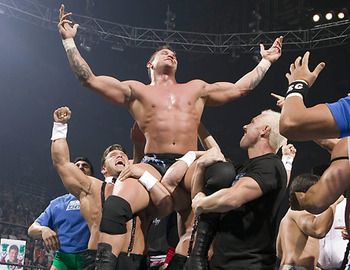
#2. Randy Orton
I have a ritual of watching old Surivivor Series shows in November—a process that became easier when WWE released a box set of the early years of the show, and easier yet with the launch of the WWE Network. In rewatching a stretch of shows from the mid-2000s it struck me just how strongly the WWF pushed young Randy Orton at this particular annual event.
Consider 2003—Orton’s Survivor Series debut—when he was an anchor for Team Bischoff against Team Austin for control of Monday Night Raw. The match came down to a one-on-one situation, with Orton representing the heels, facing off against the one and only Shawn Michaels on the face side. Orton capped a solid performance by pinning HBK in the middle of the ring, hence cementing his place as a fringe main eventer. One year later, Orton would be a few months removed from his reign as the youngest world champion in history, and was arguably the top face in the company. Again, he would find himself in a main event elimination tag match, with the members of the winning time getting guest GM privileges for the month to follow. Again, the match came down to a final twosome, and again it was Orton who stood tall, scoring a pin over arch-rival Triple H. The next year would feature a Raw vs. Smackdown interbrand showdown elimination tag. Stop me if you’ve heard this one before: there were just two men left in the end—Orton and Michaels. Orton picked up the duke yet again. That’s three straight Survivor Series that saw Orton emerge as the sole survivor in the main event—a record no talent in WWE history has yet matched.
Yes, Orton’s perfect record at Survivor Series came to an abrupt stop in 2006, when Team DX all but squashed the Orton and Edge-led Team Rated RKO. And Orton’s teams fell to Kofi Kingston’s crew in 2009 and Wade Barrett’s in 2011, and Dolph Ziggler’s in 2012 (though it’s worth noting Orton was the final man eliminated in each of these outings) . But in the intervening years, Orton more quietly reinforced his place as a Survivor Series great, when he successfully defended world titles against Michaels in 2007, Barrett in 2010, and The Big Show in 2013, in addition to captaining a team that beat Batista’s squad in 2008.
Randy Orton has never been far from the main event of a Survivor Series and, with the exception of 2006, always made a good showing for himself. I’d argue there’s only one WWE star with a better record of performance in November.

#1. Shawn Michaels
Unlike his Randy Orton, The Undertaker, or The Rock, Shawn Michaels was not the beneficiary of a big push from the dawn of his Survivor Series career. In 1988, he suffered an inauspicious count out loss in a massive tag teams vs. tag teams elimination match; in 1989 he was a bit player for a face team built to push The Ultimate Warrior; in 1990 he let his team down when he suffered a pin at the hands of Paul Roma, and in 1991 the team of The Rockers and The Bushwackers couldn’t get the job done against The Nasty Boys and Beverly Brothers unit.
What a difference a year can make.
By November 1992, Shawn Michaels had struck out on his own and was an unlikely new upper mid-card heel, and the new Intercontinental Champion. Michaels got a shot against the equally unlikely new WWF Champion, Bret Hart, and the two undersized talents went on to produce what was arguably the best Survivor Series main event up to that time. Hart and Michaels would cross paths again, captaining opposing teams for a less auspicious match 1993. Michaels may have seemed to have been curtain-jerking come 1994 when he captained a team in the opening match, but when he and his bodyguard Diesel nearly came to blows, the WWF was planting the seeds for a surprising series events that would culminate in the two competing for the WWF Championship at the following year’s WrestleMania.
By 1995, Michaels’ push was on in earnest. He and Ahmed Johnson teamed up to survive the Wild Card elimination tag match at that show, and a year later, Michaels would be defending his world title against Sid. In 1997, Michaels would have a career-defining moment, playing an integral part in the Montreal Screwjob and leaving Canada at the start of yet another world title reign.
As we all know, HBK left wrestling for over five years due to a back injury, only to make a return in 2002—shocking if only for just how damn good he still was. Survivor Series 2002 marked a crowning moment in that return when Michaels won the first ever, and probably best ever Elimination Chamber Match, last pinning Triple H to achieve his second Survivor Series world title win ten years after his first failure. From there, Michaels would enter a period of his career that, in retrospect, seems to have been subtly designed to get Randy Orton over as a main eventer—the final eliminated party to Orton’s sole survivor in 2003 and 2005, and then coming up short as a challenger to Orton’s world championship in 2007. Michaels still had some gas in the tank, though, heading up a Team DX that swept Orton’s Team Rated RKO in 2006 and leading a team to route JBL’s squad in 2008. Michaels closed out his Survivor Series years in a triple threat WWE Championship match with John Cena and Triple H in 2009—a forgotten gem that most notably included the incredible swerve of Michaels superkicking Triple H’s head off in the opening seconds to assert this match would be every man for himself and that Michaels would go to any extreme to recapture world title glory.
I think you can raise a fair argument for any of my top three—Michaels, Orton, or Taker—as Survivor Series’s top star. I’ll give Michaels the duke for a combination of longevity, historically important performances (the Montreal Screwjob and first Elimination Chamber Match), tenure in the main event, and, of course, the tiebreaker that always seems to work in HBK’s favor—all-around quality of in-ring performance.
Which top Survivor Series performers did you want to see make the countdown? Triple H? CM Punk? Randy Savage? Let us know in the comments. See you in seven.
Read stories and miscellaneous criticism from Mike Chin at his website and his thoughts on a cappella music at The A Cappella Blog. Follow him on Twitter @miketchin.
More Trending Stories
- Tony Khan Says AEW Skipped Seven-Year Dynamite Anniversary Plans For PAC Tribute
- Tony Khan Is ‘Very Intrigued’ By Possibility Of Kairi In AEW
- Ilja Dragunov Comments on Receiving ‘Overwhelming’ Reaction From Fans at AEW WrestleDream, Puts Entire AEW Roster On Notice
- Max Caster Says He Is Stepping Away From The Ring & Going To Therapy


