
wrestling / Columns
Ask 411 Wrestling: What is the History of John Cena Tapping Out in WWE?
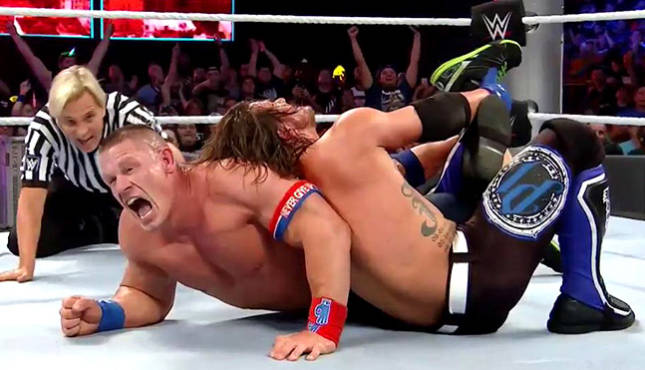 Image Credit: WWE

Welcome guys, gals, and gender non-binary pals.
Through Hel Stryer and brimstone . . . it’s Ask 411 Wrestling!
I am your party host, Ryan Byers, and I am here to answer some of your burning inquiries about professional wrestling. If you have one of those queries searing a hole in your brain, feel free to send it along to me at [email protected]. Don’t be shy about shooting those over – the more, the merrier.
Hey, ya wanna banner?

Tyler from Winnipeg is crying uncle:
Gunther has claimed Cena hasn’t tapped out to anyone . . . is this fact?
It is fiction.
I note that I received this question in between the Wednesday, December 10 edition of this column and Saturday Night’s Main Event on December 13, when Cena and Gunther are wrestling each other in the former’s retirement match. Therefore, it’s entirely possible (and I would say likely) that by the time you are reading this, you have all seen Cena tap out to Gunther himself.
However, assuming that happens, it will not be the only time Cena has tapped out.
I am not preparing a comprehensive list of every Cena submission over the years, because that wasn’t the question, but here are a handful of examples, including what I believe is every WWE main roster submission loss for the Dr. of Thuganomics.
First, for an early example of Cena tapping, we go to January 30, 2002 in Louisville, Kentucky where John Cena, still known under his initial ring name of Prototype, wrestles Ron “H2O” Waterman. Waterman catches Cena in an ankle lock, and Cena taps out . . . though manager Kenny Bolin has distracted the referee, so it doesn’t actually count as a loss.
Moving to the main roster, on the episode of Smackdown taped on July 2, 2002 but aired on July 4, Chris Jericho and John Cena met in a singles match. This is back when Cena was still a generic blue chipper, pre-white rapper gimmick. In other words, he had nowhere near the status he does now. As a result, he wound up tapping to the Walls of Jericho.
On December 2, 2003 in San Jose, California, Chris Benoit tapped out John Cena with the Crippler Crossface on another episode of Smackdown. This was a number one contenders match for Brock Lesnar’s WWE Championship.
This bring us to Kurt Angle. He is, to my knowledge, the only man to make John Cena tap out more than once. The first time occurred on October 19, 2003 at that year’s No Mercy pay per view in Baltimore, Maryland. The second occurred on February 15, 2004 in San Francisco’s Cow Palace at the No Way Out pay per view, when Cena submitted to the ankle lock in a triple threat match also involving the Big Show.
But wait, there’s one more! Kinda . . .
On the October 24, 2005 episode of Monday Night Raw from Fresno, California, Kurt Angle again wrestled John Cena, this time in a match with Mick Foley as special referee. When Foley was taken out by Carlito Caribbean Cool, heel general manager Eric Bischoff hit the ring in a ref’s shirt and took over officiating. Angle trapped Cena in the ankle lock. While Cena was reaching for the ropes to force a break, Bischoff grabbed his hand and tapped it on the mat, then calling the match a submission victory for Angle.
Was it a clean tap? No, but Eric Bischoff would definitely say it counts . . .
Donny from Allentown, PA is blurring lines:
I have been watching a lot of WWF TV recently from 1987 shortly after Wrestlemania III and was quickly reminded how heavily the WWF was pushing at the time the whole Ken Patera/prison storyline. But in fact it was not a storyline. It was truth. Was this in your recollection the first time ever a real life situation involving wrestling talent was used on screen to further an angle? The only other one I could think of was Magnum T.A.’s car wreck in 86 that turned Nikita Koloff babyface.
Nah, real world situations have been incorporated into professional wrestling for as long as there has been professional wrestling.
I don’t know if it’s definitively the first instance, but one very early instance that I can think of is the world championship feud between Ed “Strangler” Lewis and Joe Stecher.
In 1924, Lewis held the world championship of a company promoted by himself, Bill Sandow, and Joseph “Toots” Mondt, collectively referred to as the “Gold Dust Trio.” Lewis was a well-established star by this point, and the Trio wanted to create another star by having a former football player named Wayne Munn defeat the Strangler for the world title.
Munn did, in fact, defeat Lewis on January 8, 1925, becoming the new world champ. On April 15, 1925, Munn was scheduled for a title defense against Stanislaus Zbyszko. Unfortunately for Munn, Zbyszko was a legitimate wrestler and was frustrated with having to continually put over guys like Munn, who was pushed heavily by the Gold Dust Trio because of his star power and not because of his in-ring talent. As a result of that frustration, Zbyszko shot on Munn in their April 15 bout and won the world championship despite that not being the planned finish.
Zbyszko had effectively stolen the world championship that belonged to the Gold Dust Trio, and there wasn’t anything the Trio could do about it publicly, because nobody involved in wrestling at that point wanted to admit that it was anything other than a legitimate sport.
Ultimately, Zbyszko decided to sell the world championship he had stolen to Joe Stecher, who at the time was a huge star in his own right but operated outside of the promotion established by the Gold Dust Trio.
Throughout the mid-1920s, Stecher and Lewis would trash talk each other in newspaper interviews, but it wasn’t in the form of two wrestlers working a kayfabe feud with one another. Yes, there was an element of kayfabe to it because they had to keep up the pretense that wrestling was legitimate, but really the basis of their ill will was the legitimate promotional rivalry and heat over what Zbyszko had done.
Eventually, though, the two men did come together and wrestle a series of matches between 1928 and 1929, putting their real world war of the words into good use in building the bouts.
Bryan has his ups and downs:
Is it possible for a wrestling card to be too good for its own good? I mean is there a legit need for duds or squashes to give the audience a breather? People talk about “stealing the show” at Wrestlemania, but if everyone does that does it cancel out? Even I forget that matches on a card don’t exist in a vacuum. There’s a finite level of audience energy. Can a “popcorn match” be a good match, and furthermore SHOULD it be good?
Go watch a movie, read a book, or engage with any other piece of non-wrestling entertainment media. Are any of them at their 100%, highest point of excitement for their entire duration?
No, they’re not. The Avengers don’t start fighting Ultron in minute one of the movie, and it doesn’t carry on for two-and-a-half solid hours. Freddie Krueger doesn’t crack wise and murder somebody every thirty seconds. A Song of Ice and Fire isn’t all dragons, all the time.
Wrestling should be the same way. You’ve got to pace yourself. You’ve got to have ups and downs and things have to breathe. That doesn’t mean you have to have matches that are actively bad per se, but you you should pepper in matches that are a bit slower paced a bit less hard hitting so that fans can recharge their batteries and so that your highs on the show seem all the higher. If everytihng is special, nothing is special.
Nick is advancing to the head of the class:
What are the criteria for WWE to have certain debuting wrestlers bypass NXT by going straight to the main roster instead? Recent examples include Penta and Rey Fenix.
I don’t believe that there are hard and fast criteria. Obviously, you’re going to have to have quite a few years under your belt as a wrestler. With certain rare exceptions (e.g. Dominik Mysterio or celebrities), WWE isn’t going to put somebody who has just a match or two under their belt on main roster television.
However, years in the business isn’t the only consideration. You’re also usually going to have to have experience working on a United States-based television product. Just ask Shinsuke Nakamura, who came to WWE with 14 years of doing high level matches in New Japan. Yes, he had that experience, but wrestling in Japan is much different than wrestling in WWE, so time in developmental to help him figure out how to play to cameras and position himself towards a hard cam was still helpful. Penta and Fenix already had that experience thanks to Lucha Underground and AEW.
Of course, sometimes a wrestler checks all those boxes (e.g. Bobby Roode) and still spends some time in NXT anyway. That’s why I say there are no hard and fast criteria. It seems to be a determination made on a case-by-case basis.
Night Wolf the Wise deserves his flowers:
We all know the classic wrestling feuds that stay in our mind forever because of how great they are: Austin vs Rock, HBK vs Bret Hart, Von Erichs, Vs Freedbirds, so on and so forth. In your opinion, what are some wrestling feuds that are underrated that don’t get talked about more often. Keep in mind you can choose any wrestling company and any era of wrestling
I think WWE fans sleep on Hulk Hogan versus Paul Orndorff, which was more important to the birth of Hulkamania than a lot of people give it credit for. Hogan versus Orndorff was the Hulkster’s first major feud after he defeated Iron Shiek for the WWF Championship, and Hogan/Ordorff singles matches became one of the biggest drawing programs of the champ’s career. Plus, they came back with it a second time in 1986 after brief face turn for Mr. Wonderful, and it had another healthy run there.
However, the problem is that there was never a huge blowoff match between the two men on pay per view, and so much of the history of the WWF as the company has written it minimizes anything that happened outside of PPV – even when it comes from a period when house shows were still the company’s primary means of generating revenue.
Really, when it come to Hogan opponents, Paul Orndorff deserves to be remembered alongside names like Randy Savage and Andre the Giant, but I don’t hear most fans talking about him in that regard.
Tony R. is a believer:
I have a question about the best sell job you have seen in a single match. One where you thought the wrestler was legit injured because of how well they sold. Was just watching WM and thought Hogan’s knee was legit injured versus the Warrior this the question.
October 28, 1986, Binghamton, New York. Aired on WWF television the weekend of November 22, 1986. Randy Savage. Ricky Steamboat.
Coming off the top rope, Savage slams the ring bell down on Steamboat’s throat and supposedly crushes it, helping to set up the match between the two which is well-remembered as part of Wrestlemania III. The Dragon’s selling of this injury angle was a master class. It is selling an injury which is almost never seen in wrestling and, even though it’s something he would not have a lot of experience doing, Steamer still found a way to make it look realistic to the point that, well into the 2000s, I was running into people who thought it was legitimate in some way. In fact, I had a friend in school who SWORE Steamboat’s throat turned purple and swelled up, even though you couldn’t employ those sorts of special effects in that context. It was a false memory no doubt created in part by how great the selling was.
My second thought is a few years older, taking place on April 6, 1981 in the legendary Mid-South Coliseum in Memphis, Tennessee. Jerry Lawler faces Terry Funk in an empty arena match. Late in the bout, Lawler takes a sharp fragment of a shattered wooden chair and jams it in to Funk’s eye, supposedly “blinding” him and causing him to writhe around on the mat yelling “My eye! My eye!” in a manner that only the Funker could. This one was particularly compelling because Funk was actually the heel in the match, and he managed to pull off this unique performance in such a way that you did feel some degree of sympathy for him but not in a manner that resulted in Lawler turning heel or Funk turning face. It didn’t feel like something within the traditional good guy/bad guy dynamic. It felt like something that really would happen in a legitimate fight or combat sport where things were taken just a step too far.
I also could have said something generic like “Ricky Morton’s entire career,” but those two specific moments are so ingrained in my mind that I felt they were better answers to the question as worded.
YZ isn’t entirely on the level:
At what point did wrestling become scripted/predetermined? How did it happen and do we know why promoters did this? Was Greco-Roman wrestling scripted? How did kayfabe come to live for so long and what broke it?
Wrestling match outcomes first became predetermined in the late 19th Century. At first, not every match on a show may have been predetermined, but certain key bouts were. Over time, we progressed to the point that every outcome was decided in advance.
Why did it happen? Gambling. Basically, less than scrupulous promoters realized that people were betting on matches and they could pocket a lot of cash themselves if they controlled what the outcomes of the contests were. Even once the gambling element fell by the wayside, wrestling remained predetermined because worked matches are just flat-out more entertaining than legitimate bouts, which involved a lot of laying around in holds.
As far as breaking kayfabe is concerned, newspaper accounts of wrestling matches were calling them out for being fixed almost immediately after they became fixed. However, the first major exposure of the business was probably the 1937 book Fall Guys, which was penned by a sportswriter named Marcus Griffin.
We’ll return in seven-ish days, and, as always, you can contribute your questions by emailing [email protected]. You can also leave questions in the comments below, but please note that I do not monitor the comments as closely as I do the email account, so emailing is the better way to get things answered.


