
wrestling / Columns
Ask 411 Wrestling: What Gimmick Matches Did Cena and Orton Never Face Each Other in?
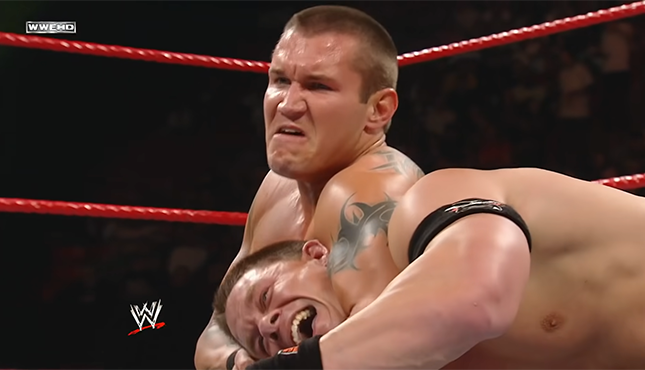 Image Credit: WWE

Welcome guys, gals, and gender non-binary pals, to Ask 411 . . . the last surviving weekly column on 411 Wrestling.
I am your party host, Ryan Byers, and I am here to answer some of your burning inquiries about professional wrestling. If you have one of those queries searing a hole in your brain, feel free to send it along to me at [email protected]. Don’t be shy about shooting those over – the more, the merrier.
Hey, ya wanna banner?

Joe is proving a negative:
I was thinking with the last showdown between John Cena and Randy Orton, inspired by Michael Cole’s pre-bout spiel, at what major shows and in which match types have they not competed against each other?
As far as major shows that were available to appear on during their careers are concerned, the Legend Killer and the Doctor of Thuganomics have never wrestled each other at a Survivor Series (they’ve teamed there but never wrestled), a King of the Ring pay per view (they did face each other on a King of the Ring themed episode of Raw), a Bad Blood, a Fully Loaded, a Judgment Day, a No Mercy, an Armageddon, a Great American Bash, a Taboo Tuesday/Cyber Sundy, an Extreme Rules/One Night Stand, a Payback, a Fastlane, a Roadblock, a Crown Jewel, a Super Showdown, or a Clash of Champions.
Cross-referencing a listing of Cena and Orton’s matches with Wikipedia’s “pro wrestling match types” article tells us that we have never seen the two generational rivals compete in the following matches. Note that I’m trying only to include matches that have occurred somewhat regularly or are otherwise noteworthy, excluding one-off or more obscure indy-based bouts. Also, I’m not including bouts where different names are used for more or less the same thing. For example, for our purposes here a hardcore match, extreme rules match, and no holds barred match are all the same thing.
Here goes:
Blindfold Match, No Count Out Match, Pure Wrestling Rules Match, Raw Underground, Battlebowl, Bunkhouse Stampede, Cinematic Match, Ambulance Match, Buried Alive Match, Body Bag Match, Casket Match, Dumpster Match, Last Ride Match, Barbed Wire Match, Electrified Steel Cage Match, Inferno Match, Lion’s Den Match, Punjabi Prison Match, War Games, Flag Match, Explosion/Time Bomb Match, Falls Count Anywhere Match, First Blood Match, Last Man Standing Match, Texas Death Match, Thumbtack Match, Boiler Room Brawl, Empty Arena Match, Parking Lot Brawl, Lumberjack Match (Cena & Orton once teamed in a Lumberjack Match but have never fought in one), Beat the Clock Match, Best Two Out of Three Falls Match, Three Stages of Hell Match, Crybaby Match, Kiss My Foot/Ass Match, Loser Leaves Town Match, Luchas de Apuestas, Tuxedo/Evening Gown/Bra and Panties Match, Submission Match, Mud/Pudding/Gravy Match, Tornado Match, Mixed Tag Team Match, Intergender Tag Team Match, Parejas Inreibles Match, Chairs Match, Country Whipping Match, Fans Bring the Weapons Match, Handcuff Match, Pole Match, Strap/Chain/Bullrope Match, Lingerie Pillow Fight, Straightjacket Match, Dog Collar Match, Stretcher Match, Taped Fist Match.
James knows there’s never been a right time to say goodbye:
Do you have a list of performers that have received a 10-Bell Salute in memorial of their passing? I do not recall any other promotion other than WWF/WWE having had any similar tributes, but I would interested in learning how many have received the 10-Bell Salute from over the years in addition to whomever was the first performer to receive one.
So I don’t often answer questions this way, but let me start by directing you to Wikipedia’s article on the ten-bell salute to answer much of your question. It contains a listing of most significant ten-bell salutes that have occurred on wrestling television since the 1990s as well as a couple from the 1980s.
That being said, the Wikipedia article answers much of your question and not all of your question. That’s because the article, like a lot of wrestling content on Wikipedia, sadly ignores a lot of wrestling history prior to the Hulkamania era.
Thus, I’m going to try to fill in some of that history, to the extent I can.
It is hard to say exactly when the tradition of the ten-bell salute began. It was most likely inspired by military gun salutes, in which cannons or other artillery were fired off as a means of celebration or honoring dignitaries, alive or dead. The most popular of these was the 21-gun salute. Most sources indicate that gun salutes go back as far as the Fourteenth Century.
It is also worth noting that the ten-bell salute is not unique to pro wrestling, as it also has a history in pro boxing.
As noted above, it is difficult to definitively say who received the first ever ten-bell salute. Jim Cornette was once asked on his podcast about the history of the ten-bell salute, and he couldn’t necessarily identify its origins either but did state that the practice was one that went back “decades.”
The first ten-bell salute that I was able to find record of was on March 22, 1977 at a WWWF television taping in Philadelphia, which was to honor “Argentina” Antonino Rocca following his death on March 15. The show was taped and aired on March 26. Rocca, for those who might not know, was a wrestler in the 1950s and really the first top attraction for the McMahon family in Madison Square Garden. He had also been a WWWF television announcer very recently prior to his death.
Tyler from Winnipeg only sends in hardcore questions:
Only counting the original ECW, of Extreme Championship Wrestling, which people did play by play or color commentary during its run?
By my count, there were twenty-one different people who did announcing for ECW when it ran on its own promotion as opposed to being a WWE-produced television show.
The first announce team in ECW history predates their becoming “extreme” and took to the airwaves when the company was just Eastern Championship Wrestling. They were Jay Sulli on play by play and Steve Wonderful on color. You can see a quick clip of them in action here. As near as I can tell, Sulli never did anything in wrestling before or since, though his time in ECW did also get him one credited match, as he participated in a battle royale on ECW UltraClash 1993 in which all the other competitors were either women or male managers.
Wonderful recently did a six hour long livestream with the guy who used to be Chubby Dudley. I can’t be bothered to watch all of that, but the first bit did explain how Wonderful got into wrestling, and surprisingly his first connection was with Otto Wanz in Austria who Wonderful ran into when he was serving in the U.S. military in Germany. Wonderful was a musician who got some basic wrestling training in exchange for composing music for Wanz’s shows, and then he did the same thing for American indy promoter Joel Goodhart when he got back to the U.S. Eventually, that grew into work as an announcer and a wrestler. He stopped appearing on ECW television because he got a gig with WCW as a local promoter, which he worked in during 1992 and 1993.
You also had some wrestlers coming in for periodic commentary in that Eastern Championship Wrestling / early Extreme Championship Wrestling era, with Terry Funk, Eddie Gilbert, and Don Muraco all taking turns. ECW promoters Tod Gordon and Paul Heyman, at the time still called Paul E. Dangerously also got on the mic in the company’s early days.
Joey Styles eventually showed up in the summer of 1993, and he was obviously the voice of the promotion from that point onward, until its closure in spring of 2001.
A few wrestlers would also join Styles in the commentary from time-to-time, including “The Sexiest Man Alive” Jason, The Rockin’ Rebel, Tony Rumble, and Shane Douglas.
Matty in the House was mostly a backstage interviewer for ECW in its early days, but he did get on commentary once in a while. Matty’s real name was Matt DeMatt, who also had a bit of an acting career after his time with ECW came to an end. He was mostly just a background actor, with the most significant project he took part in probably being Leon: The Professional.
Another announcer who handled a few shows for the Dub but couldn’t eclipse Joey Styles in terms of popularity is Bob Smith. Outside of his on camera appearances for ECW, Smith was a wrestling photographer who worked his way up to being the editor of Pro Wrestling Illustrated for a time. While he was working for the magazine, he came up with the idea of the PWI 500 and put together the first several installments of the 500.
For a period of time during the summer of 1994, Joey Styles had a falling out with ECW, and the replacement was a gentleman who worked under the name Willie Watts, though his tenure was very short-lived. I have not been able to find any details about who Watts was or his background. However, as you may have guessed, his on air name was based on that of Cowboy Bill Watts. Willie Watts was a Black man, and Paul Heyman, who had heat with Bill Watts going back to their shared time in WCW, chose the Willie Watts name for his new Black announcer as a reference to the longstanding rumors that Cowboy Bill had some racist tendencies. Apparently Willie Watts was not well thought of during his short run, as he picked up several votes in the 1994 Wrestling Observer Newsletter awards in the “Worst Television Announcer” category, though that distinction was ultimately won (?) by Gorilla Monsoon.
Other wrestlers who came in for guest commentary during the later days of ECW included ”Pitbull” Gary Wolfe, Tommy Dreamer, and, yes, even Kurt Angle when he first dipped his toe into the water of pro wrestling after winning his Olympic gold medal. (Angle on commentary at this time was really, really bad by the way.)
The last three names I have to mention I will not go into a lot of background on, because I suspect our readership is very much familiar with them. They are Rick Rude, Joel Gertner, and Cyrus, or Don Callis as we know him now.
To the best of my knowledge, those are all of your ECW announcers.
Stromi is here for his roses:
Not counting the Slammys, how often has the WWF/E had a Manager of the Year voting angle? I can think of two.
Yeah, I’ve counted two as well.
The first was in 1977, and voting was supposedly conducted through Wrestling Action magazine, the official publication of the WWWF. Interestingly, on at least some shows it was stated that any manager from anywhere in the wrestling world was eligible, which lead to guys like Roddy Piper and Oliver Humperdink getting name-checked on WWWF programming even though they were not in the territory at the time. In reality, the only contenders were the Federation managers, at the time consisting of the Grand Wizard, Arnold Skaaland, Freddie Blassie, and Lou Albano. As the sole babyface in the group, it only made sense for Skaaland to win, which he did. Afterwards, Albano attacked Skaaland, which lead to a match between the two on the December 19, 1977 Madison Square Garden show, which Skaaland again won.
A similar angle was run again in 1985, with the contenders being Freddie Blassie, Mr. Fuji, Hillbilly Jim, Johnny V, Lou Albano, and Bobby Heenan. Albano and Hillbilly were babyface managers at the time, while the rest were heels. When it came time to announce the winner, the Brain revealed that he had gotten the other bad guys to all pledge their votes to him, which made him the winner. However, at the last minute, Hillbilly Jim realized that if he pledged his votes to Albano, then Captain Lou would win. That’s exactly what happened, and Cap was declared the victor. An enraged Heenan Family laid out Albano and Jim until the remainder of the hillbilly family made the save, setting up a feud between the two factions.
Somewhat oddly, this angle ran at the same time all the managers in the WWF were vying to become the manager of “Macho Man” Randy Savage before he ultimately debuted Miss Elizabeth to lead his career, which is two pretty heavily manager-forward stories at the same time.
Bryan plays a symphony of destruction:
We’ve all had a good laugh about the late Hulkster’s tall tales about being in Metallica and their denial, but has the band’s most famous real former member ever commented on it? I read his book twice, Hogan’s not mentioned do you know if he’s ever commented on it?
I believe that the former member of Metallica that Bryan is referencing is Dave Mustaine, and, no, I’m not aware of Mustaine ever having commented on Hogan’s claims about his almost joining the band.
Move along, Richard U.. There’s nothing to see here:
You have talked about “lost media” in the last couple columns. Those conversations always remind me of the very first PWI Match of the Year. In 1972, it was won by a Bruno Sammartino Battle Royale in Los Angeles. Several times over the years I have searched for information about this match on the Internet with almost no results. I have seen every other year’s winner on YouTube, but not this one. There seems to be no footage or even any real information about it. Do you have anything?
Somebody did write in to the column back in 2023 asking if there was any footage of the match. I looked into it then, and the answer was “no.” I’m also not aware of anything having surfaced in the intervening two years.
However, Richard didn’t just ask about footage. He also asked if there was any other information out there about the match, and I’m pleased to report that there is.
First off, the bout took place in the Olympic Auditorium in Los Angeles, California on January 14, 1972, which at the time was promoted by Mike LeBell as part of his southern California territory. Cagematch reports that there was an attendance of 11,292 fans. The results listed there and in other, similar databases that I could find do not mention the names of other competitors, just listing it as Sammartino winning a 22-man battle royale. It’s worth noting, though, that the battle royale was the last match of the evening and there were 22 men in all the bouts earlier on the card, so it seems like a reasonable assumption that the 22 men in the battle royale were the same 22 men who wrestled earlier in the evening. (Sammartino’s earlier match on the card saw him defeat Kinji Shibuya in singles action, for whatever that’s worth.)
But wait, there’s more!
Though I am not aware of any video existing, the match was documented in another way, being the subject of the cover story of the May 1972 edition of the magazine creatively entitled The Wrestler. You can find the entire issue online at the Internet Archive if you are so inclined.
I’m going to summarize the information about the match provided by the magazine, but I want to say that it should be taken with a grain of salt. These magazines wrote about wrestling from a kayfabe perspective, and they were not above creating their own embellishments to make stories a bit more exciting or suited for print.
One such claim in the magazine that I suspect is an embellishment is a claim that 25,000 fans were turned away when trying to buy tickets for the event at the door. That seems unlikely. However, I don’t doubt that the match was a huge deal, because it was Bruno’s first appearance in southern California in roughly five years, and he was one of the wrestling world’s top attractions at the time.
The magazine also notes that this was Sammartino’s first-ever appearance in a battle royale, which on its face seems ridiculous given that he had been wrestling all over the world for 13 years at this point. However, looking at available records, there does not seem to be a prior recorded instance of the Living Legend stepping foot into this sort of match.
The article names the following men as additional competitors in the battle royale: 1) Rocky Johnson, 2) Mil Mascaras, 3) John Tolos, 4) Kenji Shabuya, 5) Earl Maynard, 6) Masa Saito, 7) Black Gordman, 8) Goliath, 9) King Krow, 10) Cowboy Frankie Lane, 11) Raul Mata, 12) Francisco Flores, 13) Salvador Lothario, 14) Wildman Armstrong, 15) Peace Brother #1, 16) Haystack Calhoun, 17) Dutch Savage, 18) Dory Dixon, 19) Pantera Negra, 20) Tony Rocco, and 21) Ripper Collins.
For what it’s worth, this list matches with my theory that the competitors in the battle royale were just the same 22 guys who wrestled earlier on the show, as every one of these fellows had an undercard bout.
From there, the article goes into a play-by-play of the match, which could be totally fabricated or a legitimate account for all I know. There are several photographs of the match, which I have an easier time believing are legitimate than the narrative.
And that’s really all the background on the match that I’ve got. I suspect it’s selections as MOTY actually has a lot to do with its magazine coverage, as otherwise there would be a relatively small amount of people nationwide who were familiar with it.
We’ll return in seven-ish days, and, as always, you can contribute your questions by emailing [email protected]. You can also leave questions in the comments below, but please note that I do not monitor the comments as closely as I do the email account, so emailing is the better way to get things answered.
More Trending Stories
- Backstage Update on WWE Tryout Invitee Being on TNA’s Radar
- Gangrel Recalls Vince McMahon Using His Blood Spray Entrance To Rib Donald Trump
- Backstage Update On WWE Leadership and Triple H’s Status Following JPMorgan Stock Report
- Several Recently Released WWE Wrestlers Reportedly “Waiting to Sign” With AEW


