
wrestling / Columns
Ask 411 Wrestling: Should Randy Orton’s Social Media Persona Be Used on WWE TV?
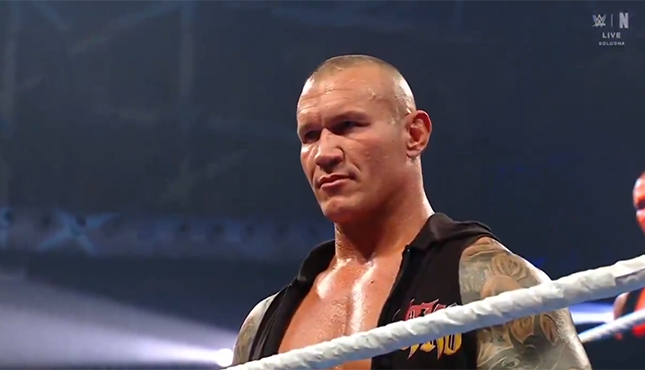 Image Credit: WWE

Welcome guys, gals, and gender non-binary pals.
Through Hel Stryer and brimstone . . . it’s Ask 411 Wrestling!
I am your party host, Ryan Byers, and I am here to answer some of your burning inquiries about professional wrestling. If you have one of those queries searing a hole in your brain, feel free to send it along to me at [email protected]. Don’t be shy about shooting those over – the more, the merrier.
Hey, ya wanna banner?

A Different Ryan has rose colored glasses on:
Just watched the WWE vault match between Hogan and Savage from London. Hogan actually got physical with Sherrie, slamming her into the ring apron twice (and into Savage, too). As a kid I don’t recall babyfaces ever getting physical with female valets. Am I misremembering?
Nah, you’re totally misremembering. When Sherri was in the WWF, she was bumped around by the male babyface wrestlers on the regular. I recall Hogan attacking her in multiple matches, including after the main event of Summerslam 1989 when he gave her an atomic drop to set up a loaded purse shot from Miss Elizabeth. The Ultimate Warrior also got his licks in on Sherri during the time that he was feuding with Randy Savage, including in the video linked above.
This carried over to WCW, too, because Sherri was paired with Ric Flair when Hulk Hogan first joined the promotion. Hogan got his smacked her around in that company as well.
Jaimoe is a nice guy once you get past his hardened exterior:
Would Randy Orton have been even bigger if he was allowed to show his social media personality on WWE television?
I don’t follow a lot of wrestlers on social media, so I have to say that originally I wasn’t sure what was meant by Randy Orton’s social media personality. However, having done some investigation, I’ve learned that in the past few years he has developed a reputation for reaching out and being supportive of fans who are struggling with various issues, particularly mental health.
I do think there would be a way to work that into his character that would be beneficial, but you would have to be rather careful with it so as to not make it seem as though he is exploiting people who are reaching out to him in good faith. However, this is something that Orton only became known for within the last couple of years, when he was already well-established as a star in the wrestling world. As a result, I don’t know if this could make him a bigger star given the height he’s already achieved.
Shaun feels like he’s seen this one before:
Has anyone beaten the same person for a World Championship in two or more companies?
I was not able to find any instances of this happening, though I’m open to being corrected in the comments if anybody has contrary information.
In fact, there aren’t even that many instances in which somebody has beaten the same person for a world championship in two different companies.
Hulk Hogan did beat Randy Savage for the World Title in both the WWF and WCW, while Savage and Ric Flair both beat each other for the top prize in those same two promotions.
Another pair that I was not expecting to see at all before I started doing research was Dolph Ziggler and Alberto Del Rio. Del Rio defeated Ziggler for the 2002-2013 version of the World Heavyweight Championship in WWE back in 2013, and then Alberto also beat Ziggler for the AAA Mega Championship in 2024.
Tyler from Winnipeg is doing a dramatic slow climb:
What is the absolute best Money In The Bank match?
Honestly, it’s hard if not impossible for me to rank Money in the Bank matches because they all blend together in my mind. I don’t think that the wrestlers who have been involved in them over the years have done all that much to make them stand out from one another.
Bryan hopes the smoking man’s in this one:
Season 7 of the X-Files had an episode called Fight Club (no relation to the movie) and had Mulder and Scully investigate some paranormal stuff surrounding an over the hill wrestler played by Randal “Tex” Cobb and RVD had a small role as his opponent. Why would a TV show have a plot about pro wrestling and not cast a real pro wrestler as the lead? Roddy Piper and Terry Funk would have been perfect.
I don’t know if you have seen the episode but it missed an interesting opportunity to have Mulder point out the need to believe wrestling is similar to his own need to believe in aliens.
Now I’m just picturing a wrestling poster featuring David Wills saying “I still believe” in the style of Mulder’s iconic “I want to believe” poster.
Anyway, I was not able to find anything specific about the casting choices made for this particular episode of this particular show, but there are any number of reasons that a popular television program would cast a non-wrestler as a wrestler, including but not limited to availability of wrestlers who were good for the part or those in casting feeling that the non-wrestlers had better acting chops.
After all, it’s not like you always need a wrestler to play a wrestler. That’s certainly not the direction Darren Aronofsky went for The Wrestler or how casting worked out for The Iron Claw, and when the wrestling-themed sitcom Learning the Ropes was created in the late 1980s, retired football player Lyle Alzado was casted as the main character wrestler/rather than any real in-ring performers. (Though “Dr. Death” Steve Williams doubled for Alzado under a mask for any wrestling scenes.)
If you do want to see a wrestler on an episode of The X-Files, watch Season 3, Episode 20 in which Jesse Ventura appears as one of the mysterious “men in black” often associated with UFO encounters. There was also an interesting choice to play Ventura’s partner in the MIBs.
If you said, “Who is Alex Trebek?” then you are correct.
Scott from Scotland is a replica of a girl I know:
Has anyone since Chris Benoit won a match with a Crossface? I know after a wrestler that has a move as a finisher is no longer active that move drops several levels to just a transition move (excluding Saint’s utterly uninspired tornado DDT that makes a mockery of Jake’s) but did what Benoit do hasten this submission into transition move territory quicker than normal?
What did Benoit do to hasten his finisher becoming a transition move?
He killed his wife and child and then himself.
I don’t mean to be flippant about that. It’s the answer to the question. With Benoit having disgraced himself in just about the biggest way possible, people are going to care a lot less about his legacy – and they SHOULD care a lot less about his legacy.
Has anybody used the move to win a match since his death? Yes, absolutely.
Bryan Danielson and Sasha Banks both regularly used the move as their finisher, as the LaBell Lock and the Bank Statement, respectively. Ditto KENTA, who used the Game Over. If you want to be really pedantic, you’ll tell me that Danielson and KENTA trap the arm differently than Benoit and Banks doesn’t trap the arm at all, but overall the moves look enough like what the murderer did that they’re the same thing for purposes of this question.
However, if you want to limit it to the exact same move with the exact same arm trap, the answer is still yes. Yuji Nagata has used what American fans would identify as the Crippler Crossface for a very long time, but he calls it the Nagata Lock II. He used it as a finisher before the Benoit tragedy, and he’s continued to use it as a finisher after the Benoit tragedy.
My cat’s name is Ignacio:
The NWA World Title had some of the biggest names in pro wrestling. Ric Flair, Harley Race, Giant Baba, but since NWA became smaller, the names aren’t that big neither. Gary Steele, Mike Rapada, Kahagas. Can you gave us a who-is-who of the NWA World champions between 1994 (Douglas rejects the title) and 2017 (Corgan buys NWA and Aldis wins the title), to understand who are these names forever linked to the history of NWA (not counting NWA-TNA period, of course).
You want me to provide biographical information about somewhat obscure indy wrestlers?
Yeah, you’re just playing right into my hands here, buddy.
The first NWA Champion after the Shane Douglas incident was Chris Candido. I think that everybody reading this knows who Candido is, so I’m not going to spend that much time on him. However, for the sake of completeness, he was an ECW mainstain and eventually a Bodydonna in the WWF. Later on he had a largely forgotten Cruiserweight Championship reign in WCW before substance abuse issues stalled his career. He did have a bit of a feel good run in the early days of TNA after cleaning himself up, but sadly he died at the age of 33 from complications arising from surgery to repair a broken leg suffered in the ring.
Candido’s reign was ended by Dan Severn, and, according to the March 6, 1995 Wrestling Observer Newsletter the title change was fairly abrupt because the belt needed to come off of Candido before he started his run with the WWF. It occurred on a Smoky Mountain Wrestling show in the 19,000 person town of Erlanger, Kentucky in a match that wasn’t even promoted in advance. Severn was a decorated amateur wrestler and, though many people think of him as a UFC fighter who got in to pro wrestling, he was actually a pro wrestler first, starting with the Japanese promotion UWF-I in 1992. On the strength of his amateur record, he was brought into the Ultimate Fighting Championship beginning with UFC 4 and became one of the early stars of the promotion. His NWA Title run lasted for four years between 1995 and 1999, during which he alternated between shoot fights and pro wrestling appearances.
The next man to hold the championship was Naoya Ogawa. Ogawa started his combat sports career as a judoka and won several world championships in that sport in addition to a silver medal at the 1992 Olympics. Following his judo career, Ogawa was approached by Antonio Inoki, who pulled him in to professional wrestling for a project that Inoki called Universal Fighting-Arts Organization or UFO for short. (Somewhat coincidentally, in 2015 during his time as a politician, Inoki questioned the Japanese military about their history with unidentified flying objects or UFOs.) UFO was originally a shoot-style side project of sorts for New Japan Pro Wrestling but became its own promotion when Inoki had a falling out with NJPW. Around the same time, Howard Brody was the president of the NWA, and he was allegedly looking to shake things up with the championship because he felt Severn being used as a midcarder in the WWF while NWA Champion had hurt his credibility. So, he put together a deal with Inoki in which Ogawa would take the belt for a period of time.
From Japan we went to the United Kingdom, as Gary Steele is the man who unseated Ogawa. This is perhaps one of the more obscure names on this list as, outside of a couple of trips to Japan and this NWA Championship victory, Steele really was just a British indy guy who was active from the mid-1990s through the early 2000s. I frankly couldn’t even find anything about the politics of why he became champion, though if I had to take an educated guess it would be throw his home promotion at the time – UK Hammerlock – a bone because they were an NWA affiliate and this would be their one shot to say they had a British world champion. Steele’s reign only lasted about a week, as he won the belt during the NWA 51st Anniversary Show in Charlotte, North Carolina on September 25, 1999 and lost it right back to Ogawa on October 2, 1999 at an indy show which I believe was promoted by Tony Rumble in Thomaston, Connecticut. I am guessing that nobody in Thomaston that night had any idea who Naoya Ogawa or Gary Steele were.
Ogawa’s second reign with the championship lasted until July 2000, when he vacated the belt. According to the July 10, 2000 Wrestling Observer Newsletter, Ogawa gave a press conference in Japan where he stated that he needed to give up the championship to focus on an upcoming shoot fight against Rickson Gracie. However, the Observer reported that this was a bit of a break with what Ogawa and the NWA originally agreed to. The first plan was for Ogawa to go to England that summer to drop the belt back to Gary Steele, but Ogawa pulled out of that, supposedly due to a shoulder injury. (The injury was real but whether it actually prevented him from taking the match sounds more questionable.) When that bout fell through, the plan shifted to Ogawa vacating the title due to the injury, but when it came time to vacate he never said anything about the injury but just talked about the Gracie fight, which make sense if you’re Ogawa because that is where your next big payday is coming from, even if it does violate your deal with the NWA.
With the championship being vacated, the NWA decided to hold a one-night tournament for the title on September 19, 2000 on a show promoted by NWA Florida in Tampa. I’m not going to lie, this may have been the saddest tournament in recorded history. The announced competitors were Greg Valentine, Dean Malenko’s brother Joe, “Colorado Kid” Mike Rapada, Hector Guerrero, “Cuban Assassin” Fidel Sierra, Jerry Flynn, Stone Mountain, and Kendall Windham. As of the year 2000, six of those eight men had been on WCW television as straight up job guys in the preceding two years, and the other two were Joe Malenko and Stone Mountain, the former of whom had very little exposure in the U.S. and the latter of whom I literally never heard of until researching this column.
However, the world’s saddest tournament only got sadder, because Valentine and Malenko, who were set to wrestle each other, both couldn’t make the show at the last minute, Malenko due to a surgery and Valentine due to a travel issue. So, their match was declared a double forfeit. Windham and Mountain then wrestled to a double count out, which means that what was an eight-man tournament effectively became a four-man tournament with Rapada defeating Guerrero and Flynn defeating Sierra in the first round, followed by Rapada going over Flynn in the finals to become the new NWA World Heavyweight Champion.
But just who is Mike Rapdada, exactly? Also known as the Colorado Kid, he grew up in that state and after some limited training elsewhere really got his start in Memphis with the USWA in the mid-1990s. He was largely just a southern indy guy, though as previously noted he did get a few shots with WCW working as a security guard and an enhancement wrestler. In 1998 in Music City Wrestling, he did win the NWA North American Title, the same title Jeff Jarrett held on WWF television during the ill-fated NWA invasion angle. It was there that NWA officials would have developed a positive opinion of Rapada and ultimately decided to make them their heavyweight champion, as he had some regional cache in the south even if he was not a nationally known name.
Rapada did drop the title to Sabu for a little less than a month in late 2000, but you all know Sabu, so I’m not going to do a huge write-up on him. The Colorado Kid then regained the championship, becoming a two-time NWA World Heavyweight titleholder.
Rapada’s second reign was ended by Steve Corino. Most reading this will remember Corino from ECW, where he was initially a quasi-manager/quasi-wrestler, almost like Roddy Piper when he first came to the WWF. Eventually he took on a more serious in-ring role thanks to a feud with Dusty Rhodes and was also a centerpiece of early Ring of Honor. However, what some fans may not realize is that, in the early 2000s, Corino also branched out beyond the U.S. mainland, becoming a regular in Japan’s Pro Wrestling ZERO-ONE and Puerto Rico’s World Wrestling Council.
Things get a bit weird here. Before we talk about what happened, let’s talk about who the next NWA World Heavyweight Champion was. It’s Shinya Hashimoto. Hashimoto was one of the biggest stars in New Japan Pro Wrestling in the 1990s, referred to as one of the “Three Musketeers” along with Masahiro Chono and the Great Muta. However, in late 2000, Hashimoto was involved in an odd worked-shoot situation with Antonio Inoki and NJPW in which Shinya was released from the company with a wink-wink nudge-nudge that he would still actually work for them in a way that he could be portrayed as an outsider. To further sell that Hashimoto was an outsider, he started his own promotion, Pro Wrestling ZERO-ONE (because it started running shows in 2001), though again always with the understanding that he would be working with NJPW.
However, things took a turn when Hashimoto legitimately found financial backing for ZERO-ONE outside of New Japan, meaning that his kayfabe separation from the company turned into a real separation and his promotion that was set up largely to sell that kayfabe separation turned into an actual promotion.
At the same time this worked-shoot weirdness is developing in New Japan, Hashimoto is also engaging in some worked-shoot weirdness around the NWA Title. On October 13, 2001, he travels to St. Petersburg, Florida, to wrestle Corino for the belt on the NWA 53rd Anniversary Show. They did a finish in which Corino bled excessively and acted like he had a head injury, then tried to sell it like it wasn’t the planned finish of the match and even had members of the NWA board of directors come out in front of the audience and start arguing about what should happen with the title because things didn’t go according to plan. In fact, it’s even somewhat unclear as to what the finish of the match was today, with some sources calling it a no contest and some sources calling it a ref stoppage win for Hashimoto. However, even though this was all done to make it look like a shoot, this was planned all along.
Regardless of the finish, the championship was vacated as a result. Even though the title was vacated, Corino, still claiming to be champion, traveled to Hampshire, England and put the title on the line against former champion Gary Steele on October 27, 2001. The finish to that match was also worked to be controversial, as it was a ladder match and Corino pulled down the belt but it fell into Steele’s hands, causing the referee to declare Steele the winner and new champion, though the NWA board says he was never champion because the title was vacated and Corino was not champion at the time.
This lead to a match on December 15, 2001 in McKeesport, Pennsylvania, with Hashimoto, Corino, and Steele fighting for the vacant championship in what the promotion called an “Iron Man Challenge” match, though it was really a three-way in which you had to pin both other wrestlers in order to win. Hashimoto picked up the victory there to close one of the strangest chapters in the NWA Title’s history. Keep in mind that all these weird angles and disputed finishes were taking place in a promotion that had no television or even wide DVD distribution and only a few hundred people at most attending the shows, so you have to wonder who all of this was for.
Dan Severn became a two-time NWA Champion by defeating Hashimoto to end his reign on March 9, 2002 on a ZERO-ONE show in Tokyo. This was a screwy finish in which the NWA president was in attendance and insisted on using an American referee who then fast-counted Hashimoto on a German suplex to give Severn the belt. However, he was stripped by the NWA board in May 2002 when he decided to honor his prior commitment to another promoter rather than agreeing to defend the belt on the first ever TNA weekly pay per view.
And that brings us up to the TNA era of the NWA World Heavyweight Title. Ignacio also asked about the history of the championship between the TNA era and the Billy Corgan era. However, this answer has already run long, so let’s pick that up next week.
We’ll return in seven-ish days, and, as always, you can contribute your questions by emailing [email protected]. You can also leave questions in the comments below, but please note that I do not monitor the comments as closely as I do the email account, so emailing is the better way to get things answered.
More Trending Stories
- WWE Reportedly Assisted Konnan With Medical Costs After Double Leg Amputation
- Kaitlyn Reveals What John Cena Said To Her After Her Match With AJ Lee at WWE Payback 2013 Cut Into Cena Main Event
- Ariel Helwani Calls WWE Under TKO ‘Soulless,’ Slams the John Cena Retirement Tour
- Pat McAfee Reportedly in Talks for Huge ESPN Contract Renewal, Could Become ESPN’s Highest-Paid Employee


