
wrestling / Columns
Ask 411 Wrestling: Are the Undertaker’s WWE Hall of Fame Announcements Working?
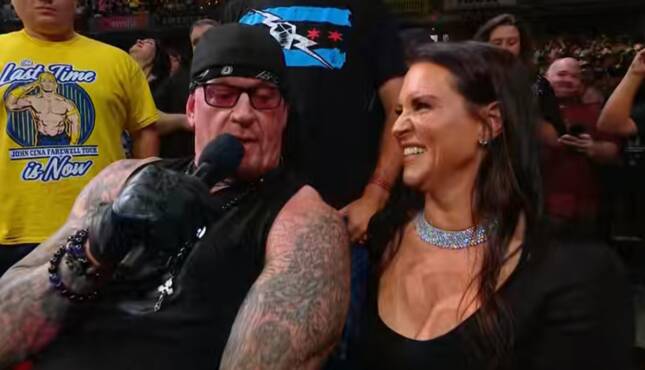 Image Credit: WWE

Welcome guys, gals, and gender non-binary pals.
Through Hel Stryer and brimstone . . . it’s Ask 411 Wrestling!
I am your party host, Ryan Byers, and I am here to answer some of your burning inquiries about professional wrestling. If you have one of those queries searing a hole in your brain, feel free to send it along to me at [email protected]. Don’t be shy about shooting those over – the more, the merrier.
Hey, ya wanna banner?

Matt B. is standing in for Teddy Long:
Now the Undertaker seems to be doing the Hall of Fame announcements do you think these are a little predictable? I miss the random announcements during Raw.
Do you think it would be better if half the time he would chokeslam the person? So you think it’s going to be Hall of Fame inductee but instead it’s a solid chokeslam and a not this year. If say he did this 50% of the time it would still retain the ‘are they or aren’t they’ component and be similar to other sports where people get upset that someone wasn’t inducted the first year they’re eligible. Also people would be scared to see him every time he appeared.
I’m not a fan of that idea, to be honest.
You’ve got a very limited group of people who are realistically going into the Hall of Fame, and if you make half of them look like idiots by having the Undertaker chokeslam them without their fighting back, you’ve just devalued people who probably will be going into the HOF at some point in the next few years.
Plus, it won’t be too much longer before your Hall of Fame candidates are significantly younger than Taker, and it will look even worse for them if they’re being beaten up by an old man.
Rahil has two very similar looking holds:
Does Sting has a positive record over Bret Hart? He beat Bret Hart a lot in early ’99 on house shows. What is the record?
Yes, Sting has a positive record against Bret Hart. Specifically, the Stinger as twelve wins, five losses, and two no contests against the Hitman, assuming we’re just talking about singles matches.
For what it’s worth, only five of those matches were televised, with a no contest in a U.S. Title match on the October 5, 1998 WCW Nitro, a DQ win for Bret on the October 19, 1998 Nitro, a win for Bret in a U.S. Title match at Halloween Havoc 1998, a win for Sting in a World Title match on the October 18, 1999 Nitro, and a win for Bret in a World Title tournament match at the 1999 Mayhem pay per view.
Ignacio is doing it for the ladies:
A few months ago, I asked for a who’s who of NWA World Heavyweight Champions. Would you do the same with the NWA Women’s Championship?
For those who don’t recall Ignacio’s prior question, he asked me to profile the NWA World Champions from the title’s more obscure years, during the post-ECW but pre-TNA years and the post-TNA years. You can go back and read it here.
But what of the ladies?
There is A LOT to unpack here, so we’re going to have to break this up into at least two different installments. Today, we’ll begin in 1950 and continue through about 1998, where we’ll pick it up next week.
The first recognized NWA World Women’s Champion was Mildred Burke. Burke became a huge wrestling star in the 1930s and won a different version of the World Women’s Title from Clara Mortensen in Chattanooga, Tennessee. With that title and her stardom, when the NWA decided it was going to recognize a women’s champion in 1950, they just said Burke was their gal. Unfortunately, after the title win things went south pretty quickly. Burke was married to Billy Wolfe, at the time the man who booked all women’s talent for the NWA. Wolfe was, by most accounts, an abusive, philandering jerk. When she called him out on it and ultimately divorced him in 1952, she found herself frozen out of the NWA. Mildred’s entire story was documented in the excellent biography Queen of the Ring 2010 which was turned into a motion picture in 2024.
Speaking of Mildred Burke’s problems with the NWA and Billy Wolfe, they play directly into how she lost the NWA Women’s Title. On August 20, 1954 in Atlanta, Georgia, Burke lost the title to her rival June Byers who was a major star in her own right but was also, not coincidentally, Wolfe’s daughter-in-law. Prior to the 1954 match, Wolfe was promoting Byers over Burke and essentially holding her out as the real world’s champion who Burke was ducking. A deal was finally worked out for the match in Atlanta, but in order to get Burke to agree, it had to be a shoot and a two-out-of-three falls match.
However, things did not go as Mildred thought they would. Byers beat her in the first fall, and in the second fall ringside commissioners called off the match, essentially saying that after the bout had gone on for an hour, it was a stalemate and a no contest. Immediately following the result, newspapers reported that the match was a draw since neither woman won two falls, but the NWA took the position that since Byers won the only decisive fall in the match, she was the overall winner and new Women’s World Champion. After a few months of the NWA machine promoting that as the outcome, fans largely forgot about the original result.
In some ways, I feel bad for Byers when it comes to this result (though I could be biased), as she was a solid wrestler and major star in her own right, though in present day it seems like she gets mostly remembered as one of the villains in Burke’s story as opposed to being recognized for her own career.
Byers had about two uncontested years as NWA Women’s World Champion, but we come into more controversy in 1956. Several promoters of NWA territories in the northeast – including Vince McMahon Sr. – stopped recognizing Byers as the Women’s Champion. While she continued to be recognized as the champion in much of the country through her retirement in 1964, the northeastern promoters claimed that The Fabulous Moolah became champ by winning a battle royale for the title on September 18, 1956 in Baltimore, Maryland. Once Byers retired in 1964, the rest of the NWA did fall in line and recognize Moolah.
I’m guessing everyone reading this knows Moolah, so I won’t go too deep on her background. You probably also know that she became very tight with the WWWF/WWF and ultimately sold her championship to them in 1984, with WWE canon recognizing her as their first Women’s Champion beginning in 1956 and continuing uninterrupted until her 1984 loss to Wendi Richter.
The NWA’s history books tell a different story, though.
Moolah lost the Women’s Title to Bette Boucher on September 17, 1966 in Seattle, Washington. By this point in time, Moolah was not just a wrestler but also a trainer and the person who provided women’s talent to most wrestling territories throughout the country. Boucher was one of the women who Moolah trained, and the title change was likely orchestrated to just give the fans in Seattle something special, as Moolah won it back on October 3 in Vancouver, British Columbia. As for Boucher, she remained part of Moolah’s troupe of wrestlers through 1970, with the Fabulous one booking her out to the WWWF, Jim Crockett Promotions, the AWA, and even the original WCW in Australia among other territories.
Moolah also provided talent to work in Japan after an alliance was struck between Vince McMahon Sr. and Takashi Matsunaga, who was involved in running the earliest women’s promotions in that country. This resulted in Moolah going on a tour of Japan between March and April of 1968, and on March 10, 1968 in Osaka, Moolah dropped her NWA World Title to Yukiko Tomoe, who was being built as one of the early stars of women’s wrestling in the Land of the Rising Sun. This was part of a proud tradition of Japanese wrestlers winning American titles to help legitimize them, like Rikidozan winning the Los Angeles version of the World Heavyweight Title or Antonio Inoki briefly snagging the WWF Title. By the end of the tour – specifically on April 2 in Hamamatsu – Moolah had regained her championship.
Our next NWA Women’s Champion is an interesting one. It’s Evelyn Stevens, who held the title for roughly 24 hours, beating Moolah on October 8, 1978 in Dallas, Texas and losing it back the next day in Fort Worth. Stevens, who was not part of Moolah’s troupe, had been wrestling in Texas and the Great Plains states since the early 1960s, and she was romantically linked to two different male wrestlers, dating Wahoo McDaniel for a time and being married to “The Spoiler,” Don Jardine. In fact, according to the Wrestling Observer‘s obituary of McDaniel, there was a famous story in wrestling circles in which Stevens learned Wahoo was cheating on her, made a beeline for the bar he was drinking at, kicked the barstool out from underneath him, and stomped a mudhole in the guy until she was pulled off.
In a less comical scenario, Stevens was convicted of murder in 1987. After she divorced Jardine, she entered into what newspapers described as a common law marriage with a man named Frank Riegle. In December 1986, she shot him three times in the face and chest, thereby rendering him dead. Stevens was sentenced to 20 years in prison but only served five before being paroled, with the early release being attributed to a belief that the shooting was precipitated by Riegle’s abuse of Stevens.
I should note that the women listed above as beating Moolah are the ones who are most definitively proven to have pinned her shoulders to the mat. There are stories of the Fabulous one also doing other quickie title changes throughout the country and world, including to women like Susan Greene in 1976.
In any event, Moolah was the champion again as of October 8, 1978, and here’s where the Women’s Title goes into a bit of an odd period. As I previously mentioned, the Fabulous Moolah had full control over the championship by 1984 and handed it over to the WWF, ending any recognition of the belt by the NWA.
The championship really does not have a consistent history for almost twenty years after Moolah bolts to th WWF. This gets a bit convoluted, so first let me explain what happened to the title, and then I’ll circle back and give some background on the women who were involved, because that’s really what Ignacio’s question as asking for.
Debbie Combs reportedly won a women’s battle royale in San Jose, California on February 13, 1986 to claim the vacant Women’s World Title, giving us our first champion since Moolah’s departure. The same records reflect the exact same match was held on February 15, 1986 in Honolulu, Hawaii, with it being played up that Combs won the title for the first time there too. However, outside of title histories, I’m not able to verify these matches anywhere as actually having happened.
Combs continued to defend the NWA Women’s Title sporadically until May 16, 1998, when she defeated Robbie Rage in Versailles, Pennsylvania. (This is not the male wrestler named Robbie Rage who was part of the tag team High Voltage in WCW but rather a woman trained by Gypsy Joe who had been wrestling since 1998). Combs did lose the NWA Title once in the ring to Malia Hosaka once on May 9, 1996 in Johnson City, Tennessee, though she won it back the very next night in Fall City, Tennessee. Otherwise, I could find no record of Combs ever losing the championship to definitively end her reign. Some title histories do say that she was stripped of the title in October 1996, but, again, she was still defending the title until 1998, whether the NWA officially recognized it or not.
Making things even more confusing is the fact that other women are listed in some title histories as having held the NWA Women’s Title at the same time Combs did, with no indication of how they won it.
Having dug into this, I suspect that at least some of these title reigns being listed result from some degree of confusion. Misty Blue Simmes is listed in the NWA Women’s Title history in some sources, and I did find results from one card on August 29, 1987 in Houston in which she was listed as winning a match for the championship against Comrade Orga, though I wonder if this was a mix-up related to Simmes holding the NWA United States Women’s Championship, a separate title, at the time. Susan Sexton is also listed as an NWA World Women’s Champion in some histories, though I can’t find record of her ever winning or losing it. I suspect this may be a function of Sexton appearing on several WCW shows, including Clash of the Champions XII, while she was the world champion of the LPWA, a small all women’s group that was trying to make a run on PPV at the time. If you watch the Clash match back, the LPWA is mentioned in passing exactly once, and for much of the bout Sexton is just referred to as the “Women’s World Champion.” The cameras even seem to shoot her belt in such a way as to avoid fully displaying the “LPWA” lettering on it.
The other two names that appear in NWA Women’s Title histories at the same time Debbie Combs was defending the championship are Bambi and Peggy Lee Leather. Those histories show Bambi as being recognized as champion at some point in 1990, though my research as turned up zero indication of how that came to be.
There is an explanation as to some of the other Bambi/Peggy Lee title reigns, though, and it relates to one Jim Crockett, Jr. After Crockett sold his company to Ted Turner, he had a five-year non-compete clause which prevented him from having anything to do with pro wrestling. He started running shows again in 1993 and affiliated with the NWA. On July 26, 1994, Crockett’s NWA territory ran a television taping in East Ridge, Tennessee. Peggy Lee Leather was billed as NWA Women’s Champion on the show, apparently having been awarded a new version of the championship despite the fact that Debbie Combs was still running around and defending what she had. Peggy Lee retained her championship over Bambi in the fourth match of the taping, but then Bambi beat Peggy in the seventeenth match of the taping (presumably for a different episode) to become the new titleholder. Bambi retained the championship over Leather on another card held on October 29, 1994 at the legendary Dallas Sportatorium, and that was the last anyone saw of this version of the title.
So, that is the confusing history of the NWA Women’s title between 1986 and 1998. But who are the women involved in it?
Debbie Combs was a second-generation wrestler, the daughter of Cora Combs, who herself had been part of the troupe of wrestlers managed by Billy Wolfe in the Mildred Burke era. After being trained by her mother, Debbie’s first matches were under a mask as “Lady Satan,” with her mom being one of her regular opponents. She wrestled in multiple territories in the 1970s and 80s, finally being brought in by the WWF in 1987 where she regularly faced both Fabulous Moolah and Sensational Sherri when they were Women’s Champion there. After that, she mostly went back to the indies, though she had sporadic matches for both the WWF and WCW in the 1990s as an opponent of Madusa/Alundra Blayze. In fact, she was originally scheduled to be Blayze’s opponent at Wrestlemania X.
Before she got into wrestling, Misty Blue Simmes had a pretty eclectic background. She was a boxer for a time, and she was also an adult film star, even once sharing a scene with Ron Jeremy. Eventually, she met up with Killer Kowalski and was trained for wrestling at his school. After only a year in the sport, she landed in Jim Crockett Promotions, which is where her best known work took place. JCP never had much of a women’s division but, for about five years, you could periodically see Misty Blue there – and later in WCW – mixing it up with the likes of Linda Dallas and Kat LeRoux. During her run, the relatively small number of “smart” wrestling fans that existed were pretty critical of her, saying she got her job based on her looks when there were more talented female wrestlers out there. (Fortunately, this would be the last time smart fans would ever criticize a female performer in this way.) After JCP, Misty bounced around indies for a few years, but she was not particularly committed to wrestling.
Susan Sexton was born in Perth, Australia and fell in love with wrestling there at a young age. In interviews, she said she was trained by a local wrestler named Ali Musa, though the only references I’ve been able to find to that person is in sources that talk about him training Susan Sexton. Eventually, she was able to connect with Mildred Burke, who was running a troupe of lady wrestlers in the mid-1970s. That brought Sexton to the United States, where she really just kicked around independents aside from having a few matches with the AWA in its dying days. The run that she had with the LPWA and its brief crossover with WCW was the most notoriety she ever had in wrestling. Currently, she works as a psychic in upstate New York. No, I’m not kidding. Here’s here website.
Bambi was born in Stone Mountain, Georgia and spent her early years there. By coincidence, female wrestler Joyce Grable was living in Georgia at the same time Bambi came of age, and Grable took the youngster under her wing. Bambi started wrestling in 1986, and some of her earliest notable bouts came in the form of mixed tags in the Memphis territory where, wrestling as Bambi, she teamed with James Earl Wright, who at the time was using the ring name “The Hunter.” Yes, that’s right – Bambi and the Hunter. Bambi also fell in with David McLane, the founder of GLOW, when he was running his second promotion, Powerful Women of Wrestling, which had a more serious approach than GLOW. Bambi was a staple on southern indies for many years, and in 2000 she reunited with McLane when he launched Women of Wrestling. At that time, Bambi started competing under her real name, Selina Majors. She was also involved when McLane managed to reboot WOW in 2013 and has continued to work with them to this day in more of a backstage capacity.
Bambi’s longtime rival was Peggy Lee Leather. She started off in 1980 and was trained by the Fabulous Moolah and Joyce Grable, and she popped up on WWF shows as part of Moolah’s troupe very early in her career (known as just “Peggy Lee”), in addition to touring with All Japan Women for several years. In 1985, she had a brief run in the Florida territory where she was known as Peggy Lee Pringle and promoted as the sister of Pervical Pringle III, who would later become Paul Bearer. She remained active as an indy wrestler after the territories died out, which is when she added “Leather” to her name and became a years-long foe of Bambi. In fact, she even followed Bambi into the McLane Women of Wrestling promotion, where she was known simply as “Thug.” Sadly, Peggy passed away in 2023 at the age of 64.
Last but not least, we’ll talk about Malia Hosaka, who got her one-day Women’s Title reign by beating Debbie Combs. Hosaka was a Hawaiian native who regularly got shoehorned into foreign heel roles. She was also trained at Killer Kowalski’s school and, interestingly, none other than Misty Blue was helping work with ladies at the camp in 1987 when Hosaka broke in. Malia became the ultimate journeyman wrestler, having matches in five decades and appearing in many major promotions, though never remaining in any of them for too long. The companies she’s competed for include the WWF, WCW, ECW, TNA, FMW, WWC in Puerto Rico, and the Herb Abrams UWF. In the mid-2000s, Hosaka became a valued veteran presence on the roster for the indy group SHIMMER: Women Athletes, which deserves quite a bit of credit for setting the stage for contemporary women’s wrestling in the U.S.
That does it for this week. We’ll return in seven-ish days, and, as always, you can contribute your questions by emailing [email protected]. You can also leave questions in the comments below, but please note that I do not monitor the comments as closely as I do the email account, so emailing is the better way to get things answered.


