
Movies & TV / Columns
Chuck Norris: The Important Movies Part 2
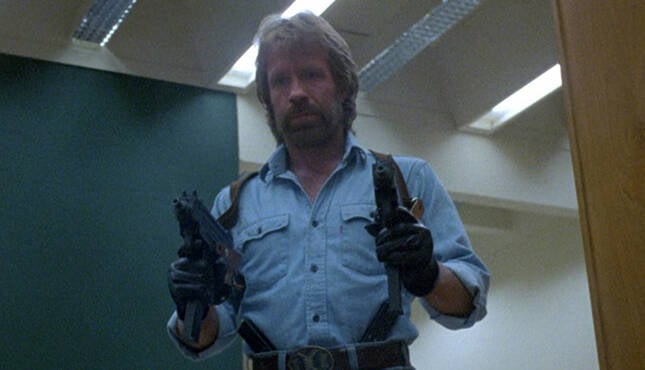 Image Credit: Cannon Films

Chuck Norris: The Important Movies Part 2
Before I get into part 2, I just want to reiterate and make sure everyone reading this understands that this is not a “Best Chuck Norris Movies” list. I am not counting down his movies, from least best to best. That is a completely different series of articles and a completely different discussion. What I am doing here is discussing what I think are the most important movies in Chuck Norris’ career. An important movie in an actor’s career doesn’t necessarily mean it’s that actor’s best movie, and as this piece continues (there is one more part after part 2), you will see that I am going to discuss Chuck Norris movies that are not his best at all, but, in the grand scheme of his place in pop culture, they are important. I may do a Chuck Norris movie countdown list at some point in the future, similar to ones I’ve done for directors John Carpenter and George A. Romero, but I haven’t decided on that. Again, I just want to make sure everyone knows that this is not a discussion of Chuck’s best movies. It’s a discussion of his important movies.
And just in case you missed it, or if you want to read it again, here is part 1. And now, without any further what have you, Chuck Norris: The Important Movies continues with part 2.
**
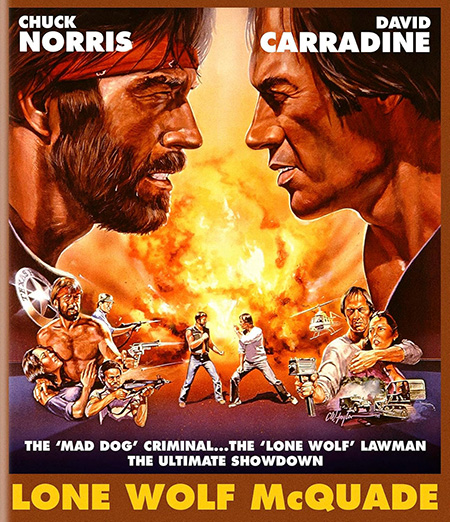
Lone Wolf McQuade (1983): When you look at Lone Wolf McQuade and how it fits into Chuck’s career, you have to understand that it serves as a bridge between his being marketed as “martial arts superstar Chuck Norris” and “action star Chuck Norris.” Before Lone Wolf McQuade, you could say that Chuck was a “karate guy,” as that was essentially the big draw for movies featuring him. With Lone Wolf McQuade, Chuck is starting his transition from being a “karate guy” to being a “guy that knows karate.” There is an actual difference between the two.
Lone Wolf McQuade was directed by Steve Carver, who had directed Chuck in 1981’s awesome An Eye for an Eye, and with Lone Wolf McQuade Carver saw a chance to alter how Chuck was portrayed in movies. In Lone Wolf McQuade, Chuck’s Texas Ranger JJ McQuade is a grimy cowboy badass that prefers to work alone (he does have a friendship with a fellow Texas Ranger, Dakota, played by the great L.Q. Jones, but as we see at the beginning of the movie Dakota is retiring from the Texas Rangers). McQuade is also a serious beer drinker, and he’s accused of not having the proper “style” that his commander, played by R.G. Armstrong, expects (McQuade doesn’t “live clean,” doesn’t go to church, and while he does have a family McQuade is divorced). McQuade also has a beard, the first time Chuck appeared in anything with one. Before Lone Wolf McQuade, Chuck was always either clean shaven or he had a mustache. The beard is a look that would essentially become the Chuck Norris look in the future (although he would appear from time to time without the beard and go back to the mustache look, like in Chuck Norris: Karate Kommandos, his first attempt at comedy, 1986’s Firewalker, and in flashbacks in Missing in Action 2: The Beginning and Hero and the Terror).
In Chuck’s first major sequence in Lone Wolf McQuade, we see him take on a gang of cattle rustlers in the desert and rescue a team of Texas state troopers that have been taken hostage by the rustlers. When confronting the rustlers, Chuck first uses a bolt action rifle to shoot at the rustlers, and later uses a MAC-10 to take out most of the gang. Chuck does do a few kicks, but they’re not flashy roundhouse kicks or anything like that. The emphasis is on Chuck using guns and appearing as a cowboy. There’s also a brief sequence where Chuck’s JJ McQuade, walking towards the gang of rustlers, is seen in silhouette, the “spaghetti western” style music swelling on the soundtrack from composer Francesco de Masi, creating an iconic image of an almost mythic figure approaching danger. Yes, Chuck did appear in silhouette at the beginning of Forced Vengeance in what is an iconic moment of cinematic martial arts fighting, but the whole silhouette thing plays differently in Lone Wolf McQuade. Chuck Norris, in this movie, has become something different.
Now, there is a major martial arts theme running through Lone Wolf McQuade (again, this is a bridge movie from one persona to the next, so it’s going to be a mix of old and new). We already know Chuck’s JJ McQuade, because he’s played by Chuck Norris, is going to engage in karate fighting of some sort. The main bad guy in the movie, though, is Rawley Wilkes, played by David Carradine, best known as Caine on the TV show Kung Fu (1972). Carradine became a sort of martial arts icon because of his participation in Kung Fu, despite not being an actual martial artist (I believe it was explained that Carradine had a dancing background and because of that was able to mimic martial arts moves and could follow choreography), and Wilkes is referred to as a European karate champion. There’s a scene where Wilkes actually challenges McQuade to a fight during a martial arts exhibition at a big hooha party, a challenge McQuade rebuffs. McQuade and Wilkes do eventually square off at the end of the movie, in one of Chuck’s best fight scenes, and it’s a fight that had to happen eventually because why else have Chuck Norris and David Carradine in the same movie? McQuade doesn’t finally take out Wilkes because of his superior martial arts prowess, though. After attacking his daughter (Sally, as played by Friday the 13th Part 3D final girl Dana Kimmell) and then shooting his girlfriend and, at the same time, McQuade’s new lover Lola, played by Barbara Carrera, Wilkes is rushed away by a concerned henchman, and McQuade runs after him with a grenade, throwing it outside of the little hut Wilkes tries to hide in and blowing up barrels of fuel that then cause a massive explosion that destroys the building. Considering the big draw of the final confrontation is to see two karate masters duke it out, it seems weird that the movie would end with an explosion and not a massive kick to the face. There are stories out there that Carradine had it written into his contract that he couldn’t lose onscreen via hand-to-hand combat, which could be true and that’s why the movie ends the way it ends, but the ending also serves a different purpose. A karate guy always beats the bad guy with karate. An action hero can do that, too, but he doesn’t have to. And that’s what we see at the end of Lone Wolf McQuade.
You should also take into account the sequence towards the beginning of the movie, after McQuade is given a new partner in Texas state trooper Kayo (Robert Beltran) and Kayo shows up at McQuade’s house the next morning. McQuade doesn’t want a new partner (he says multiple times “Forget that partner crap!”) and chases Kayo out of his house. We see a dilapidated heavy bag in McQuade’s house, but we never see him using it to work out. Instead, we see McQuade in what amounts to his backyard, getting in some target practice before he officially begins his workday. McQuade lays waste to multiple wooden targets in spectacular fashion with his trusty Smith & Wesson Model 29 sidearm and Browning Auto-5 shotgun ( Thank you Internet Movie Firearms Database for that info), shocking Kayo, who is watching via binoculars. We really are in new territory here with Chuck.
Lone Wolf McQuade is also the first movie where we see Chuck having a complicated home life. While it’s true that JJ McQuade has a reputation as a cop that prefers to work alone and he lives alone out in the desert with this wolf dog his only company, McQuade is actually a divorcee with a teenage daughter and an ex-wife that he tries to have a good relationship with (McQuade’s ex-wife is played by Sharon Farrell). McQuade’s family likely fell apart because, as McQuade’s ex-wife states, she couldn’t deal with his dangerous job anymore and they became estranged. But McQuade is still in their lives. It’s an interesting way to go with what amounts to a “man’s man” tough guy also having this other side to his life (they could have easily removed the daughter and ex-wife from the story and made the “love” part of the story all about Carrera’s Lola, but they didn’t).
Lone Wolf McQuade is probably the best looking movie in Chuck’s filmography. Director Carver worked with cinematographer Roger Sherman, who had already done the cinematography for Carver’s An Eye for an Eye and Chuck’s 1979 effort A Force of One. Lone Wolf McQuade feels gigantic, and is lush with vast desert landscapes that are simply gorgeous to look at, something I don’t think anyone was expecting (both A Force of One and An Eye for an Eye look good as action movies, but visually they aren’t exactly super vibrant. Lone Wolf McQuade is in another league).
Now, there is a story to be told about how Lone Wolf McQuade resembles Chuck’s future TV show Walker, Texas Ranger, but I’m going to get into that in Chuck Norris: The Important Movies Part 3. I will say at the moment, though, that without Lone Wolf McQuade you don’t have Walker, Texas Ranger, and you don’t have Chuck Norris as we understand him (in a pop culture sense).
And now some pointless Lone Wolf McQuade trivia: Modern horror legend and stunt professional Kane Hodder’s second movie as a stuntman was Lone Wolf McQuade. On top of performing stunts in the movie, Hodder also has a “blink and you’ll miss it” part as a henchman for Wilkes. Hodder plays the henchman that murders low level criminal and “snitch” Snow, played by the great William Sanderson.
The secondary villain in Lone Wolf McQuade is gun runner Falcon, a dwarf in a motorized wheelchair played by noted “little person” actor Daniel Frishman. Frishman would also play an Ewok in Star Wars Episode VI: Return of the Jedi in 1983. If you don’t consider 1983 a “career year” for Frishman, the term “career year” has no meaning.
L.Q. Jones, who plays Chuck’s old Texas Ranger friend Dakota, would work again with director Steve Carver on the movies Bulletproof (1987) starring Gary Busey, and River of Death (1989) starring Michael Dudikoff. Jones would also work with Chuck Norris again, appearing in a season two episode of Walker, Texas Ranger.
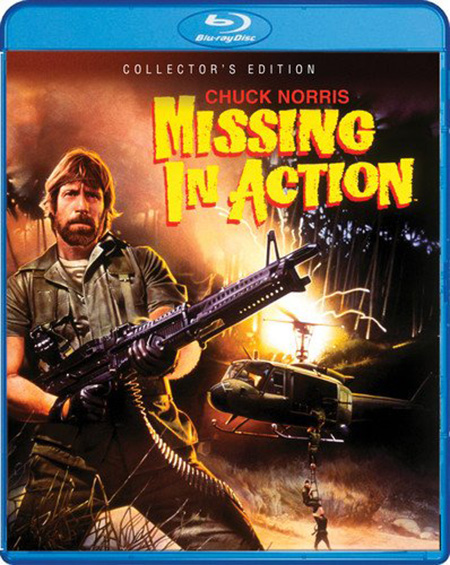
Missing in Action (1984): Missing in Action, directed by Joseph Zito, is the first Chuck Norris movie where he is a full on action hero. It’s also the first Chuck Norris movie I remember seeing as a kid. It was on HBO, and I can remember my parents watching it, liking it, and then recording it on a VHS tape (it was recorded on the same tape as Rambo: First Blood Part II, which is amazing when you think about it, as both Missing in Action and Rambo: First Blood Part II are about rescuing American prisoners of war from Vietnam several years after the end of the war). Lots of people remember the scene in Missing in Action where Chuck’s James Braddock rises up out of the water wielding an M60 and laying waste to a group of Vietnamese soldiers. I know I do. I also remember the sequence at the beginning of the movie, during Braddock’s PTSD nightmare, where Braddock jumps in slow motion with a grenade in each hand from a watchtower. I didn’t fully grasp what the heck was really going on the first time I saw it, but I knew how insane it was for someone to jump from a high place while holding two hand grenades. You don’t hold hand grenades, you throw them. Right?
And so the first part of the Missing in Action is essentially Braddock going to Vietnam as part of a big meeting between the United States government and the government of Communist Vietnam, Braddock dissing the Vietnamese representatives as soon as he gets off the plane and starts interacting with them (several of them were his captors when he himself was an American POW), and then going on a sort of “night mission” to torment and then accidentally kill one of the Vietnamese government higher ups (this higher up is played by the great James Hong). After all of that happens, Braddock meets up with some local contacts, eventually teams up with an American ex-patriate played by the great M. Emmet Walsh, and decides to head behind enemy lines to find and rescue the American POWS that Braddock knows are there but the Vietnamese government claims do not exist. Braddock, of course, is right, he kills a bunch of Vietnamese soldiers, general mayhem ensues, and he rescues the American POWs, eventually barging into the big US/Vietnam government meeting that’s being covered by the international media (the final shot of the movie is Braddock holding up one of the POWs).
Lots of people consider Missing in Action one of Chuck’s best movies. I like it, and I can’t deny that Zito’s direction is top notch, but it’s not my favorite Chuck movie (Missing in Action is Zito’s first action movie as a director, as he was best known up until that point for making the slasher horror movies The Prowler, which came out in 1981, and Friday the 13th: The Final Chapter, which came out the same year as Missing in Action, 1984. In fact, both The Final Chapter and Missing in Action opened at number one at the theatrical box office. How many directors out there can say that they’ve done that in their career?). I actually prefer the sequels to Missing in Action, especially Braddock: Missing in Action III (1988). While I don’t think you can call any of the Missing in Action movies fun, Braddock: Missing in Action III is definitely the most watchable and rewatchable of the three. Missing in Action 2: The Beginning is depressing as hell (it’s basically a prison movie and prison movies can be soul crushing) and is often labeled as terrible because “Chuck isn’t acting in the movie.” I disagree with that. I think Chuck’s performance in Missing in Action 2: The Beginning is quite good, it’s the most vulnerable performance of his career (he wouldn’t be that vulnerable again until 1988’s Hero and the Terror), and he handles the material better than expected. Chuck also has one of his best “final fights” at the end of Missing in Action 2: The Beginning, going up against the dastardly prison camp leader Colonel Yim (Soon-Tek Oh). Colonel Yim has one of the best lines in the movie, a line that I would quote back and forth with my Dad for years. The line? “He can walk from here to Los Angeles and it would not do him any good.”
Now, there are some people who might argue that Missing in Action 2: The Beginning should be considered Chuck’s actual last martial arts movie, since a big chunk of that movie is waiting for Chuck’s fight with Soon-Tek Oh and Chuck doesn’t engage in much gunplay. My answer to that is, yes, the movie is centered around the eventual showdown between Chuck and Soon-Tek Oh, but Missing in Action 2: The Beginning is not a martial arts movie. It is a prison movie with some martial arts stuff thrown in. On top of that, Chuck gets to use a flamethrower in the movie. Martial arts warriors don’t typically get to use flamethrowers in their movies.
I didn’t learn this until much, much later, but Missing in Action was actually supposed to be the sequel to the movie that eventually became Missing in Action 2: The Beginning, written and directed by Lance Hool. Missing in Action 2: The Beginning was filmed first and was supposed to be Missing in Action. However, director Joseph Zito was able to complete his Missing in Action movie before Hool’s movie was finished editing, and Zito convinced Cannon Films’ Menahem Golan and Yoram Globus to release his Missing in Action movie first. So the “real” Missing in Action 2 became Missing in Action, and the “real” Missing in Action became Missing in Action 2. Anyone confused?
Braddock: Missing in Action III is the first movie that Chuck Norris’ brother Aaron directed, apparently replacing Joseph Zito (I will discuss why Zito was likely replaced when I get to Invasion U.S.A.). Aaron Norris had been a stunt performer and/or stunt coordinator on all of Chuck’s movies and once Zito was removed Aaron was promoted. I would say that Aaron did a good job with his first movie. A very good job. Aaron would go on to direct eight movies total starring his bother Chuck, and one movie starring Michael Dudikoff (that would be Platoon Leader, which also came out in 1988).
Missing in Action is the start of Chuck’s first of three movie franchises that he would have in his career. Chuck’s second franchise was The Delta Force franchise, with The Delta Force coming out in 1986 and Delta Force 2: The Colombian Connection (aka Delta Force 2: Operation Stranglehold) releasing in 1990. There is a third Delta Force movie, Delta Force 3: The Killing Game (1991), directed by the great Sam Firstenberg, although Chuck doesn’t star in that one. Mike Norris, Chuck’s son, would be “the Norris” in that flick. I think it’s weird as hell that Cannon stalwart director Firstenberg never worked with Chuck Norris (he never worked with Big Chuck Bronson, either). I’ll have a little more to say about that later.
Missing in Action was Chuck’s most successful movie at the theatrical box office, showing that Chuck’s move to “action star” was a wise one. Being an action star as opposed to just a martial arts star opened up the possibilities for future movies.
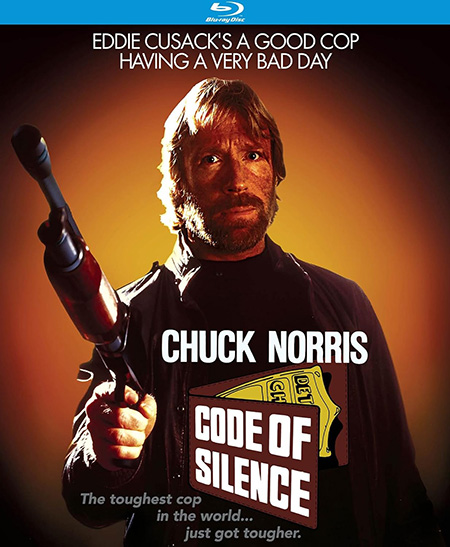
Code of Silence (1985): Code of Silence, directed by Andrew Davis, is the second of three Chuck Norris movies that came out in 1985. The first was Missing in Action 2: The Beginning, and the third was Invasion U.S.A.. Sandwiched in the middle is Code of Silence, which was not produced or released by Cannon Films (it was released by Orion Pictures) and is usually labeled as Chuck’s best movie. I would say it’s definitely one of Chuck’s best movies, and that it does contain his best performance as an actor. Director Davis clearly knew how to get the best out of Chuck, and he surrounded him with a group of fantastic Chicago centric/Midwest actors that complement Chuck every step of the way as well as the great Henry Silva as the movie’s main villain (you can hear Davis talk about this a bit during the commentary track on the Kino Lorber Blu-ray release). I would also say that Code of Silence is the classiest looking movie in Chuck’s filmography, as it looks and plays like a real big deal Hollywood movie. It’s also the best showcase, at least up until Invasion U.S.A., for Chuck’s action hero persona, as we see throughout the movie that Chuck’s character, Chicago cop Eddie Cusack, is a guy that carries a big gun while out on the streets, but he can use his karate skills if he has to (it’s important to note that Chuck doesn’t kill the movie’s top bad guy, played by Henry Silva, using those karate skills. Instead, Chuck shoots him dead). Chuck also doesn’t rely on his martial arts skills in the movie’s final siege sequence. Chuck’s partner at the end of the movie is a goddamn robot. A robot!
When it comes to showcasing Cusack’s martial arts prowess, we see him doing an intense work out in the police station’s cop gym, kicking and punching and whatnot, and then we see Cusack later on get involved in a massive brawl in a bar. We saw Chuck engage in a bar brawl in Silent Rage and wipe the floor with a biker gang. While Chuck kicks major ass in Code of Silence, Chuck also gets his ass majorly kicked in the brawl, too. Who the heck ever expected to see that kind of thing in a Chuck Norris movie? Chuck Norris isn’t supposed to lose a bar fight!
Code of Silence made almost as much as Missing in Action at the theatrical box office, making it one of Chuck’s biggest box office hits. When you take that and the shockingly good reviews Chuck got for his performance in Code of Silence, why the heck didn’t he get a chance to make more movies like Code of Silence? I don’t really know. My first guess is that Chuck wanted more direct control over what he was doing, and Cannon Films was the only place that was willing to give it to him (Chuck’s next six movies were made through Cannon, with 1992’s Sidekicks the first non-Cannon movie since Code of Silence). It’s also possible that Chuck saw Code of Silence as a chance to work with someone outside of Cannon, he took the opportunity and made the most out of it, and then went back to Cannon because he knew he made more movies to make. Again, I don’t really know. When you look back at it, it all seems so very weird. Chuck certainly could have had an even bigger career, working with bigger companies and bigger movies, if he wanted to go that way.
It’s been my experience that, when it comes to the idea of Chuck Norris and his filmography, it seems like Code of Silence, despite its rave reviews and reputation, is a movie that people end up discovering after watching Chuck’s more well-known movies (generally meaning his Cannon movies). They usually end up loving it after watching it. Usually. There are some people out there who don’t dig it as much as his Cannon output. Code of Silence, to them, is too much like a “real” movie. I find that weird, too.
And now a pointless bit of Code of Silence trivia: In Code of Silence, Dennis Farina plays Dorato, Cusack’s partner who gets injured while on the job at the beginning of the movie (he wears a cast on his leg for most of the movie). A running bit in Code of Silence involves Dorato coming up with retirement schemes for himself and Cusack, and one of the schemes suggested is an alligator farm. The first time we see Chuck’s badass retired CIA character Matt Hunter in Invasion U.S.A. we see him wrangling alligators in Florida. Well, I should say that we see Hunter doing this after the epic opening titles sequence to Invasion U.S.A., where we see Chuck operating an airboat with his shirt open while the awesome Invasion U.S.A. blares in the background.

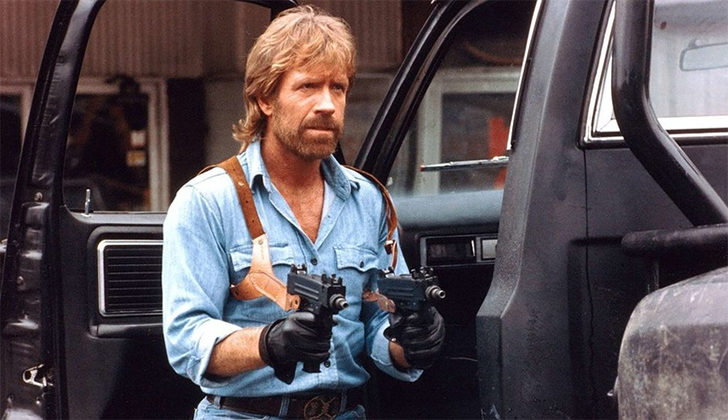
Invasion U.S.A. (1985): And then there’s Invasion U.S.A., the most Chuck Norris Chuck Norris movie ever made. It’s the movie, next to Lone Wolf McQuade, people typically end up thinking of when they think of Chuck Norris. Chuck clad in denim, wielding two Uzis, staring daggers into the bad guy he is likely milliseconds away from wasting with those two Uzis. It’s an iconic look. Invasion U.S.A. is also the first movie where Chuck did some screenwriting, co-writing the movie with James Brunner (Brunner wrote the screenplay for An Eye for an Eye). Chuck apparently came up with the idea for the plot to Invasion U.S.A. after reading an article in Reader’s Digest about terrorists infiltrating the United States. On top of that, Invasion U.S.A. is also the fourth movie in his filmography that could be considered “political.” The first is Good Guys Wear Black, Chuck’s only anti-Vietnam War movie. And then there are the two Missing in Action movies he had made up until that point, movies that were about the controversial idea that there were still American prisoners of war in Vietnam (you could also argue that they were sort of pro-Vietnam War movies).
Invasion U.S.A. is the biggest movie Chuck made for Cannon and it looks it. Directed by Joseph Zito, Invasion U.S.A. is a non-stop barrage of explosions, massive explosions, even bigger explosions than that, loud gun battles, and major stunt sequences that are goddamn insane, not to mention super dangerous looking. And it’s all real. As director Zito explains on the Shout! Factory Blu-ray commentary track, he didn’t use any miniatures in the movie for any of the action sequences. Those tanks that you see in the movie? Those are all real tanks. Those houses that the evil Rostov (Richard Lynch, in his greatest villain performance) blows up? Those were real houses blown up with real explosives. That mall that gets trashed when Chuck’s Matt Hunter drives a truck right through its front doors in the middle of a major terrorist attack with machine guns and bombs? That’s a real mall. And that sequence in the mall where Chuck is hanging off the side of that truck? That’s really Chuck. Holy shit.
Check out my appearance on the terrific Failure to Franchise podcast, where I talk about Invasion U.S.A. in greater detail with hosts Trevor and Chris (the podcast is also available via Apple, Spotify, and other podcast places, if you prefer to listen to it that way):
Something I didn’t get a chance to discuss on the podcast is how George A. Romero’s classic zombie flick Day of the Dead is connected to Invasion U.S.A.. First, Tom Savini did the practical special effects for both movies. Along with Gregory Nicotero and Howard Berger, Savini went from working on Day of the Dead to working on Invasion U.S.A.. Savini and company obviously had way more to do on Day of the Dead than Invasion U.S.A., but the special makeup effects he did do on Invasion U.S.A. definitely have that Savini style. According to the Shout! Factory Blu-ray special featurette on the special effects in Invasion U.S.A., the biggest effects Savini and company worked on were the dead teenager body that gets trampled on during the beach invasion (they essentially made a gelatin dead body) and the scene where Chuck rams a knife into Montoya’s hand (Montoya is played by Alex Colon). I would assume, too, that Savini also worked on the scene where Rostov forces a cocaine straw up a woman’s nose by slamming her head down on it, and the exploding Rostov dummy at the very end of the movie, but the featurette doesn’t mention any of that (there were other people labeled in the credits as working on “additional special effects makeup,” like Dean Gates, Ricardo Gonzales, and Pete Mitchell, so maybe they did the cocaine straw and the dummy?).
The second Day of the Dead/Invasion U.S.A. connection is how the movies look like they were made in 1985. The cinematographer on Day of the Dead was frequent Romero collaborator Michael Gornick, while the cinematographer for Invasion U.S.A. was João Fernandes. How the hell did they essentially synch up while making two very different movies? Was it all a big coincidence? I can’t figure it out. But I do find it interesting that before shooting Invasion U.S.A., Fernandes worked on multiple horror movies, three of them for director Zito (1980’s Blood Rage, 1981’s The Prowler and 1984’s Friday the 13th: The Final Chapter) as well as Children of the Corn (1984). Was Gornick somehow influenced by the look of those movies? Gornick wouldn’t work as a cinematographer again after Day of the Dead, while Fernandes would shoot several Chuck Norris movies after Invasion U.S.A., starting with Braddock: Missing in Action III and then doing Delta Force 2: The Colombian Connection, The Hitman, Sidekicks, Hellbound, Top Dog, Forest Warrior, and eight episodes of Walker, Texas Ranger. Gornick liked working with Romero, while Fernandes liked working with both Zito (he did all of Zito’s movie up until Invasion U.S.A. and then worked with him again on Zito’s Dolph Lundgren epic Red Scorpion in 1988) and Aaron Norris.
Go ahead, watch those two movies. You will see how they look very similar.
Now, why did Chuck Norris and Joseph Zito stop working together? Why did Zito get replaced on Braddock: Missing in Action III? Presumably, it’s all about a casting decision that they disagreed on with Invasion U.S.A.. As the story goes, Chuck Norris originally wanted the reporter character in Invasion U.S.A. to be played by Whoopi Goldberg, who he had seen in a play and was impressed by (Whoopi also was apparently an uncredited extra on A Force of One). Zito didn’t agree with Chuck, and instead Zito cast Melissa Prophet as the reporter. Chuck didn’t agree, the fact that Zito didn’t agree with him pissed him off, and then later on Chuck decided that he didn’t want to work with Zito ever again.
As for why Chuck never worked with Sam Firstenberg, I don’t really know. Chuck did have a chance to work with him, sort of, as Firstenberg did direct the 1986 Cannon movie Avenging Force, which was originally set up as a sequel to Invasion U.S.A.. Chuck didn’t want to do Avenging Force, and he was eventually replaced with fellow Cannon star Michael Dudikoff, and, of course, Dudikoff worked with Firstenberg on 1985’s American Ninja. Beyond just not wanting to do it, we really don’t know why Chuck didn’t want to do Avenging Force. It could be that he was too busy to do it (Chuck was already doing The Delta Force and Firewalker in 1986, along with Chuck Norris: Karate Kommandos, so maybe he just didn’t have the time to do it for 1986?). Or maybe he just didn’t want to play Matt Hunter again (Dudikoff ended up playing a guy named Matt Hunter in Avenging Force, although it isn’t the Matt Hunter from Invasion U.S.A.. It’s just another guy named Matt Hunter).
And now some pointless Invasion U.S.A. trivia: Billy Drago, who plays the criminal that Rostov meets with towards the beginning of the movie and then shoots his balls off after jamming a cocaine straw into a woman’s nose, would work appear in two more Chuck Norris movies. The first was 1988’s Hero and the Terror. Drago would then play the main villain in Delta Force 2: The Colombian Connection and appear in a 1995 episode of Walker, Texas Ranger.
James Pax, who plays one of the more prominent terrorists in Invasion U.S.A. (he participates in the fake police shooting in the Latino neighborhood, and then he tries to shoot Matt Hunter while dressed as a member of the National Guard), would go on to play one of the Three Storms, Lightning, in the classic John Carpenter flick Big Trouble in Little China (1986).
Alex Colon, who played the terrorist Montoya, would go on to work again with Joseph Zito in Red Scorpion.
The badass score created for Invasion U.S.A. by composer Jay Chattaway was used in at least two more Cannon movies, both of them Big Chuck Bronson movies. The first was 1987’s Death Wish 4: The Crackdown. You will the Invasion U.S.A. music in the scene where Bronson’s Paul Kersey watches a big meeting between the two rival L.A. crime gangs at an oil field. The second movie was Assassination, also from 1987. You will hear the theme from Invasion U.S.A. over the opening credits to Assassination.
Go ahead and listen to that podcast. It’s well worth it.
**
Up next: Part 3- the finale!
**
Please check out and “like” The Gratuitous B-Movie Column Facebook page, which is here.
Buy my book Not Coming to a Theater Near You! 50 Great Direct-to-Video Action Flicks of the Early 2000s published by BearManor Media here or here or wherever books are sold!
Don’t forget to sign up with disqus if you want to comment on this article and any other 411 article. You know you want to, so just go do it.
B-movies rule. Always remember that.


