
Movies & TV / Columns
The Top 25 Movies of 1998 (#5 – 1)
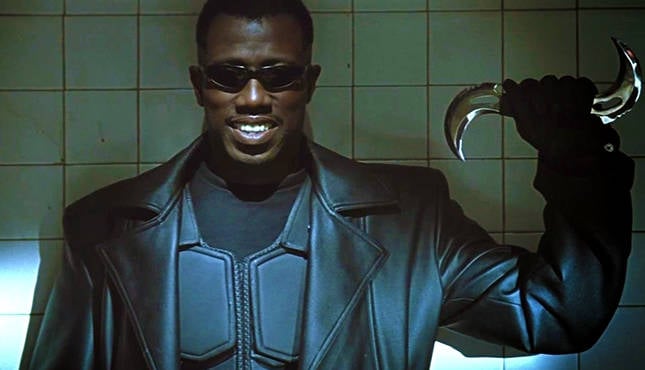 Image Credit: New Line Cinema

The Top 25 Movies of 1998: #5-1
Okay, so here we are with the final part of the Top 25 Movies of 1998 megalist. It’s been fun looking back at the movies that came out in 1998 and figuring out which ones were good enough to make this list. I think I might do another one of these year based movie ranking megalists at some point in the near future. I will just have to figure out year makes the most sense to look back at (some years have so many good movies that the list will have to be broken down into multiple lists because there are just too many movies to look at). Maybe 1996? 1989? A year from the early 2000’s?
In case you missed the first four parts of this list or just want to read them again for some reason here are the links for all four
Part 1: #25-#21
Part 2: #20-#16.
Part 3: #15-#11
Part 4: #10-#6
And so, without any further what have you, what are the last five movies on the Top 25 Movies of 1998 list?
The Top 25 Movies of 1998: #5-#1
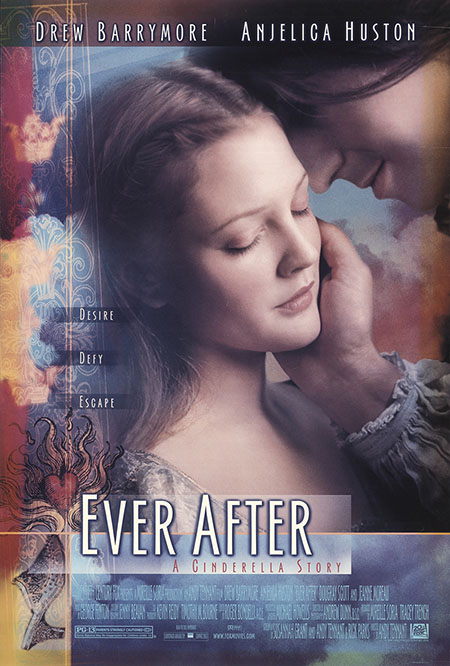
Honorable Mention: Ever After: A Cinderella Story: I know I said when I started this list that I wouldn’t be including any honorable mentions, but I’ve decided to break that rule and briefly talk about a movie that would have made the “main list” had it been, like the Top 30 instead of the Top 25. Ever After: A Cinderella Story is, as the title suggests, a version of the “Cinderella” story that everyone in the world knows from the Disney animated movie and the Grimm’s Fairytales stories. Ever After takes place in 16th century France, in the “real world” of the time (there are no magic or fantasy moments), and features a terrific Drew Barrymore as Danielle, the Cinderella of the story, and a brilliantly diabolical Anjelica Huston as Danielle’s “evil stepmother” Baroness Rodmilla de Ghent. Dougray Scott also appears as the prince. At first I didn’t care for this movie at all. I didn’t really “get” it. It didn’t help that every time I saw it I always caught it in the middle of the movie and I really wasn’t paying attention to it. When I actually sat down and watched it from the beginning and paid attention to what the hell was going on I liked it. I liked it quite a bit. And the movie I watched it the more I grew to love it. I think it’s too long, but I’ve grown to just accept its length. Barrymore is amazing in it (I’m surprised she never got the chance to make more “period movies” like this one) and, again, Anjelica Huston is so damn evil in it. It’s so satisfying when she’s found out and destroyed. I also enjoy how it uses the Cinderella story as a template for a “real world” story. I’m not sure it would have worked as something with copious fantasy elements. In five years I wouldn’t be surprised to see this move up on the list. It is that good and that enduring.
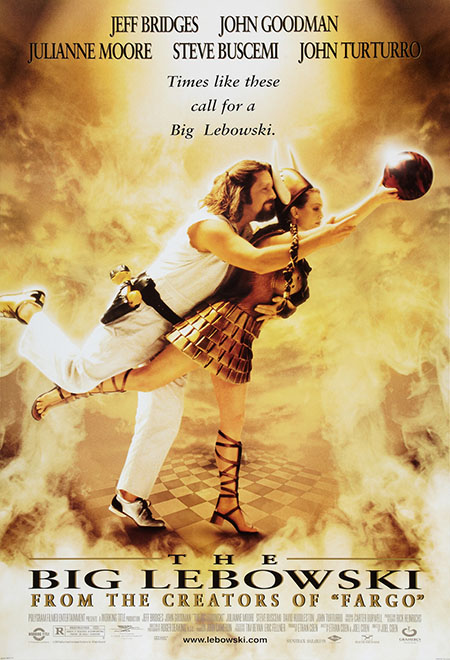
5-The Big Lebowski: I first saw The Big Lebowski on cable. I know it had a theatrical run but for some reason I don’t remember ever seeing a TV commercial for it. I was also initially reluctant to see it because, to me, it sounded too similar to the Woody Harrelson led Farrelly Brothers comedy Kingpin. A movie “about bowling?” How many bowling movies, bowling comedies, did the world really need? The Big Lebowski, of course, is nothing like Kingpin (I love Kingpin, by the way). TBL may feature people who like to bowl, but it isn’t about bowling (at least not literally. TBL is very much like how The Dude describes bowling to The Stranger, “strikes and gutters, ups and downs”). Instead, The Big Lebowski is a sort of comedy mystery movie featuring a detective who no one in their right mind would ever consider a true blue detective (that would be The Dude, played by Jeff Bridges). And you really don’t know it’s a mystery movie until about the halfway mark. Because where did the money go? You know, the money that was supposed to be picked up to retrieve the believed kidnapped wife of the rich Jeffrey Lebowski, the “other” Jeffrey Lebowski. Up until then it just seems like the chronically unemployed The Dude just has stuff happening to him and people keep “hiring” him to fix various problems. It also seems like a sort of hangout movie, where we see The Dude hanging out with his best friend Walter Sobchak (John Goodman) and the perpetually unaware Donny (Steve Buscemi). But then when the various subplots start coming together and we find out, just like the Dude, what really happened, you realize what a truly satisfying and brilliant movie Joel and Ethan Coen put together. It’s a comedy. It’s a mystery movie. It’s bittersweet. It’s hilarious. It’s incredibly quotable. It’s everything. It’s brilliant. And it’s one of those movies that somehow gets better with each viewing. The movie was, at best, a modest hit when it was released. In terms of the critical reception, it was the Coens’ follow up movie to the Oscar nominee Fargo and “the people who decide what art is” were clearly expecting something else. The Big Lebowski didn’t become a thing until years and year later. The Coens don’t do sequels (they did allow John Turturro to do a sort of side sequel featuring Turturro’s Jesus Quintanna), I think I would like to see the Dude appear again in something, sort of have another adventure. I would love to see how Walter and the Stranger and Bunny Lebowski are doing now (what are the nihilists doing? Do they still believe in nothing?). Bu then, maybe it’s just best to keep experiencing The Big Lebowski and leave it at that. It’s already way more than enough.
Weird question: for those of you who like this movie and like to quote it amongst friends and whatnot, who do you quote more: The Dude or Walter? And how many of you think “Shut the fuck up, Donny” all of the time?
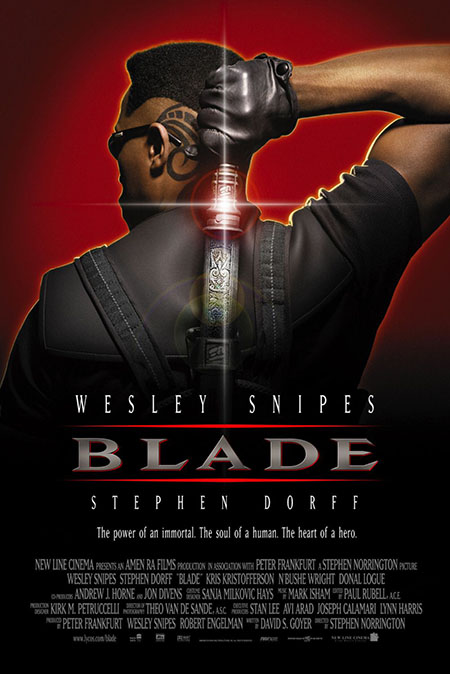
4- Blade: I was somewhat leery of Blade when it came out at the tail end of the 1998 summer movie season. I was excited because the trailers for it were cool and star Wesley Snipes looked cool as hell in it, but I was also worried that it would end up being terrible. It was coming out at the end of the summer, where most “big deal” summer movies went to die and it was based on a comic book that no one seemed to know about (well, at least no one in my social circle knew about. Why the hell would some big hooha Hollywood movie studio make a movie about a comic book no one knew?). In the end, I was just hoping for a moderately good movie.
Luckily, Blade was good. Really good. Insanely good. Visually jaw dropping. That opening sequence in the night club, where we see Snipes as Blade, flying around the room killing blood covered vampires and the vampires turning to dust before our very eyes. Holy crap! What the hell was going on here? And the movie just kept delivering the goods in terms of action and gore. Snipes was so iconically cool, so goddamn badass, the movie was overwhelming. And then there was Kris Kristofferson as Whistler, Blade’s friend/father figure and vampire killing partner. Why the hell was this country music guy, the Rubber Duck, in this thing? And why was he so good?
When the movie finally ended and Blade killed all of the vampires, including ultimate scumbag Deacon Frost (brilliantly played by Stephen Dorff), it was nothing short of a cinematic triumph for everyone: Snipes, Kristofferson, N’Bushe Wright, Marvel Comics, and director Stephen Norrington, whoever the hell that was. Blade was going to take over the world. It had to. Blade didn’t take over the world, but it garnered enough money and buzz that when it hit home video it was a big deal. I know it was for me because I would get to see it again. And again and again. The movie also was the start of a franchise, a franchise that should have continued well beyond three movies but didn’t because of stupidity (Blade Trinity sucks). At least we got two good movies out of the character.
Blade is still amazing today. It has all of the things that make for a transcendent action horror movie. I doubt the upcoming Blade reboot in the MCU will hit as hard as the original.
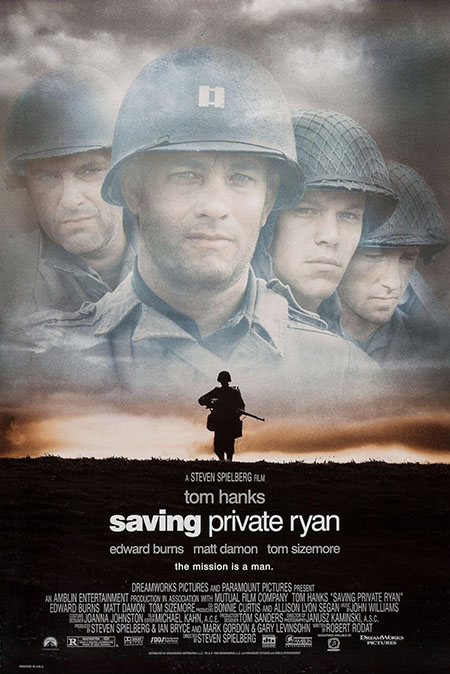
3- Saving Private Ryan: Steven Spielberg’s World War II drama Saving Private Ryan had all sorts of buzz when it came out in the summer of 1998. It was an immediate Oscar contender based on its pedigree (directed by Spielberg, starring Tom Hanks, was about World War II). It was considered an important movie because it was a celebration of “the Greatest Generation,” which was a constant idea on TV (Tom Brokaw wouldn’t stop talking about it). Saving Private Ryan also had the “most brutal and realistic” war sequences ever filmed, sequences that were triggering veterans’ PTSD/shell shock. How could that be possible? What the hell did Spielberg and company put on film? I went on a weekday afternoon a few weeks after the movie’s release. The theater was maybe ¼ filled. I think I was the second youngest person in the movie (my sister was easily the youngest). Even with so few people in the theater you could feel an odd anticipation for the movie to begin. What exactly were we all in for?
And then the movie began. You could feel the tension grow as Spielberg set the stage for what was to come (the American soldiers throwing up in the boat as it was getting ready to land). And then the front of the boat opened and multiple soldiers were shot dead almost immediately. And then sound started. You couldn’t understand what Tom Hanks or Tom Sizemore or any of the other characters were saying. It was just gunfire and explosions and carnage. Blood and guts spraying everywhere but none of it was exciting. It was gross. It was sobering. And you couldn’t take your eyes off the screen. It was like that throughout the rest of the movie’s nearly three hour run time. In terms of intensity the movie never got as intense as the opening sequence again, but it didn’t have to. You were hooked, neck deep in the muck and blood and danger with the characters.
Saving Private Ryan changed World War II movies forever, and likely all war movies going forward. Earlier movies depicted the brutality of the Vietnam War (think Platoon) and the Civil War (think Glory), but nothing else compared to Saving Private Ryan. If you make a war movie today you are going to be compared to Saving Private Ryan. You have to follow its lead or people won’t take you seriously.
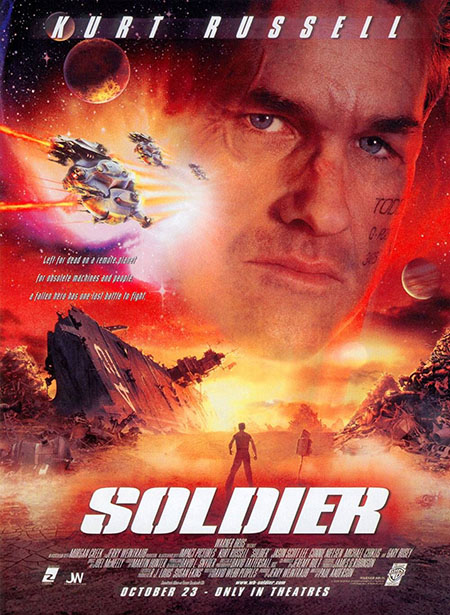
2- Soldier: I’ve been a fan of Soldier since I saw it in the theater its opening weekend. I was jazzed about having another sci-fi movie starring Kurt Russell (would it be as good as his second go as Snake Plissken in Escape from LA which came out two years earlier?) and I was intrigued by what director Paul W.S. Anderson did with his follow-up to the incredibly weird sci-fi horror flick Event Horizon. Would Soldier, which clearly based on its trailer and other marketing material was some sort of sci-fi action movie, be superior to Event Horizon? After seeing Soldier, it was obvious to me that Anderson had surpassed Event Horizon, and that Kurt Russell had given his greatest movie performance up to that date (and I would argue that it’s still Russell’s best movie performance).
Yes, that’s what I said. Soldier is Russell’s best movie performance. I know I’m in the mega extreme minority on this, but I think Russell should have received a Best Actor Oscar nomination for his performance as Todd 3465 in Soldier. That was obviously never going to happen because sci-fi action movies rarely, if ever, get nominated for anything outside of, maybe, special effects, especially back in 1998 when the movie came out and bombed at the box office. It’s not the “kind” of movie that gets looked at for anyone’s acting performance. The Academy, and critical establishment, the “people who get to decide what art is,” should have, though. Todd is Russell’s most nuanced performance. Todd barely has any dialogue in the movie, as the character is meant to be a soldier/human weapon that follows orders and not much else. Whatever Todd may be feeling at any moment Russell has to express through his face, subtle eye movements, and the way he moves his body. And Todd ends up feeling a lot as the movie progresses and he figures out, after being literally thrown into the garbage when more advanced human weapons are enlisted and then living with a group of pacifists, that there’s more to life than the military and fighting and war. He doesn’t have to fear having feelings and expressing himself. At the end of the movie, when Todd has to suit up and take on the very super soldiers that replaced him, he’s doing it out of love for people he’s actually gotten to know as human beings. It’s a transcendent moment. Watch how Todd “does war” at the beginning of the movie and then at the end. The Todd we see at the end is an actual person, not a machine. It’s such a brilliant performance. And Anderson managed to make a classic western (think Shane) out of “cheap” sci-fi trappings. I don’t think people were expecting a heartfelt, feelings-on-its-sleeve futuristic western out of Soldier. I suspect that’s why the movie tanked at the box office; the audience thought they were getting one kind of movie, they got something else, and they were annoyed. Soldier has managed to garner a cult audience of sorts since 1998, and if you haven’t seen it in a while or not at all, track it down and give it a shot. It is well worth your time.
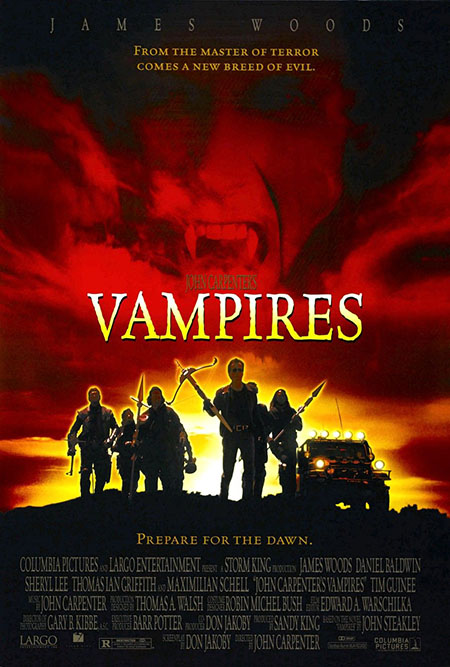
1- Vampires: Also known as John Carpenter’s Vampires, Vampires is director John Carpenter’s last major hit (it opened at #1 at the box office when it came out in the fall of 1998) and the closest thing to a western that he’s directed to date. Featuring an absolutely ferocious performance by James Woods as Jack Crow, the leader of a Vatican backed vampire killing crew, Vampires is a badass, rough as hell action horror flick that has Crow, after losing most of his team to an attack by master vampire Valek (Thomas Ian Griffith), trying to put together a new team while chasing Valek all across the southwestern United States. Valek is looking for an old Catholic artifact that, when used in a weird beard ritual, will allow Valek to walk in the sunlight, making him unstoppable. Crow’s new team includes Daniel Baldwin’s Montoya, Sheryl Lee’s hooker turned vampire victim turned vampire psychic Katrina, and Tim Guinee’s meek-at-first Father Adam. Chock full of gore, general nastiness, a supremely bad attitude, and Carpenter’s best overall score for one of his own movies, Vampires is a movie that grabs you by the throat and never let’s go. There’s just so much great stuff in this movie, so much badassness, it’s a classic through and through. And was I the only one who, when Vampires came out and had a website, went to it every day in order to listen to the “Padre’s Wood” closing credits theme that had its own subpage on the site? I did that until I was able to purchase the movie’s soundtrack on CD. Obsessed? A bit, but it’s great stuff.
Vampires spawned two sequels: Vampires: Los Muertos, directed by Carpenter friend Tommy Lee Wallace and starring Bon Jovi (it’s pretty good as its own thing, a little slow but it has its moments. It shouldn’t be the first sequel to Vampires, though. The world would be better off with a Carpenter directed, Woods starring sequel), and Vampires: The Turning, directed by Marty Weiss, which is better than it has any right to be.
**
Thanks for reading. Agree? Disagree? Sign up with disqus and comment. You know you want to, so just go do it.
Please “like” The Gratuitous B-Movie Column on Facebook!
Oh, and B-movies rule. Always remember that.


