
Movies & TV / Reviews
Westworld 2.4 Review – ‘Riddle Of the Sphinx’
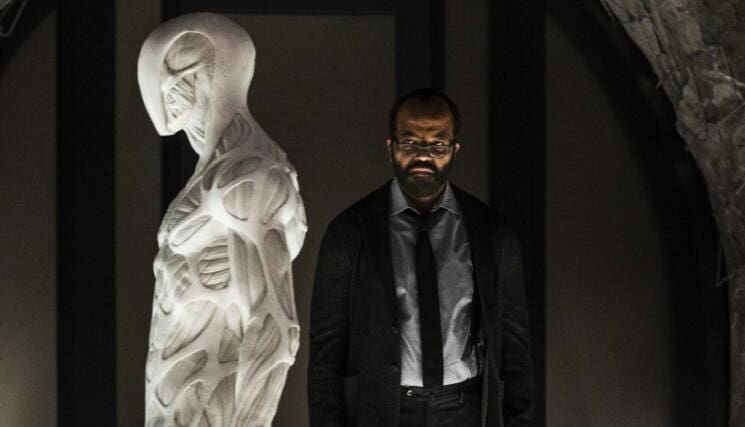 Image Credit: HBO


 Loading...
[Warning: spoilers abound for those who have not seen Sunday’s episode of Westworld.]
The Riddle of the Sphinx is a well-known part of Greek mythology. Part of the tale of Oedipus, it features the anthropomorphic creature asking travelers a question in order to enter Thebes. It’s described as the most famous riddle in history: “Which creature has one voice and yet becomes four-footed and two-footed and three-footed?” The answer, as most can tell you, is “man.” He crawls as a baby, walks erect as an adult and needs a cane when he reaches old age. It’s a riddle about mortality and, ultimately, the finite lifespan of humanity.
Westworld’s fourth episode, which uses the riddle for its title, leans heavily on themes of mortality. As many people speculated a couple of weeks ago, Delos bought into Westworld with the idea of using hosts as a way to prolong lives. But as should have been expected, it’s not that simple. “The Riddle of the Sphinx” divests itself from Dolores’ crusade and Maeve’s quest for her daughter for an hour, all so it can focus on the idea of Delos’ dream turning into as close as a literal representation of Hell on Earth that you can conjure without bringing actual brimstone and demons into the plot.

It’s to Lisa Joy and Jonathan Nolan’s credit that Westworld has developed enough for them to drop their main characters for an episode. I mean sure, Bernard and William are sort of main characters. But this show has had Dolores and Maeve at the wheel since the beginning. A lot of shows would be afraid to not feature them at all, specially when the story is so dense on the page. Westworld not only makes that bold choice, it does so remarkably smoothly. It succeeds in making us almost forget that we’re spending most of our time with Jim and Grace, who we barely know. Bernard is there, and so is William. But they get to step back and cede the forward trajectory of the plot to other characters. That’s a brave move, made all the more audacious because it works.
And what a trip it is. Westworld has not been timid about adding disturbing elements to its heady sci-fi. But the scenes involving Jim in particular raise the bar in how it plays out like a slow-boiling horror show. From the very first moments of the opening scene, it’s clear that there’s something going wrong before we know where we are. Using the Rolling Stone’s “Play With Fire” isn’t subtle foreshadowing, but its effective. Jim’s daily routine evokes thoughts of The Hatch from Lost, or perhaps Patrick Bateman in American Psycho.

And it only gets creepier from there. William’s visit plays out innocuously enough, albeit with some foreboding imagery. But the repeated scenes throughout the episode get worse and worse. Jim had a great plan to stave off his impending death, but he’s instead doomed himself to the darkest of afterlifes. With each visit from William, things get worse and worse. He learns that his wife has died. He later learns his daughter killed herself, and that he’s been through this 148 previous times. It’s not a life at all; it’s condemnation to a Sisyphean existence where it all goes back to a horrific reset.
Peter Mullan’s performance makes it even more chilling, interpreting his cognitive plateau more like biological ticks than technical glitches. It’s a move that lets us see the man underneath and not the host we’re being told to see. That gives us the ability to empathize with a guy we’ve barely met as his world falls apart. And it makes both Jimmie Simpson and Ed Harris’ performances as William that much more diabolical. Let’s face it; knowing that each iteration was going to be destroyed, there’s no way that by the 100th time or so William wasn’t tormenting Jim. His disdain for hosts and plotting nature makes it very likely that each version of Jim after a certain point died knowing the truth.

The build-up is perfectly paced by Joy (who directed) to make Jim’s descent into madness by the end entirely plausible. When Bernard and Elsie find Jim in the remnants of his “apartment,” Jim has gone completely over the edge. He’s carved himself up and degraded to incoherence while that Stones song plays, just waiting for the fire to take him. But as Bernard suggests, just because Jim was a failure doesn’t mean the board isn’t still trying. William may be done with eternal life, but there’s money in that. Jim’s horrific fate gives a real emotional terror to the idea of what may happen if Delos implements their plan. It’s a brilliant, disturbing way to establish the stakes.
Jim’s story is also important in order to bring the mystery of Bernard’s arc into focus. Westworld’s has hit its stride in season two by keeping the mystery grounded in contrast to the way season one was mostly about the build-up. Bernard’s time slippage has a lot of ambiguity to it, to be sure. But unlike the William/Man in Black mystery, there are enough overt clues for the arc to keep from spinning its wheels too much. Of course, his snatching of the human memory core is the big mystery this week.
I think it has to be Robert. Westworld leans heavily on the ghost in the machine trope, and the idea that Robert is moving through his hosts (via the neural mesh mentioned in the season premiere) seems to be the logical conclusion of that. But there are plenty of other compelling possibilities. Nolan and Joy have found the balance between the obvious answers and the potential alternate explanations to make them all plausible — and all fit the story as we know it thus far.

Even as Jim’s arc demonizes William, the episode is taking care not to keep him empathetic, if not sympathetic. The elderly William is a bastard to Jim, sure. But he’s also a man wracked with his own pain, and it drives him to a noble (if violent) path. William’s relationship with Lawrence has not been benevolent, to say the least. But even this callous old man has his limits. When Major Craddock unleashes his brand of torment on Las Mudas, William finds he can’t abide it.
Part of it may be self-serving, of course; he still has use of Lawrence. But William also knows Lawrence’s pain, having seen his own wife dead. When he finally reaches his limit, we briefly get a Man in Black we can cheer for complete with an exploding Craddock. But even then, Lawrence’s daughter goes into Ford mode and reminds William, “I know who you are. One good deed doesn’t change that.” I’m finding myself more and more invested in William’s arc this season as it ties back to the whole. And I won’t lie; I’m really looking forward to what has to be the confrontation between Dolores and William as they lead their forces to the same location.

The introduction of Emily into the narrative only makes that eventual encounter all the more interesting. I was already in love with Grace from her opening sequence last week, when she shot a lover to prove he wasn’t a host and shot a tiger. This week she proves herself the most capable human in the park not wearing a black cowboy suit. So it only makes sense that she’s William’s daughter, of course, arriving at the park in an assumed name. Emily has her own mission in the park, and it’s fair to assume that it has to do with her father. She also might be the only thing William cares about as much as Ford’s game. Again, this raises the stakes for all the characters. It’s just the cherry on top that she’s a genuine bad-ass to boot.
At this point, it’s fair to say that Westworld has acheived a Game of Thrones level of plot complexity. When you have to completely shut out two of your major story arcs for a full episode to give the third proper time, you have a lot going on. But much like that other HBO show, Westworld is pretty deft at keeping things moving along briskly and not (so far this season, at least) bogging down. We haven’t even gotten to the much-hyped Shogun World, but it doesn’t feel like the show has put it off too far into the season. Season one of the show raised a lot of big questions. But season two’s ability to provide just enough answers is really pushing the series to a new level.

Some Final Thoughts:
• Apologies for missing last week. Sundays can be busy around these parts and I had a bunch of things that kept me from seeing the episode in time.
• Elsie lives! And thank Christ, too. “Don’t worry. I’m not gonna brick you, asshole. You got too much shit to answer for.”
• That said, it must be noted that we don’t know if she’s still alive in the period where Bernard is back with Delos. Time will tell on that one.
• As much of an asshole as William is, I like how he respects Dolores in a way. When Craddock talks about how Wyatt got over on them, he murmurs, “good for her.” He seems legitimately proud.
• I mentioned the Hatch scene from Lost earlier, and it’s a clear reference point for viewers familiar with that show. However, Lisa Joy has confirmed that it wasn’t an intentional homage.
• For those who missed it, the Ghost Nation’s “first of us” was the man with Angela in the presentation to Logan from season two, episode two.


