
wrestling / Columns
Ask 411 Wrestling: Is Rock’s Heel Character a Satire of Vin Diesel?
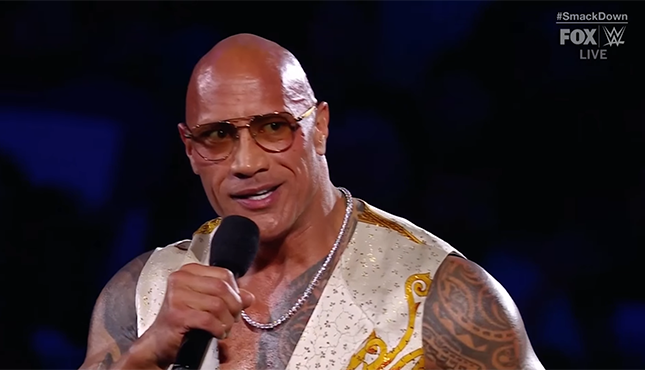 Image Credit: WWE

Welcome guys, gals, and gender non-binary pals, to Ask 411 Wrestling. I am your party host, Ryan Byers, and I am here to answer some of your burning inquiries about professional wrestling.
If you have one of those queries searing a hole in your brain, feel free to send it along to me at [email protected]. Don’t be shy about shooting those over – the more, the merrier.
Hey, ya wanna banner?

Mark S. knows that the Ask 411 readership is a family:
Saw your last article about Rock’s recent heel turn and I had a thought: Do you think that it is a satire of Vin Diesel?
We all know that Rock and Vin do not get along and do you think this is a way for Rock to take the piss out of him? For example, he’s dressing in tank tops like Vin and keeps talking about family like he’s Dominic Toretto. Is this heel turn all a bit of dig at Diesel?
What do you think?
I might be inclined to agree with you if the Rock was an action star who was just now setting foot into wrestling for the first time. However, we’ve got many years of watching heel Rock in WWE, and the current version of the character doesn’t come off as a satire of anybody as much as it does being remarkably similar to the heel role Rocky occupied when feuding with the likes of Goldberg in the early 2000s. And, yes, he’s talking about family quite a bit, but that’s all related to the fact that his current program plays off his own familial ties to Roman Reigns as well as Cody Rhodes’ attempt to finish a story started by Rhodes’ father.
As for the tank tops, they’re obviously inspired by the button-up shirts that the Rock wore in the late 1990s, just with the sleeves cut off and the neckline cut down, because the man has evolved into a beast whose arms and shoulders are too large for 99.9% of modern clothing.
Tyler from Winnipeg fixates on facial hair:
I think it’s time HHH shaved that horrible beard off. It’ll grow back.
So what’s the question here?
APinOZ is all about the numbers:
Apart from the Covid WM36, what’s the smallest live attendance at Wrestlemania?
First off, I want to note that, due to time constraints, I used WWE’s own announced attendance figures to answer AP’s question. As is commonly known and accepted, the company inflates the numbers it gives as part of television broadcasts, as has been the case since at least Wrestlemania III with the mythical 93,173 member audience. Even though those numbers are fabricated, I don’t think that they have been fabricated to the point that the company has announced one event as outdrawing another when it reality it didn’t. In other words, though WWE’s attendances are inflated, I believe they’re all inflated relative to one another.
That being said, the lowest announced attendance for a Wrestlemania is Mania VII, with the show emanating from the Los Angeles Memorial Sports Arena before a claimed 16,158 fans. Of course, this is the card that infamously was moved from the Los Angeles Memorial Coliseum to the Sports Arena due to pathetically weak advance ticket sales for the Hulk Hogan/Sergeant Slaughter main event that was fueled by Gulf War jingoism.
JonFW2 is faking it until he makes it:
Short but very sweet: Is it easier to come into wrestling with an athletic background and learn to act? Or easier to come in as an actor/celebrity and learn to work?
History certainly tells us it’s the former. Terry Funk. Dusty Rhodes. Giant Baba. Antonio Inoki. Steve Austin. The Rock. Jack Brisco. Those are among the biggest names and the most critically acclaimed professional wrestlers in history. None of them were actors who decided to train to become athletes so that they could pursue pro wrestling careers. They were all athletes of some stripe who got in to pro wrestling as a new athletic endeavor and learned the finer points of selling and conveying a character after the fact.
It’s Damion‘s dinner time:
Let’s say for some reason you HAD to start a wrestling promotion but it also had to be a completely different product than AEW/TNA/WWE. What style do you think would be the most accepted/successful if introduced to American viewers?
For example, trying to bring back pure hardcore ECW style, with people getting set on fire and going through a billion tables every episode or lucha libre where most if not all the promos and such are delivered in Spanish or Japanese strong style, etc.?
This is also assuming your promotion had enough stroke to land a few major stars, e.g. if you go lucha you will definitely be able to land Rey Mysterio if that’s who you wanted to be the face of your new promotion.
First off, good job saying “if you had to start a new promotion,” because of the question began with “if you could start a new promotion,” I would probably say that I would not want to start a new wrestling promotion right now . . . there’s already too much product out there, and I don’t know if there’s any room for additional players in the market.
That being said, in this unusual situation in which somebody has a gun pointed at my child’s head and will pull the trigger if I don’t start a new wrestling promotion, I think that the best odds you do have for success would be doing something completely different than what is currently available on television.
As far as my promotion is concerned, even though there are some in-ring stylistic differences, in terms of overall structure I consider WWE, AEW, and even Impact to all be very similar. It’s all the same basic format of matches punctuated with in-ring angles and a couple of things being announced in advance but a lot of the storyline of the show focusing on matches being booked that will air later that night.
I’ve long had an idea for shaking up that structure with something that, to my knowledge, has not been successfully attempted in pro wrestling before. Rather than the show being focused on a wrestling card unfolding in an arena, the show would be a hybrid of traditional professional wrestling and reality television. It would be a mixture of documentary-style segments building up matches, exploring the personalities involved in them, and discussing the consequences of the bouts. Then, we would see the match itself. The “reality” segments would be patterned on the HBO 24/7 boxing series that was used to build fights in the late 2000s and 2010s – except that all of the content would be worked.
The actually style of matches in the ring could be varied but, because the reality segments would focus on sitdown interviews and training footage of wrestlers, you would mainly recruit talent that is comfortable building matches in that manner. A guy like Paul Heyman could be a critical asset, not as an in-ring performer, but as somebody who would likely understand this style of fight promotion and excel in it.
The moniker of Triple T Ticking Time Bomb Tazz just keeps getting longer and longer:
I enjoyed the Waylon Mercy character in WWF. It seemed the character had a lot of potential, but was abruptly gone from TV. What happened?
Veteran wrestler Dan Spivey was rechristened as Waylon Mercy by the WWF in 1995, but the gimmick was short-lived because Spivey was broken down physically from working a hard style and had to get out of wrestling altogether. His last match as Waylon Mercy was on October 10, 1995 against Bob Holly on a WWF European tour, and he never stepped foot into a wrestling ring again except for taking part in a ten-man tag for Dory Funk Jr.’s !BANG! Wrestling promotion in 2015.
After wrestling, Spivey had a career as a male model for a time.
All around the world, statues crumble for William J.:
I remember as a kid after WCW folded there was a PPV with a bunch of WCW guys. I can’t remember what it was called. I think it eventually turned into TNA. I know Jeff Jarret and Sting were on the show. Any clues? I want to say World Wrestling was a part of the title but not a 100% sure.
You’re talking about World Wrestling All-Stars.
The WWA was the brainchild of Andrew McManus, who was a music promoter in Australia and who had previously attempted to run a wrestling tour of his home country in the year 2000 when WCW was still functioning. The major draw on that tour was Dennis Rodman, and it resulted in a show called iGeneration Superstars of Wrestling that was taped in Sydney on July 30, 2000 and aired on U.S. pay per view in December of the same year. Top matches were Rodman versus Curt Hennig and the Road Warriors taking on Public Enemy in a double tables match. There were apparently several shows on this tour, but results are difficult to come by. iGeneration actually wound up canceling the last bit of it due to injuries, and a planned second tour never materialized.
However, when ECW and WCW both went under, McManus tried it again, this time under the moniker of World Wrestling All-Stars. Though it wasn’t a smash success, WWA did a fair amount better than iGeneration, running five tours of the UK and Australia and five pay per view events (one in the U.S.) between 2001 and 2003.
The shows mostly consisted of former WCW talent who were not snapped up by the WWF, joined by guys like Road Dogg and Brian Christopher who made their names in the Fed but were on the outs with the company at the time. Eddie Guerrero also appeared for WWA during the period that he had been fired by the WWF due to his substance issues, and the company tried to make a homegrown Australian star out of Nathan Jones before he signed a WWF contract.
WWA didn’t “become TNA,” though after TNA was founded the two companies started working closely together and TNA talent would appear on WWA shows. In fact, WWA’s last pay per view featured their world championship being unified with the NWA World Heavyweight Title (then controlled by TNA) and their cruiserweight championship being unified with the NWA-TNA X Division Championship. However, WWA never ran again after that show, so we’ll never quite know what WWA would have looked like as an NWA territory.
Voice of Logic from Disqus is coming down the aisle:
I was watching This is Awesome on Peacock the other night, specifically the episode about WWE weddings. It got me wondering about “first time ever” in wrestling. What was the first wrestling wedding?
In December 1984 on an episode of WWF Tuesday Night Titans, Paul “Butcher” Vachon married a young woman by the name of Ophelia, which set up a food fight instigated by “Dr. D” David Schultz. That’s where the whole thing began, as near as I could tell.
Doug has fallen to his knees and is staring at his hands in disbelief at what he has just done:
Bob Backlund vs. Iron Sheik, 12/26/83. Backlund himself referred to the end of this match as proof that he never lost the title during his early-90s heel run. Who would be the lineal champion in this scenario?
For those who don’t recall, a lineal championship is a concept that we have explored several times during my run on this column, and in short it traces what the history of a title would be if the belt could only change hands by pinfall or submission in one-on-one encounters. Dig through the archives if you’d like to see more examples.
Kicking things off, Backlund doesn’t lose a match by pinfall or submission for roughly eighteen months after the Sheik match, finally dropping a fall to Larry Zbyszko on June 29, 1985 as part of an AWA show in Rockford, Illinois, making Larry Z. our lineal WWF Champion as the actual WWF is now in the clutches of Hulkamania.
It doesn’t take long for Bob Backlund to get his win back, as he defeats Zbyszko again for the AWA on July 11, 1985 in Salt Lake City, Utah.
After the summer of 1985, Bob takes some time off from professional wrestling, and he doesn’t resurface until over three years later, specifically on December 22, 1988 in Osaka, Japan for the UWF, where he loses by TKO to Nobuhiko Takada.
The next month, Akira Maeda defeats Takada on another UWF show. That’s January 10, 1989 at the Budokan in Tokyo.
Maeda is undefeated for a year, and, when he loses again, it’s once more to Nobuhiko Takada, making Maeda a two-time lineal WWF Champion. The match occurs on January 16, 1990, back in the Budokan.
Yoshiaki Fujiwara, inventor of the Fujiwara armbar, picks up a win over Takada in a Japanese city that I’ve never heard of before: Minamiashigara. Try saying that one five times fast. In any event, that’s on February 27 of 1990, still for the UWF.
Fujiwara is knocked out by Kazuo Yamazaki on April 15, 1990 in Fukuoka on a UWF card. Though he’s the lineal WWF Champion here, younger puroresu fans will probably better member Yamazaki from his run doing color commentary for New Japan Pro Wrestling.
We’re continuing a run of legendary shoot style wrestlers winning our fake championship, and up next is Masakatsu Funaki, who wins over Yamazaki by TKO on June 21, 1990 on a UWF card in Osaka. (For readers not particularly familiar with Japanese wrestling, this is not the Funaki who was part of the WWF roster in the 1990s and 2000s. That’s Shoici Funaki, no relation.)
Another two-time lineal WWF Champion is crowed, with Akira Maeda going over Funaki on October 25, 1990 for the UWF, once more in Osaka.
After spending five years in the UWF, the lineal WWF Championship jumps promotions again, following Akira Maeda to RINGS. While there, he loses it to Dick Vrij on August 1, 1991, still in Osaka. Vrij is a name that I wasn’t even familiar with, but apparently he’s a Dutch MMA fighter who dabbled in pro wrestling with 90% of his matches taking place in RINGS.
On January 25, 1992 in Urayasu, Japan for RINGS, Akira Maeda wins a rematch with Vrij to become a three-time lineal WWF Champion.
We’ve seen Americans, Japanese, and Dutch in our lineal title history thusfar, so let’s mix it up with a Russian! Volk Han beats Maeda on the April 3, 1992 RINGS card in Hiroshima.
After some Russian-on-Russian violence, Andrei Kopylov upends Volk Han on July 16, 1992 on yet another RINGS show in Osaka. Interestingly, this match was Kopylov’s professional wrestling debut after nine years as a competitor in the Soviet marital art of sambo.
Hey, look, it’s Akira Maeda again, now a four-time lineal WWF Champion. On August 21, 1992, he defeats Kopylov in Yokohama for RINGS.
You probably didn’t think we’d see another Dutch guy on this list, but here we are, as Chris Dolman defeats Maeda in the RINGS Mega Battle Tournament in Tokyo on December 19, 1992. Dolman spent a few years as a professional wrestler but throughout his career was primarily a judoka and sambo player.
Dolman would go on to defeat his countryman Dick Vrij in the finals of the Mega Battle Tournament, and he would remain undefeated in professional wrestling until August 21, 1993, when Volk Han would reclaim the lineal WWF Title for mother Russia in Yokohama for RINGS.
Now we move in to the 1993 installment of the RINGS Mega Battle Tournament, which sees a couple of lineal title changes. On November 18, Nikolai Zouev beats Volk Han in the second round of the tournament, making him the lineal champion. Zouev is another Russian MMA fighter who had a relatively brief pro wrestling career, mostly in RINGS.
On December 8, 1993, in the semi-finals of the Mega Battle Tournament, Georgian karate practitioner Tariel Bitsadze picks up a victory against Zouev by referee’s decision.
The finals of the 1993 Mega Battle Tournament actually take place in 1994, specifically January 21, 1994 in the Budokan. In those finals, Bitsadze goes down at the hands of Akira Maeda, who is now a five-time lineal WWF Champion.
On September 21, 1994, Dick Vrij once again captures our fake championship, picking up a TKO victory against Maeda in less than three minutes. This occurs at the Osaka Prefectural Gymnasium.
Did I mention that there were a lot of Dutch guys in RINGS? There were, because another one of them, Hans Nijman defeats Vrij on November 19, 1994 in the third round of that year’s Mega Battle Tournament, held in Tokyo. Nijman had experience in karate and kickboxing and would enter MMA the following year.
On December 19 in the semi-finals of the same tournament, Akira Maeda becomes a six-time lineal WWF Champion by defeating Nijman in Osaka.
Maeda goes on to win the Mega Battle Tournament in addition to remaining undefeated for many more months, until Volk Han comes back to our fake title history for the first time since 1993, beating Akira on April 22, 1997 in Osaka, once again on a RINGS show.
https://www.youtube.com/watch?v=E5aoU1hiZAs
We’ve got a new name on the list for the first time in a while, with Yoshihisa Yamamoto going over Han by TKO on August 13, 1997 in Kagoshima for RINGS. Yamamoto was another guy who got into pro wrestling with RINGS following a judo career, and he moved to legitimate MMA not long thereafter.
Yamamoto doesn’t even wrestle for almost a year but, when he gets back into the ring, he loses immediately to Akira Maeda, now a seven-time lineal champion. This occurred on July 20, 1998 in Yokohama for RINGS.
In what would actually turn out to be Maeda’s last professional wrestling match, he loses on February 21, 1999 to Aleksandr Karelin in Yokohama for RINGS. Karelin was an amazing Greco Roman wrestler and three-time Olympic gold medalist before appearing in this match.
Now we find ourselves with an interesting development. This was actually Karelin’s one and only pro wrestling match that I could find record of, so he effectively retires immediately upon becoming lineal champion. What I have done in past lineal championships when somebody leaves the sport while champion is revert back to the prior title holder as of the date of the retirement. However, Karelin’s last match was ALSO Maeda’s last match, so we would go back one more level to Yoshihisa Yamamoto.
Yamamoto is still wrestling as of February 21, 1999, but he remains undefeated through the end of his career on June 24, 1999. This means we have to go back yet another level to Volk Han. Han ALSO had his last match on June 24, 1999 (which by the way is the next-to-last RINGS show), though he lost that match to a guy named Grom Zaza, the second Georgian we’ve seen on this list. Zaza was another amateur wrestler turned pro wrestler turned MMA fighter.
Unfortunately, we find ourselves with the exact same issue, as I don’t have record of Zaza ever having another pro wrestling match. We would normally revert back to Maeda, but he’s gone as previously established, so we have to look to Hans Nijman as of June 24, 1999 and thank god he loses to somebody who has a bit more of a career – though it takes our lineal WWF Championship in a bit of an interesting direction.
After the close of rings, Nijman has only two more pro wrestling matches, and the first of those is for Pro Wrestling ZERO-ONE on December 9, 2001 in Osaka, where he loses to Gerard Gordeau, who had some pro wrestling experience but was mostly known as a Dutch kickboxer. This is, by the way, the first time the lineal WWF Championship has left RINGS since 1991, spending a decade in that company.
Gordeau doesn’t have many pro wrestling matches left in his career, but one of them he loses cleanly to Steve Corino also on a ZERO-ONE card and this time on May 3, 2002 in Matsuyama, Japan. This brings the lineal WWF Championship back to a traditional pro wrestler for the first time since the 1980s, when it fell into the shoot style world. It also adds another nationality to our very diverse list of title holders, as Corino, the Canadian, joins Americans, Japanese, Dutch, Russians, and Georgians.
This comes at a time when Corino was ZERO-ONE’s top foreign heel, so it makes sense that he would lose the lineal WWF Championship to one of the promotion’s top domestic babyfaces, which happens on May 22, 2002 in Sendai, as Corino goes down at the hands of Shinjiro Otani.
Here’s a name I didn’t expect to see. Remember Nathan Jones, perhaps one of the worst WWE wrestlers of all time and a guy who we just got done talking about in connection with the WWA? Well, he shows up in ZERO-ONE on June 30, 2002 in Sapporo, and he defeats Otani to become the lineal WWF Champion.
Now we get even more obscure than Nathan Jones. In between ZERO-ONE shows, Jones travels to Melbourne, Australia, where he competes on a show promoted by the aforementioned World Wrestling All-Stars. On that show, Jones loses a match to the WWA World Heavyweight Champion Scott Steiner on October 16, 2002.
Then, in a move that I wasn’t expecting, the lineal WWF Championship lands in WWE, as Steiner signs with the company. He remains undefeated for quite some time, eventually suffering his first loss in the company at the hands of Triple H at the 2003 No Way Out pay per view. At the time, Trips was also the World Heavyweight Champion, unifying the lineal WWF Title with the WWE version of the World Heavyweight Title that was created in 2002. Steiner also never lost the WWA Championship before going to WWE, so I guess you can say the lineal WWA Title is lumped in there too. Hey, a bonus lineal title history!
Triple H loses that World Heavyweight Title to Bill Goldberg at the 2003 Unforgiven 2003 pay per view, also making Goldberg the real World Heavyweight Champion and the lineal WWA Champion. When Goldberg loses the World Title, he doesn’t lose the lineal WWF Title because he dropped the World Title in a triple threat, and a lineal title can only change hands in a one-on-one bout.
Goldberg doesn’t lose another singles match for almost fourteen years, when Brock Lesnar pins him at Wrestlemania XXXIII in a match that was also for the WWE Universal Championship, which Goldberg had taken off of Kevin Owens roughly one month earlier.
Roman Reigns takes the Universal Title, the lineal WWF Championship, and the lineal WWA Championship at Summerslam 2018.
In an oddity of a result that still boggles my mind to this day, Shane McMahon pins Roman Reigns at the 2019 Super Showdown pay per view in Saudi Arabia.
Fortunately, we don’t have to deal with Shane as a fake WWF Champion for too horribly long, as Kevin Owens pins Shane-o-Mac at Summerslam 2019 in Toronto.
Just two short days later, Samoa Joe defeats Owens on a Smackdown taping, also in Toronto, on August 13, 2019.
Four days alter, August 17, 2019, Kevin Owens takes the lineal WWF Championship back from Joe at a house show in Houston, Texas.
Three days after that, Shane McMahon rears his ugly head again, this time as a special guest referee who screws over Owens and causes him to lose to Elias Sampson on August 20 in Sioux Falls, South Dakota. This match was also part of the first round of the 2019 King of the Ring tournament.
Sampson gets hurt and has to spend some time on the shelf, so he goes undefeated for quite a while, not losing until October 26, 2020, when he is beaten by Keith Lee on an episode of Monday Night Raw in Orlando, which is also a match in which the winner would qualify to wrestle in a Survivor Series elimination match.
And here’s an interesting one as the lineal WWF Championship that beings with Bob Backlund is reunified with the ACTUAL WWE Championship when titleholder Drew McIntyre pins Lee on January 4, 2021 in the infamous WWE Thunderdome in St. Petersburg, Florida.
The lineal and real world WWE Titles continue to go hand-in-hand, as Mike the Miz cashes in his Money in the Bank briefcase at the 2021 Elimination Chamber pay per view, once again live from the Thunderdome.
Continuing our tracking of the real WWE Title lineage, Bobby Lashley beats Mike the Miz on March 1, 2021 on Monday Night Raw, and we’re still in the Thunderdome.
In what had to be considered a bit of an upset, Kofi Kingston pins Lashley on May 17, 2021’s episode of Raw, yet again in the Thunderdome.
Two weeks later, on May 31, 2021, Drew McIntyre becomes a two-time lineal WWF Champion when he comes back to the Thunderdome and goes over Kofi in a match that was also for the number one contendership to the WWE Title.
That number one contendership doesn’t go as McIntyre would have hoped, as Bobby Lashley picks up his second lineal WWF Championship when he defeats the Scot in a Hell in a Cell match at, appropriately enough, the 2021 Hell in a Cell pay per view. Lashley is also the real WWE Champion at this point, so the real and fake belts merge once more.
I called it an upset when Kofi Kingston beat Bobby Lashley, but the even bigger upset comes when Xavier Woods picks up a win and the lineal WWF Title on the July 6, 2021 edition of Monday Night Raw, yet again at the WWE Thunderdome.
Bobby Lashley is now a three-time lineal WWF Champion, as he gets his win back over Woods on August 22, 2021 in Denver, Colorado, this time at a house show. Hey, wait a minute, Denver! The Thunderdome era must finally be over!
We can now call all three members of the New Day lineal WWF Champions, as Big E Langston beats Lashley on September 13, 2021 in Boston, Massachusetts on Raw. This is also the match in which Big E becomes the actual WWE Champion.
In a non-title match, Roman Reigns pins Big E at the 2021 Survivor Series at the Barclay’s Center in New York to become a two-time lineal WWF Champion.
If you haven’t noticed, this Roman Reigns guy doesn’t lose a lot. He’s still our lineal WWF Champion to this day . . . but we’ll see if that changes come Wrestlemania.
We’ll return in seven-ish days, and, as always, you can contribute your questions by emailing [email protected]. You can also leave questions in the comments below, but please note that I do not monitor the comments as closely as I do the email account, so emailing is the better way to get things answered.
More Trending Stories
- More Backstage Details on WWE Release of Keanu Carver
- Note on Big Cass’ Status as WWE Singles Talent Following Defeat to Dragon Lee on RAW
- Former Spike TV Head Recalls Confronting Vince McMahon About RAW Ratings Drop After The Rock Left WWE
- Former Spike TV Head Kevin Kay Recalls Vince McMahon ‘Power Move’ In Men’s Bathroom


