
wrestling
Ask 411 Wrestling: Who Should Ultimately Brock Lesnar?
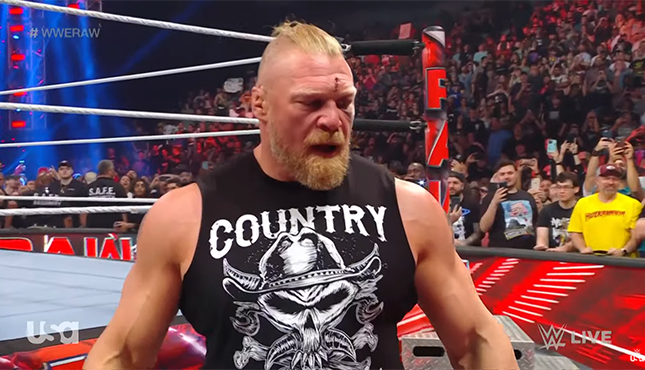 Image Credit: WWE

Welcome guys, gals, and gender non-binary pals, to Ask 411 Wrestling. I am your party host, Ryan Byers, and I am here to answer some of your burning inquiries about professional wrestling.
If you have one of those queries searing a hole in your brain, feel free to send it along to me at [email protected]. Don’t be shy about shooting those over – the more, the merrier.
Hey, ya want a banner?

I’ve been told I should promote my Twitter account more. So, go follow me on Twitter.
Mike of Da F’n Jungle has plans to vanish for 20 years after this question, only to return to star in a sequel to The Whale:
When Brock Lesnar got that standing ovation after Backlash it got me thinking about his eventual retirement, which I have to imagine is happening within a few years.
My questions are these: Who would you have retire Lesnar? How would you book the program? Who would induct Brock into the Hall of Fame?
Deciding who should retire Lesnar is a bit of a moving target, because we don’t know exactly when the man once known as the Next Big Thing will be hanging up the boots. However, if we assume that it’s going to happen in the next two to three years, there’s one name I have in mind:
Bron Breaker.
My thought is that you could call Breaker up to the main roster somewhere between eight months and a year before you know Brock is going to have his final match. Have the Son of Steiner go on an undefeated streak where he runs through several mid and middle-high card wrestlers and even a couple of your regular main eventers before throwing down a challenge to the Beast Incarnate.
Book the two men against each other in a match on one of the biggest pay per views of the year and give Breaker a victory that is clean and decisive.
Sound familiar?
It should. What I am proposing is essentially a bookending of Lesnar’s career. What the Rock did for Lesnar in 2002, Brock would do for Bron in 2024 or 2025. The formula worked once before and it could work again, and it is perhaps the most poetic way for the former UFC Heavyweight Champion to pass the torch.
The only potential negative that I can see here is that Breaker has already been kicking around NXT for closing in on two years, and some might see keeping him in developmental for another year or two as stalling out his career. If that’s the concern, I would recommend that WWE do something a bit outside their norm and send Bron elsewhere for a while. Strike up a deal with a Pro Wrestling NOAH or a cabal of British indies and let Breaker continue to hone his craft in another promotion until he’s ready for the main roster debut that would build to his match against Lesnar.
As far as inducting Lesnar into the Hall of Fame is concerned, the person to do the honors is a no brainer. It’s Paul Heyman. He has been instrumental in the entirety of Lesnar’s career, including his time away from pro wrestling, and he is perhaps the single greatest living promo guy in professional wrestling. I’m not sure how you could do anything else if all parties were willing and able.
That being said, I do have a couple of thoughts regarding alternatives if for some reason Heyman weren’t an option. The first is Dana White. White was the mastermind of a large portion of Lesnar’s combat sports career, and we might be seeing more synergy between WWE and UFC now that the two companies are folding in under the same corporate umbrella. The second is Shelton Benjamin. Shelton doesn’t have a reputation as a good stick man, but he does have more history with Lesnar than just about anybody in wrestling, going back to their days as amateurs.
Josh is looking under the hood:
I have a two part question about Mexican wrestlers and their masks. First, who decides if a wrestler is to lose their mask or not? Have their been wrestlers who have refused to lose it and then jump to another promotion to protect it? And since masked wrestlers enjoy a sense of anonymity since their true identities aren’t generally revealed to the public, why would they want to expose all of this after they unmask.
As to who decides whether a luchador loses their mask, the answer is . . . it depends.
If you’re a younger wrestler and the promotion that you’re working for came up with and owns your gimmick, chances are good that they’re going to be telling you when or if it’s time to lose it. However, if you’re a more established wrestler and/or you own your own character, then dropping your hood in the ring (or your hair, for that matter) is a negotiation. It is well known in Mexico that a well known wrestler losing their mask is going to draw a significant amount of money, so those wrestlers and major companies will be in contact with one another when either the wrestler is set to end their career and wants one last major payoff or when the promotion needs a big main event for an upcoming card. If they can work out a deal, the match is on and the mask is off. If they can’t, there’s always next year.
These deals can and have fallen apart in the past. One of the biggest recent examples that I can think of comes from 2018, when L.A. Park (the original La Parka who was with WCW back in the ’90s) made a return to CMLL to start a feud with Rush, now of AEW fame. It was reported that this was building to a Park/Rush mask versus hair match at the company’s 85th Anniversary Show on September 14, which would end with Park, who was 52 years old at the time and presumably on his way out of the business, dropping the fall and unmasking. However, word is that Park realized that he was still drawing pretty damn well and decided to keep wrestling for a few more years, so he ultimately declined to do the match after shooting angles for it.
Park was a free agent at the time, so he didn’t really leave the promotion per se. In fact, he still wrestled on the Anniversary Show that year, just lower on the card in a trios match with his son and Caristico (a.k.a. Mistico a.k.a. the original Sin Cara in WWE).
Today, almost five years later, L.A. Park is still wrestling with his mask in tact.
Finally, why would a wrestler want to unmask? There are any number of reasons. If we’re talking about a younger wrestler, it’s often to take their career or gimmick in a different direction. Sometimes wrestlers will unmask with one gimmick, disappear for a while, and reappear as another character sometime later. Rey Misterio Jr. is actually a good example of this. He was trained by his uncle, the original Rey Misterio, and the hope was to pass the gimmick on to Rey Jr. However, the senior Misterio did not want to do that until the younger wrestler had proven himself. As a result, Rey Jr. wrestled under the name and mask of Colibri in his early matches before eventually losing that mask and moving on to bigger and better things. The wrestler who WCW fans will know as Psicosis had a similar track, as he first gained popularity under a mask as Winners, lost that mask, and was later repackaged as Psicosis.
If we’re talking about an older wrestler, I pretty much answered that question already . . . it’s money. Usually if a veteran drops their mask, it’s because their career is winding down anyway and they want a big bag of cash on the way out the door.
My second question is how is Rey Mysterio allowed to continue to wrestle with his mask on when WWE tours Mexico? Apparently the Box Y Lucha commission monitors wrestlers to make sure they don’t revert to their old gimmick after unmasking and if I remember correctly, wasn’t there some sort of issue of Mysterio wearing his mask in Mexico after he had lost it back in WCW?
Not to sound redundant but, once again, the answer is money.
WWE is the global leader in professional wrestling, and, even though Mexico has its own native promotions, WWE was going to bring boatloads of cash and international attention to the country. The commission wasn’t going to let Rey Misterio’s mask stand in the way of he positive economic impact of WWE running the country with a bona fide lucha libre star on top.
Tyler from Winnipeg usually asks simple questions, but this one took some time:
Winning percentage wise, matches in and won, who has a bigger winning percentage, Kurt Angle or Del Wilkes?
For anybody reading this who may not know, Del Wilkes is the wrestler best known as the masked Patriot, who debuted in the late 1980s as “The Trooper” in the AWA and then adopted his more popular gimmick in the 1990s.
Also, to see if it lead to any more interesting data, I gathered the two wrestlers’ win-loss records not just overall but also broken down by promotion. I should note that all of these figures come out of CageMatch, and your mileage may vary if you us a different database or databases.
Looking to the WWF/WWE, Kurt Angle complied a career record of 516 wins, 483 losses, and 25 draws for a total of 1,024 matches wrestled and a winning percentage of 50.40%, meaning you could basically flip a coin to determine if Angle was going to win any given match in that promotion. Moving on to TNA, the Olympic gold medalist fared somewhat better, with 286 wins, 184 losses, and 19 draws for 489 total matches and a winning percentage of 58.5%. Finally, in miscellaneous promotions, Angle racked up 48 wins, 13 losses, and 1 draw for 62 matches and a 77.4% winning percentage. (In case you’re curious, those miscellaneous promotions mostly included proto-WWF developmental matches and a few shots for Japanese promotions during his TNA run.) This leaves Angle with an overall career total of 850 wins, 680 losses, and 45 draws, i.e. 1,575 matches, emerging victorious in 54% of them.
Now, let’s take a look at Wilkes. As noted, he started in the AWA, where he got 21 wins, 3 losses, and 1 draw for a total of 25 matches and a winning percentage of 84.0%. After that, Del first wrestled as the Patriot in the Global Wrestling Federation, where he had 27 wins, 2 losses, and no draws, giving us 29 matches and a staggering 93.1% winning percentage. The bulk of Wilkes’ career actually took place in All Japan Pro Wrestling, with 254 wins, 196 losses, and 3 draws, adding up to 453 matches and 56% of his matches won. (Interestingly, if you took at his first two or so tours with the promotion, he’d have done MUCH better, as it seemingly took AJPW a bit to warm up to the guy.) Up next we head to WCW, where Patriot won 99 times, lost 34 times, and drew 1 time for a promotion total of 134 matches and a 73.9% winning percentage. Then it’s off to the WWF for a relatively short run, namely 26 wins, 16 losses, and no draws, or a total of 42 bouts and a 61.9% winning percentage. Finally, we have some matches for miscellaneous groups, mostly indies in the Carolinas that Wilkes would work for when he was back at home in between Japanese tours. Those give us 14 wins, 6 losses, and 2 draws or 22 matches, winning 63.6% of the time.
On the whole, Wilkes wrestled 705 matches throughout his career, winning 441, losing 257, and going to a draw in 7. That means he won 62.6% of his matches, giving him an better career win-loss record than Kurt Angle by several percentage points. It’s also interesting to me that Wilkes still handily beats Angle if you compare only their WWF careers, given that the Patriot was considered to be a bit of a flop there whereas Angle was a major star.
What accounts for the difference between the two men’s records? Why did the Patriot win more than Angle despite Angle being the bigger name?
My hypothesis is that it has to do with their heel / face alignments. As most reading this will be aware, Angle switched back and forth between those roles throughout his career, probably coming out more on the heel side. (Please nobody ask me to calculate the percentages of his career that he was in each position.) Meanwhile, for obvious reasons, the Patriot was a babyface everywhere he went in the U.S., including his time in WCW, during which he wrestled quite a few more matches than I remembered. If you are a putting together a wrestling card, particularly a house show, and it doesn’t really matter in the grand scheme of things who wins and who loses a match, you are probably going to default to having the face win, because that leads to an overall more satisfying experience for the fans, and you want your fans to associate your show with positive emotions. Thus, Patriot probably racked up quite a few more wins than Angle on just that basis alone.
Unfortunately, we never got to see the two men lock up with one another, as Del Wilkes’ career ended before Kurt Angle’s really got off the ground.
Uzoma pounces on to the column:
I read that the reason Monty Brown left WWE (where he competed as Marcus Cor Von) and retired from wrestling is because his sister passed away and he chose to look after her children. Is that true?
If you google around, there are tons of websites that state this as a fact, but none of them cite what I would call a credible source. The sources that I do tend to use when answering questions of this nature say nothing of the specifics of the situation that caused his departure and instead reference issues in his family more generally. I attempted to research further to find an online obituary of somebody who I could have identified as Brown’s sister, but that did not turn up anything, either.
So, it definitely as a family circumstance that lead to him leaving wrestling, but I am not willing to say anything more than that without concrete documentation.
Paris is always on the alert:
In a world where you still believe wrestling is real, wouldn’t the 24/7 title be awesome? Imagine, you’re walking down the local pavement with your best friend who happens to be and always dresses like a ref. Seeking a nice cuppa creamed ice during the summer solstice you happen upon the current champ frolicking. You too can become a champion. Now’s your shot. If you can distract the ref you can use a fork or sledgehammer. I guess my question is whether Vince is out of touch of just able to still believe?
I think that if you somehow still believed professional wrestling was legitimate in 2023, as soon as you heard about the 24/7 Championship, you would immediately no longer believe that professional wrestling was legitimate. That’s not how sports work. You don’t just let a competitor immediately start a contest with another competitor who has not had any opportunity to train, let alone know that the match was coming.
It’s the sort of thing that would totally blow any credibility wrestling had, if wrestling still had credibility at the time it was introduced.
Big Al takes on Big Dave:
How did Dave Meltzer get his start and become so popular? Did he have contacts in the WWF/E at one point? I know he gets a lot of criticism now because he seems to wrong quite a bit with the “plans are subject to change” line but was he at one point accurate for the most part?
Meltzer is accurate for the most part. Always has been. Probably always will be. The reason that’s the case is because he DOES have contacts in the WWF/WWE. Again, always has (except for very early on) and probably always will.
In my experience, most if not all of the people who criticize Meltzer for getting stories wrong these days don’t actually read what he’s writing. If you want to actually subscribe to and read the Wrestling Observer newsletter cover to cover for six to eight months and tell me that Meltzer is wrong more than he’s right, I’ll have that conversation with you. I’m not willing to have that conversation with people who only read summaries of what Meltzer wrote on websites that aggregate content from his newsletter, and that includes 411mania.
I say that because I have been an Observer subscriber for years, and I have been familiar with wrestling news aggregator sites for years. Frankly, and I don’t mean to offend anybody associated with 411 when I say this, the aggregators do a rotten job and make Meltzer look like a significantly worse reporter than he actually is. There are, in my opinion, three primary ways in which this happens. The first is that there are some aggregators (and 411 does not do this), which just outright make things up and attribute them to Meltzer. This is not as bad as it once was, but it happens. The second is that the aggregators sometimes only report a portion of what he said or otherwise left out key context.
The third – and this happens A LOT, even at 411 in the past – is that sometimes things Meltzer says get reported as news, even though they were not intended to be news. Da Meltz is active on Twitter and does quite a few podcasts in addition to his newsletter. Sometimes in those forums, he is asked for his opinion on something or gives a prediction not based on what his sources have told him but rather based on what he thinks will happen given his decades of experience following the industry. He’s usually fairly clear when he does this. However, some sites looking for a quick headline will take Meltzer’s opinion or prediction and report it as though he said he was conveying a verified fact. This issue is compounded when you have news aggregators not even aggregating directly from the source and instead aggregating from other aggregators.
And, yes, he takes flack for the “plans change” line. However, if you listen to a shoot interview with almost anybody who has worked in WWE for the last fifteen years, they’ll tell you that plans DO change. A lot, and at the last minute. However, everybody who dumps on Meltzer likes to conveniently ignore this.
Regarding how he got his start, the short version is that Meltzer went to college for sports journalism and completed his degree, then covering legitimate sports for several years. He had always been a wrestling fan and was a tape trader, back in the pre-internet days when the only way to do that was getting on a mailing list for physical mail. He would mail out the list of tapes that he had available to trade to others, and eventually he started including match results from different territories across the country. Eventually, with his background in sports writing, this turned into a full-on newsletter. In its early days, the Observer was advertised to fans in wrestling magazines, and it got a huge boost in exposure when Meltzer was brought on to cover wrestling for The National, a daily newspaper focused solely on sports that existed for a time in the early 1990s.
Meltzer got another surge in popularity in the late 1990s when he was asked to host a daily internet radio show on the short-lived eYada.com, a concept that was ahead of its time and effectively served as a precursor to podcasting. The show, Wrestling Observer Live, morphed into a nationally syndicated radio show and still exists in that format to this day, though Meltzer no longer hosts it himself.
Big Dave’s third significant bump in notoriety among wrestling fans came in 2008 when, after resisting moving the Observer newsletter online for years, Meltzer merged his business with that of fellow newsletter writer and Wrestling Observer Live co-host Bryan Alzvarez, creating a system where the newsletter could be accessed in a significantly more convenient format by a broader audience, in addition to increasing the footprint of his audio content through podcasting.
We’ll return in seven-ish days, and, as always, you can contribute your questions by emailing [email protected]. You can also leave questions in the comments below, but please note that I do not monitor the comments as closely as I do the email account, so emailing is the better way to get things answered.
More Trending Stories
- Backstage Details On R-Truth vs. Damian Priest WWE SmackDown Finish
- Note on Reasoning Behind Recent ‘Midnight Dreamer’ Video Posted by Tommy Dreamer on Social Media
- Billy Gunn Talks About Triple H’s AEW Comments at 2019 WWE Hall of Fame Ceremony
- TNA Wrestling Reportedly Held Talent Meeting Over Contract Expirations, Multiple Contracts Nearly Over


