
wrestling / News
Eric Bischoff Reflects On How Fake Sting Angle Built The ‘Crow Sting’ Character
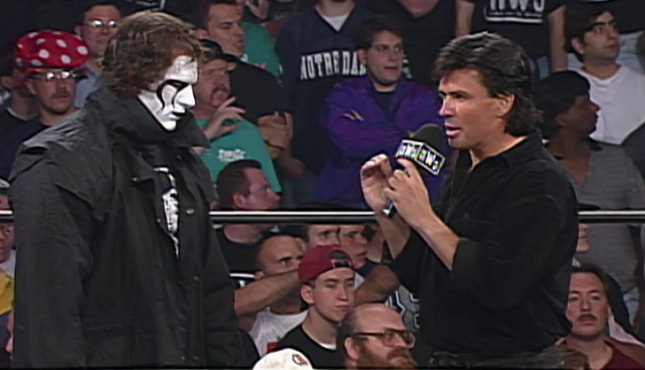 Image Credit: WWE

On the latest episode of 83 Weeks, Eric Bischoff and Conrad Thompson went back to the September 9, 1996 episode of Nitro from Columbus, Georgia, the night an imposter Sting climbed out of an NWO limousine and helped beat down Lex Luger. Bischoff talked about where the idea for the fake Sting may have come from, which part of the story he can claim, and how it fed into the character Sting became. You can check out his comments below:
On Who Came Up With Fake Sting:
“I wish I knew. Again, what came first, the chicken or the egg? Did we all sit around a table and say, ‘Boy, I wish we knew somebody that looked like Sting, we have this great storyline where we have a fake Sting, and it plays out over the course of six months?’ That’s not true. I don’t know. Here’s the possibilities. Don’t exclude Andre Freitas, because sometimes Andre would see something that perhaps he could create in his world, prosthetics of some kind, masks to create illusions and diversions and surprises, that type of thing. And Andre knew that I was always looking for those opportunities, so it could have been Andre to someone to Kevin Sullivan saying, ‘Hey Kevin, I know a guy that looks just like Sting, is there any way you could use him in a story?’
“Could that have happened? Absolutely. Could it have come up in a room and just evolved in front of us like I described before, like most ideas do? So that could have been it. I wish I knew, because it’s the kind of idea that deserves special attention, and credit to whoever it was that came up with it. It certainly wasn’t me, and like I said, my estimation was probably a number of people.”
On The Part He Does Take Credit For:
“That angle, that part of the story in particular, that was mine. And I say that only because I remember being excited about the creative that it would open up down the road. Betrayal, that’s what this is. The essential element of this story is betrayal. And everybody, and almost every age group, can relate to that feeling of having been betrayed, or maybe a fear of betrayal. So it’s a really fertile piece of ground to develop stories on. And I thought if we could create the situation where people were doubting [Sting], and basically betraying him because they believed he betrayed them, that again we’d have acres and acres of fertile ground to plant some pretty good story seeds on.”
On How the Story Built the Crow Sting Character:
“I think if you look back now, with the benefit of hindsight and more experience and a different way of looking at things. Didn’t know it at the time, but it’s a perfect example of how critical a good story is to a good character, is to a successful merchandising platform. You can’t just be visually impressive. You can’t just have a great backstory or character. You’ve got to be the complete package. And I think what we did, by the grace of God — and it wasn’t by design — was, we came up with a really fascinating, relatable, easy to believe story for Sting, which made that Crow character.
“The audience felt for him. They felt him feeling betrayed. People he thought were his friends, looking down at what he sees now as an illusion, because these are not the people that I thought they were. You’ve felt all of those feelings watching this dark character from up above in the spotlight. Who never said a freaking word, but communicated all that just through the physical presence of the way that character was designed-slash-ripped off from Brandon Lee in The Crow. But nonetheless, it worked and it connected. And it’s, I think, a fascinating and underappreciated example of how to use a great story to build a great character.”
If you use any of the quotes in this article, please credit 83 Weeks with a h/t to 411mania.com for the transcription.


