
Movies & TV / Columns
Chuck Norris: The Important Movies Part 3
 Image Credit: SPHE

Chuck Norris: The Important Movies Part 3
I don’t really have much of an intro to this final part of Chuck Norris: The Important Movies, so I think I will just get on with it. If you didn’t read or know about the first two parts of this series, the links to parts 1 and 2 are below. I will say that I hope you’ve enjoyed reading my thoughts on one of my favorite B-movie actors and personas. I ended up writing around 14,000 words, give or take, when you put all three sections together. That’s a lot for the internets.
Again, here are the links to parts 1 and 2:
And now Chuck Norris: The Important Movies concludes with part 3.
**
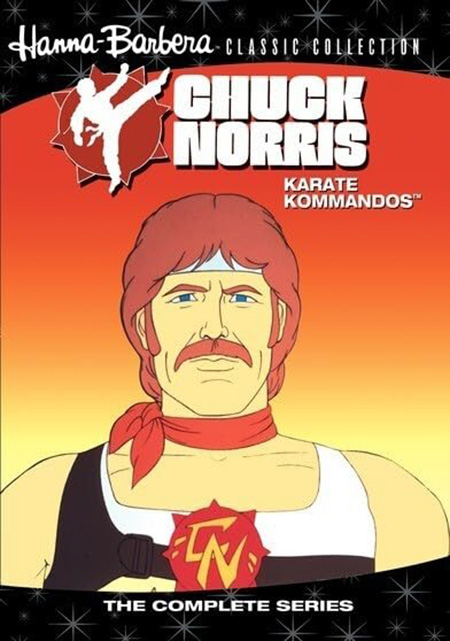
Chuck Norris: Karate Kommandos– Yes, I know that Chuck Norris: Karate Kommandos isn’t a movie, it’s a five episode cartoon mini-series that started in September of 1986, but I thought it was necessary to include it as part of Chuck’s important movies anyway. I would suspect that Karate Kommandos was a jumping off point for plenty of kids that maybe were too young/not allowed to watch any of Chuck’s actual movies and, as a result, became fans of the man. I was allowed to watch Chuck’s movies (I didn’t have any real restrictions on what I could watch as a kid), and when I found out that Chuck had a cartoon, I knew I absolutely had to see it.
Chuck Norris: Karate Kommandos was created by Chuck hisself (another big reason why it’s important as it’s the second thing he had a direct hand in creating after he did his first screenwriting for Invasion U.S.A.) and produced by the Ruby-Spears Enterprises animation company. Ruby-Spears Enterprises was responsible for creating such cartoons as the terrific Thundarr the Barbarian, Heathcliff and Marmaduke, The Scooby & Scrappy-Doo/Puppy Hour, the Mork & Mindy/Laverne & Shirley/Fonz Hour, and loads of other cartoons throughout the 1980’s. Ruby-Spears also did a cartoon featuring Mr. T called Mister T. The Mister T cartoon had Mr. T and a gymnastics team that he was coaching travelling the world competing in various gymnastics competitions and solving mysteries. Each episode would begin and end with a live action segment where Mr. T would generally explain the episode’s plot and whatever life lesson was meant to be understood by the show’s kid audience. The Mister T cartoon would go on for three seasons, completing thirty episodes. The proposed Chuck Norris cartoon would use that same basic “episode bookended by live action segments explaining the plot and life lesson” scheme, with Chuck doing various karate exercises in a gym and then talking directly into the camera. The big difference between the Mr. T cartoon and the Chuck Norris cartoon, though, would be that instead of travelling the world and solving mysteries like the Mr. T cartoon, the Chuck Norris cartoon would have Chuck Norris leading a diverse team of martial arts special agents that were going up against an evil criminal organization known as Vulture, led by a sort of cyborg called Claw and a ninja called the Super Ninja. And the Chuck Norris cartoon would also be full of action, resembling, in a way, several other action oriented cartoons that were on TV at the time. G.I. Joe, He-Man and the Masters of the Universe, Centurions, and Thundercats were among those action oriented cartoons. Heck, there was even a cartoon based on Rambo, Rambo: The Force of Freedom. Chuck Norris: Karate Kommandos would be joining good company.
So Chuck Norris: Karate Kommandos completed its five episode run and was apparently just hammered by critics and social commentators for being overly violent. Now, if you go and actually watch Karate Kommandos in the context of its fellow cartoon contemporaries, it really isn’t any more violent than any of those other cartoons. It’s fun, funny, goofy, clearly ridiculous, and filled with a “good guys vs. bad guys with the good guys always winning” message, just like those other cartoons. So what was the real problem with Karate Kommandos? Apparently, and this comes from this YouTube video from Secret Galaxy, the show’s biggest issue was that Chuck Norris was involved in it. Basically, had the main character in the cartoon not been named Chuck Norris while being portrayed by the voice of Chuck Norris, the show would have been “okay.” But since Chuck wasn’t voicing a character with a different name, Chuck was playing Chuck in the cartoon, the show was deemed to be “too violent.” And so Chuck decided he didn’t want to do more than five episodes if that was what people thought. While I wish that Chuck had reconsidered and pressed on, I guess I can’t fault him for deciding to get out of the cartoon business and move on to other projects. It’s too bad, though, because Chuck Norris Karate Kommandos was, and still is, a fun show. It would have been fucking sweet if we got at least one more batch of episodes, like ten more or something.
Chuck Norris: Karate Kommandos, just like its cartoon contemporaries, was both entertainment and an excuse to sell toys. Karate Kommandos had a full action figure line that included figures and vehicles, as well as other toys. I had two action figures, the “Chuck Norris in white” figure, as well as the Super Ninja figure. I also had a toy gun that resembled a sort of M-16. The toy gun was awesome because you could remove the stock and turn it into the machine gun that Ahnold used in The Terminator (1984), at least that was how I looked at it/played with it back in the day. I wish I still had that toy gun. And I wish I still had the Super Ninja figure, but he eventually fell apart after being involved in countless battles and wrestling matches with my Rambo, He-Man, WWF, and AWA action figures. I still have the Chuck Norris figure, though.
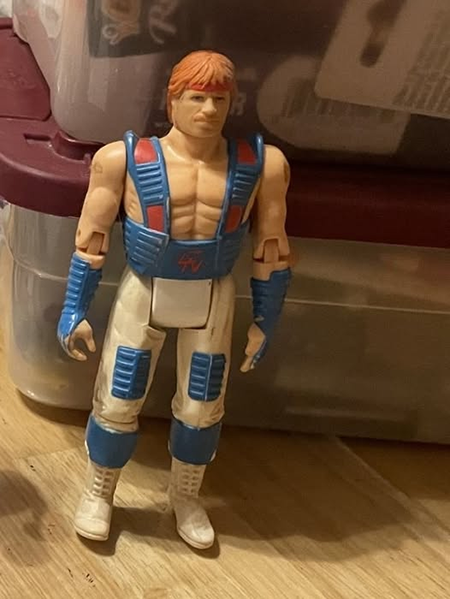
Man, the cartoons and toys and action figures of the 1980s were so damn cool, weren’t they?

Walker, Texas Ranger: One Riot, One Ranger (1993): When it comes to Chuck Norris’ place in pop culture history, a huge chunk of it is going to be all about his TV show Walker, Texas Ranger, which ran on CBS for 9 seasons and around 200 episodes (IMDb claims the show ran for 196 episodes, while the show’s Wikipedia page lists 203 episodes, so “around 200 episodes” is close enough). The show has never really gone off the air since it ended in 2001, steadily appearing via cable and broadcast syndication since then, and now appearing on various streaming services. There was also a reunion TV movie in 2005, Walker, Texas Ranger: Trial by Fire, which ended on a cliffhanger that, sadly, will never be resolved. I’ve always suspected that Trial by Fire was going to be the first of several Walker, Texas Ranger TV movies going forward, depending on how the movie did in the ratings. CBS was still sort of in the TV movie business in 2005 and, heck, if Chuck Norris was still a ratings draw, why not do two TV movies a year or something for a few years? Of course, CBS would join its fellow broadcast networks in getting out of the TV movie business, and apparently no cable network wanted to get into business with Chuck, either. That seems weird in retrospect, since Walker, Texas Ranger reruns did well enough on the USA network, and USA would eventually start airing various direct-to-video action movies from Steven Seagal, so why wouldn’t it want to get into the “new Chuck Norris led TV movie” business? It seems like a massive missed opportunity.
Now, Walker, Texas Ranger the TV show wouldn’t have happened if its first pilot movie, One Riot, One Ranger hadn’t been a hit. And when you look at who initially produced it, Cannon Television, absolutely everything regarding the show was riding on how well One Riot, One Ranger would do in the ratings. Cannon Television, the TV arm of Cannon Films, was about to go out of business, and there wasn’t enough money to do a full season of the proposed show (the first season of Walker, Texas Ranger is listed as either three or four episodes, depending on how you count One Riot, One Ranger). CBS likely would have found a way to keep the show around if that pilot movie was a hit, but if it wasn’t a hit, that likely would have been the end of it. One Riot, One Ranger was a huge hit for CBS when it finally did air, and CBS teamed up with Columbia Pictures Television to keep the show going.
Walker, Texas Ranger: One Riot, One Ranger is a generally well made TV pilot movie helmed by veteran director Virgil W. Vogel. It establishes who Chuck’s Texas Ranger Cordell Walker is, how he met his eventual partner Trivette (the great Clarence Gilyard, Jr.), their working and personal relationship with district attorney Alex Cahill, played by Sheree J. Wilson, and what the show would basically be about (Walker and Trivette taking on the bad guys in Texas). The character known as CD, which would be played for several seasons on the show by Noble Willingham, would be portrayed by Gailard Sartain in the TV pilot. The great Marshall Teague would serve as the pilot’s villain (Marshall would appear on the show several more times during its run, always as a new villain, and then one final time in the Trial by Fire TV movie. Norris and Teague were both there at the very beginning of the show and at the end).
The show is considered “old fashioned” today, as well as heavily moralistic, and that analysis isn’t all that wrong. The show, just like the One Riot One Ranger pilot movie, is all about the good guys taking on the bad guys. And the good guys, more or less, are the good guys, and the bad guys are very much the bad guys. There isn’t much in the way of nuance or “moral ambiguity.” And there’s absolutely nothing wrong with that at all. Once you start watching actual episodes of Walker, Texas Ranger and you figure out how to accept the show on its own terms, you will start to vibe with what it’s doing, and you’ll realize that Walker, Trivette, Cahill, and CD may be the good guys through and through, but that doesn’t mean they aren’t complex characters with rich backstories and that they’re not interesting. They are interesting. And the show, too, is interesting. It may not be as “complex” as the hip and edgy modern streaming shows, but the show is still viable and valid and worth watching. The fact that it managed to survive and essentially thrive for nine seasons is proof of that.
When you actually watch Walker, Texas Ranger, you’ll notice that, despite its “simple” stories, it’s a fairly complex technical production from episode to episode. From hand-to-hand martial arts brawls, to car chases, to gun battles, to explosions, Walker, Texas Ranger tried to provide what amounts to a new mini-action movie every week and it mostly succeeded. I’m still amazed to this day that the show was able to produce 22-episodes a year for most of its run and the people involved didn’t all quit in the middle of its run because it was insane to do. The team behind the show did it, though, and they did it in the endless heat of Texas.
Now, it isn’t wrong to suggest that Walker, Texas Ranger resembles Chuck’s 1983 movie Lone Wolf McQuade. And it isn’t wrong to say that the show wasn’t “inspired” by Lone Wolf McQuade. But they are not the same thing. They just aren’t. Lone Wolf McQuade director Steve Carver, who also produced the movie alongside Yoram Ben-Ami, did eventually sue CBS over how similar both Lone Wolf McQuade and Walker, Texas Ranger were, but Carver and Ben-Ami didn’t prevail in the end (they apparently sued CBS for half-a-billion dollars). The lawsuit is said to be the reason that Chuck and Carver grew apart, which is weird when you consider that Norris also later sued CBS over money he thought he was owed (again, the show has never really gone off the air and is still airing on cable and streaming today, so it’s still making tons of money as we speak). You’d think they would have reconciled over how they both thought they were owed serious money by CBS.
You can check out my full review of Walker, Texas Ranger: One Riot, One Ranger here. I encourage you to see it, as well as many episodes of Walker, Texas Ranger as you can. Get the show on DVD. Watch it on cable. Find it on a streamer (I’m hoping that the show’s entire run will eventually appear on a streamer one day, as opposed to the current “a few seasons” that we get now). If you give the show a chance, I bet you will become a fan. You may not become a diehard fan, you may not want to watch every single episode back-to-back in an epic binge, but you won’t turn it off if you randomly find it somewhere one day. It’s still a fun and entertaining show.
And how can you hate the idea of Chuck Norris singing the show’s theme song? Even if it’s ridiculous that he’s doing it, it’s still awesome and it will never not be awesome.

The Cutter (2005): In the early 2000s, the direct-to-video action movie market was chock full of low-budget action flicks starring action heroes people knew from the 1980s and 1990s. Whether it was the video store or the home video aisle at Walmart or Target or K-mart, you could and would find tons of movies starring Steven Seagal, Dolph Lundgren, Jean-Claude Van Damme, and Wesley Snipes, among others. Heck, even Oscar winner Cuba Gooding, Jr. got in on the act. For those action stars and the stars that decided to join in on the fun, doing low-budget direct-to-video action flicks was the best way to stay in the game with new movies, since big deal Hollywood had essentially gotten out of the action movie business that made those stars stars. With Walker, Texas Ranger as a TV show over and the potential occasional TV movie idea over before it got a chance to really get going, it seemed like it was only a matter of time before Chuck Norris would get into the DTV action movie business. And he did exactly that in 2005 with The Cutter. Helmed by Hero and the Terror director William Tannen, The Cutter would be the first and the last direct-to-video action flick Chuck would make for almost twenty years. The Cutter would also be the final full on Chuck Norris movie where Chuck Norris was the star.
Now, before The Cutter, Chuck did do the low-budget direct-to-video Christian flick Bells of Innocence, a movie that will sometimes get referred to as a “Christian horror movie,” but I don’t refer to it as that. Bells of Innocence is an outwardly religious movie made for a specific religious audience. I’m actually surprised that Chuck only made one uber Christian movie, considering how openly religious he became. But then Chuck did do his epic cameo in Dodgeball: A True Underdog Story in 2004, roughly a year after Bells of Innocence came out. Maybe Chuck just didn’t like being super Christian in a movie?
Or maybe Chuck just didn’t like working in the direct-to-video world. I don’t know. All I know is that he didn’t do a sequel to The Cutter or any other direct-to-video action movie until Agent Recon in 2024. And that’s a shame, as The Cutter is a fairly decent direct-to-video action flick. It isn’t anything particularly special, but it is entertaining enough, and Chuck still seems game to take on the bad guys, specifically fellow real deal martial artist Daniel Bernhardt who plays the movie’s villain. The Cutter also has The Love Boat doctor Bernie Kopell in the cast, as well as Tracy Scoggins, Deron McBee, the great Marhsall Teague, and even Chuck’s brother Aaron Norris. Chuck could have easily made more movies like The Cutter if he had wanted to. The market would have supported it.
But Chuck didn’t. Chuck decided to, essentially, retire from movie making, at least for a little while. Maybe he was truly exhausted from the creative process that he had been engaged in since Walker, Texas Ranger began in 1993. On top of doing the TV show, Chuck did several theatrical release movies (Hellbound in 1994, Top Dog in 1996), several TV movies (Forest Warrior in 1996, Logan’s War: Bound by Honor in 1998, The President’s Man in 2000 and The President’s Man: A Line in the Sand in 2002, and Walker, Texas Ranger: Trial by Fire in 2005), the Christian movie Bells of Innocence in 2003, as well as producing a Walker, Texas Ranger spinoff, Sons of Thunder in 1999. That’s a lot of stuff, man. And when you consider that most seasons of Walker, Texas Ranger are in the 22 episodes a season range, it’s amazing that Chuck wanted to do anything after doing a season of an action oriented TV show.
And, yes, you can technically refer to Chuck’s environmental movie Forest Warrior (1996) as Chuck’s first real direct-to-video effort, but I don’t. I consider it a movie that did appear on home video but was really made for cable TV. Forest Warrior was released by Turner Home Entertainment, the home video operation of Ted Turner’s Turner Broadcasting outfit, and I’d bet that most people became aware of that movie’s existence through the myriad commercials that aired on the TNT cable channel. That’s how I found out that the movie existed. And besides, Forest Warrior is a fantasy movie at its heart. It is not a direct-to-video action movie like The Cutter.
Now, does anyone out there remember when Forest Warrior first hit TNT? Was it at the end of 1996, roughly around the same time the movie actually came out on home video, or did it first air in 1997? I can’t find any reliable info online. This is important! I gots to know!
Oh, and you can check out my full review of The Cutter here.
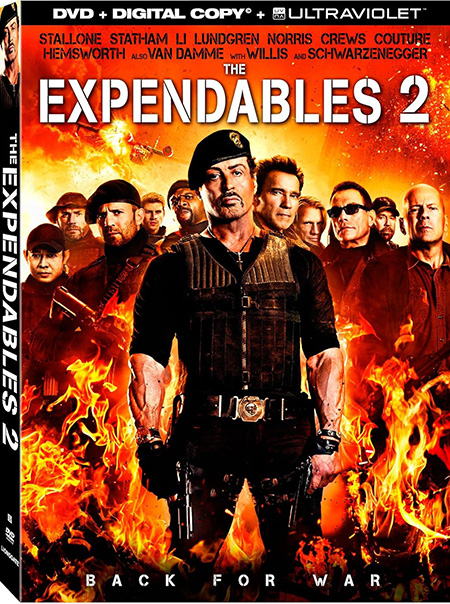
The Expendables 2 (2012): When the first The Expendables movie hit theaters in the summer of 2010, it was a major event for fans of the action heroes, old and new, that populated the movie’s cast. There was Sylvester Stallone (he also directed the movie and co-wrote the screenplay), Jason Statham, Jet Li, Dolph Lundgren, Randy Couture, “Stone Cold” Steve Austin, Terry Crews, Mickey Rourke, Gary Daniels, Eric Roberts, and Bruce Willis and even then California governor Ahnold Schwarzenegger. Who the heck ever thought there would be a movie with that many action stars in it? And would the movie be a hit and make money? Would fans of those action stars show up and support what was, at that moment in a time, a once in a lifetime type movie?
They did. The Expendables was a hit worldwide, making more than enough money to warrant at least one more The Expendables. The question then became who would be in the sequel? Were there other “old school” action stars that wanted in? We knew that Stallone, Statham, Jet Li, Lundgren, Couture, Crews, Willis, and Ahnold would be back in some capacity. We then found out that Jean-Claude Van Damme would be the movie’s villain, with new action star Scott Adkins backing him up. Liam Hemsworth was going to be in the movie, too, along with Yu Nan. And Simon West was going to be the director. And then the big news dropped. Chuck Norris would be coming out of retirement for the movie.
Holy crap! Chuck Norris was going to be in The Expendables 2! What sort of character was he going to play? What previous Chuck movie would be the inspiration for his The Expendables 2 character? Would we get to see Chuck engage in cinematic martial arts again? How would he become a part of The Expendables team? There was so much to find out.
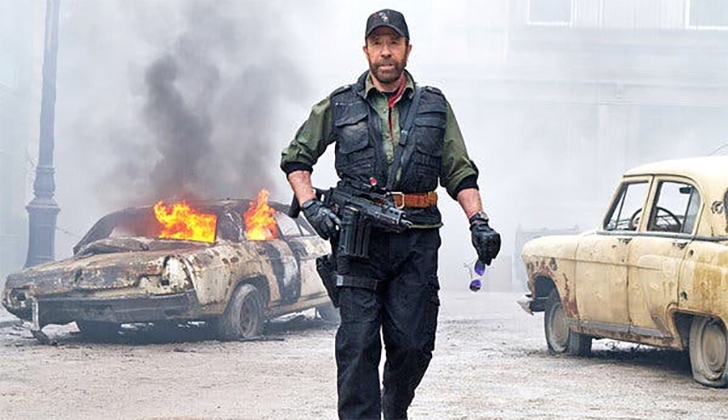
And so The Expendables 2 came out, and we found out that Chuck would play a character named after his character from Good Guys Wear Black, Booker, and that Booker was a lone warrior operating in Eastern Europe who would meet Ross and the other Expendables, actually saving them from an attack while they looked for Jean-Claude Van Dame’s Vilain (yes, that is his name). Booker would appear with the theme from The Good, the Bad, and the Ugly (1966) playing on the soundtrack, give Stallone’s Barney Ross character some information, and then Booker would disappear because he always worked alone. Despite that preference for working alone, Booker would show up at the end of the movie in the final siege, joining with Stallone, Willis, Schwarzenegger, and all the rest to destroy Vilain’s henchmen. Throughout this siege, Booker would take out the bad guys with his trusty machine gun. Unfortunately, Booker wouldn’t kick or punch or chop anyone, which was clearly a missed opportunity (but then, too, with as many characters The Expendables 2 had, there was only so much time in the movie for stuff to happen and for characters to appear. I mean, look at the rather lackluster final fight between Statham and Adkins, a fight that could have and should have been so much more. The Expendables 2 was never going to be a five hour epic and we needed to be sort of happy with what we did get, which was awesome enough).
Even with the total lack of martial arts from Chuck’s Booker, it really was cool as hell to see Chuck Norris in another actual movie, one that was playing in movie theaters. Would this appearance inspire Chuck to get back into the movie business again? Would Chuck do another direct-to-video movie, perhaps do a co-star thing with one of his fellow The Expendables 2 team members that were still churning out their own direct-to-video action movies? Would CBS want to finally resolve that goddamn cliffhanger from Walker, Texas Ranger: Trial by Fire?
Nope. The Expendables 2 would be Chuck’s final acting performance of any significance for almost eight years, when he would do what amounts to a cameo in the second-to-last episode of the Hawaii Five-O reboot starring Alex O’Laughlin in 2020 (Chuck also did a small voice cameo in an episode of the sitcom The Goldbergs in 2015). We did get Chuck to do a riff on the “Chuck Norris Rules” meme in The Expendables 2 that is still, to this day, an internet thing, so that was cool, too.
And then 2024 happened.

Agent Recon (2024): When it was announced, completely out of the blue, that Chuck Norris would be starring in something called Agent Recon, Agent Recon immediately became a must see, at least it did for me. What the hell kind of movie would bring Chuck out of retirement? Did anyone suspect that it would be a low-budget sci-fi action movie that’s actually the third movie in a low-budget sci-fi action movie franchise? I know I didn’t. I also didn’t think Chuck would come back in that third low-budget sci-fi action movie and play a goddamn alien robot. That’s what happened, though. And it’s glorious.
Glorious and insane. Because, again, it’s Chuck Norris as a goddamn alien robot. And when you add in Dar the Beastmaster hisself Marc Singer, you have a movie that demands to be seen simply because it exists. The actual star of the movie is Derek Ting, a filmmaker that has been working on this Agent movie series since 2017, when the first Agent movie, just called Agent, came out. The second movie, Agent Revelation, came out in 2021 and featured Star Trek: The Next Generation actor Michael Dorn in the cast (Dorn plays a character named Alastair, which is the same name used by Chuck in Agent Recon. I don’t know if Dorn and Chuck are playing the same character). I still haven’t seen the first two Agent movies, but I do intend to at some point. Because how the heck has this low-budget sci-fi action franchise been a thing for almost a decade now and I had no idea it existed until the news came out that Chuck Norris was going to be acting in a movie again?
Chuck does a good enough job in Agent Recon. He really doesn’t do much until the last section of the movie, where Chuck’s Alastair wields a modified mini-gun while taking out an army of alien zombies. That is cool to see. And it looks like Chuck actually engages in some hand-to-hand choreography in the movie’s big final battle sequence. I certainly didn’t expect to see that at all. Chuck’s stunt double obviously did most of the action heavy lifting, which is to be expected as Chuck is like 84 years old when he made this movie, but some hand-to-hand fighting? Fucking awesome.
It looks like Agent Recon is Chuck’s last starring role, although it isn’t his last movie. Chuck’s final movie is a horror-comedy movie called Zombie Plane, something that also features Vanilla Ice in the cast. Zombie Plane, as of this writing, has not been released but is expected to appear at some point in 2026 (I’ve seen a date in November but I don’t know if that will stick). There is a Zombie Plane trailer, which you can see here. John Jarratt, Brian Austin Green, Ice-T, and Sophie Monk are all in it, too. I’d like to know how the hell Chuck got involved in this movie. It just isn’t something you expect to see him in. A zombie comedy?
And, again, when it comes to Agent Recon, a low-budget sci-fi action movie where Chuck plays an alien robot? How did it happen?
Check out my full review of Agent Recon here.
**
Conclusion
As I write this, Chuck Norris the human being has been gone for over a month. And while, as I said when I began this Chuck Norris: The Important Movies thing, it seems impossible that Chuck Norris is gone, it was, eventually, going to happen. Chuck Norris was a human being, after all, and Death comes for all of us at some point. The legend of Chuck Norris is still with us, though, and it will remain with us into the future. When you make the kind of mark on pop culture that Chuck Norris made, that’s what happens. The legend of Chuck Norris will live forever. Chuck’s movies, his TV show, and the persona that he cultivated and his fans all over the world admired and will continue to admire. They’re all important. And the legend of Chuck Norris will endure. And that is a good thing. The legend of Chuck Norris will endure.
**
Please check out and “like” The Gratuitous B-Movie Column Facebook page, which is here.
Buy my book Not Coming to a Theater Near You! 50 Great Direct-to-Video Action Flicks of the Early 2000s published by BearManor Media here or here or wherever books are sold!
Don’t forget to sign up with disqus if you want to comment on this article and any other 411 article. You know you want to, so just go do it.
B-movies rule. Always remember that.


