
Movies & TV / Columns
Director Nick Lyon On His New Film On Fire, Working With Lance Henriksen
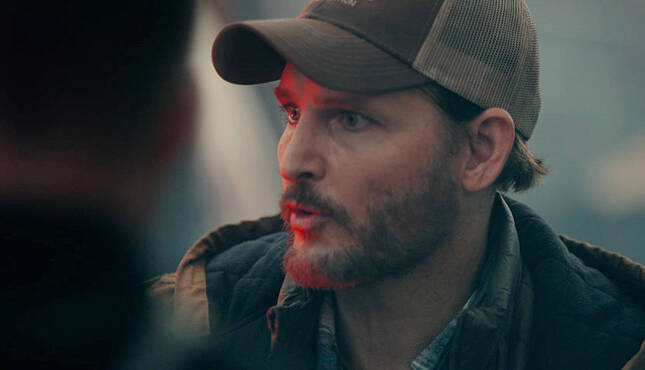 Image Credit: Cineverse

The 411 Interview: Nick Lyon

Nick Lyon is a writer, producer, and director who has been making movies, according to imdb, since at least the year 2000. Lyon has directed such movies as Species: The Awakening, Zombie Apocalypse, Bullet, Hercules Reborn, Christmas in Vienna, and Operation Dunkirk, among others. Lyon’s latest movie is the family drama/natural disaster action flick On Fire, available exclusively in movie theaters starting September 29th, 2023. In this interview, Lyon talks with this writer about making On Fire, working with co-director and On Fire star Peter Facinelli, working with Lance Henriksen, and more.
**
Bryan Kristopowitz: How did you decide that you wanted On Fire to be your next movie as a director?
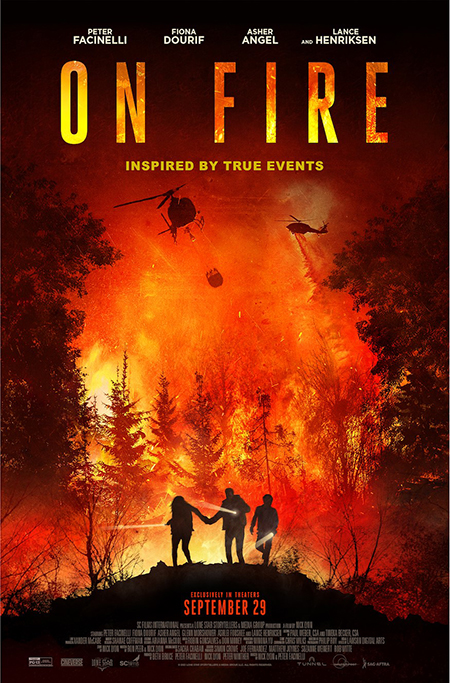
Nick Lyon: Back in 2017, I was camping with my sons and was actually horrified by the notion that we were on a one-road-in camping site, so I started asking myself, “What would we do to escape if there were a forest fire?” That sparked the idea of doing a movie of a family fleeing a forest fire, which eventually turned into On Fire. The reason I wanted to do the film is kind of the same reason I got into movies in the first place. I wanted to make art that would speak to millions of people and hopefully make a difference in the world. This doesn’t always happen with genre films. I see On Fire as a possibility to bring awareness to what people endure in forest fires. 85% of all forest fires are caused by humans, so if watching this film can help people become more vigilant in not starting forest fires then the film will have served its purpose. I believe that showing what a family would go through will give a deeper understanding of how doing something stupid like lighting fireworks in a forest can affect the lives of real people.
BK: Describe your working relationship with Ron Peer, who co-wrote the script with you. How did you come up with the title On Fire?
NL: I first met Ron back when I did my first feature film, I Love, You, Baby, starring Maximilian Schell. Ron had written that screenplay, and I was hired to direct it in the German language. I always loved Ron’s style of writing since that day because it was very tense and suspense-filled. Over the years, Ron and I became very good friends. We’ve worked together on other projects, including The Boy, The Dog, and The Clown, which Ron and I co-wrote. In the case of our collaboration on On Fire, I had a treatment that was going to get made and I promised to deliver a script to the financiers in two weeks. I was busy on production prep and finishing another film I was shooting, so I called Ron. I said, “Hey, are you up to writing this in two weeks? I need it really quick because I’m in the middle of pre-production on another film.” He delivered the first draft based on my story, and we collaborated on the script bouncing ideas back and forth after that. I did my pass, he corrected my pass, I did more work during the shoot, and so on. Ron is more like an author, and I believe he enjoys the process like taking a bath, whereas I have to really have a purpose to enjoy writing otherwise I get a little bored. It’s a dynamic partnership. I bring the directorial elements to help him with the writing, and he brings the patience needed by a really good writer to craft a script. It’s a good balance.
BK: How did you cast On Fire? What was it like working with Lance Henriksen?
NL: The casting process for On Fire was led by casting directors Paul Weber and Tineka Becker. Most of the actors were chosen through auditions, and then I had meetings with them over the phone or via Zoom. I handpicked all of the actors and felt they were the best fit for their roles. I feel I got really lucky with a great cast. Working with Lance Henriksen was amazing. He’s such a humble and nice person. I had expected him to be a tough guy, but he turned out to be the nicest guy. He trusted the creative direction of the film and really let himself go with the story. He and Peter Facinelli had a great father-son connection on screen, and all of the actors worked well together.

BK: Describe your working relationship with On Fire star and co-director Peter Facinelli. How did Peter Facinelli come to be a co-director on the movie?
NL: We were both co-producers and worked well together. It was from day one a collaborative relationship, as is typical in the creative partnership between a lead actor and a director. Peter is also a filmmaker, which made it even more seamless. He was very on point with his character and loved the script. As co-producers, we both had a very similar vision for how good the finished film would and could become. During the shoot, I tested positive for COVID-19 and we were right before Thanksgiving, so there was no way we could wait for me to clear to be able to return to set because everyone was set to leave for the holidays and had commitments afterward. So it was a blessing that Peter was able to step in to direct on the days I couldn’t be on set. Having Peter Facinelli as an ally was a great asset. At the end of the day, I felt Peter deserved a co-directing credit and offered it to him to celebrate our collaboration, which continued well through the post-production period as co-producers and co-directors.
BK: Where was On Fire made?
NL: Originally, I planned on shooting in northern California, or Idaho, but as I checked the weather, I realized it might be rainy or very cold (under 30 degrees) at night, which wasn’t suitable for a forest fire film and would be tough on the crew, especially with all fire scenes being shot at night. After researching every forest and the temperatures in November, I discovered a pine forest in Bastrop, Texas, near Austin, where the film’s financiers were located. Bastrop is also known for forest fires, and the climate was perfect, and there would be no snow, no rain and it would be warmer at night. It also helps that Bastrop is next to Austin, which has a large film and acting community.
BK: How long did it take to make On Fire, from finishing the screenplay to completing post-production?
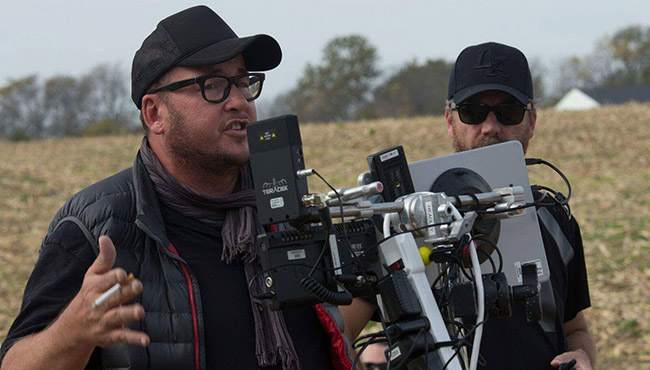
NL: If I start with the very first treatment and inspiration, it goes back to 2017. On Fire became hot in May 2021, and we shot it from October 27 to November 21st, 2021 with a 19-day shooting schedule. Then in 2022, there were a couple of pick-up days as well. It was a fast process compared to some films. Post-production, including animation, took about a year. So, from beginning to end, it’s been about a two-year process.
BK: What was the hardest part of making On Fire for you as a director? What was the easiest?
NL: Overall, preparing to make a movie is the hardest work. The decisions and architecture of a project set it up to win or fail, from casting to all locations, to wardrobe and crew, these are the ingredients needed to make such a film, and once they are in place, the filming becomes more of a mechanical process from a technical standpoint. And after the actors are a few days into the shoot, and have established who they are, everything just goes smoothly. Where things are difficult is when you are trying to make a recipe and are missing some ingredients. As a director, I believe in being prepared to ensure a film’s success.
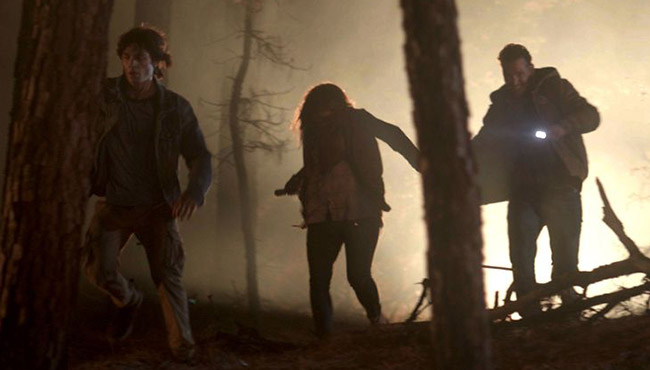
The hardest part for me was figuring out how to make the film without actually burning down the entire forest and doing so on a modest budget. While I was developing the idea, many said it would cost millions, but having experience with disaster films and special effects, I knew I could create a system to shoot the film safely and affordably by using a combination of lightning, smoke, real fire, and visual effect enhancements. We ended up leaning on visual effects a bit more than we thought after we discovered that if we used fire bars, the heat was making the ground smolder. That’s because the entire forest was covered with pine needles that had decayed into wood soil which was very flammable. So we weren’t able to use the large flame bars.
As for the easiest part, I would say that was the work with the actors. When you cast good actors and give them a good script, which is the roadmap, they just deliver, and staying out of their way is probably the best thing a director can do if everyone is on point. I would give notes, especially blocking and explaining visual effects that they would be looking at, but I always let the actors follow their guts as characters. It’s funny how instinctually great actors just know what to do. If they wander off, then you pull them back in, but our cast was very good so that made my life a lot easier. The next easiest was probably waiting for my editor, Dan Money, to finish his editor’s cut because I didn’t have to do much during that phase.
BK: How was making On Fire different from making something like Species: The Awakening or Operation Dunkirk?
NL: The main difference is that I was hired to direct Species and Operation Dunkirk, while for On Fire, I wrote, produced, and directed it myself. It’s a significant shift when you create a project from the start. In terms of physical production, Species involved a longer shoot with makeup effects, stunts, and a specific science fiction genre. We shot in Mexico City for about 28 days. Operation Dunkirk was an ultra-low-budget film I was hired to direct, and we had a very small crew, and almost no time (11 days) to shoot although it was a very ambitious script, so I relied a lot on using movie magic tricks of low-budget filmmaking like turning 10 background actors into 50 by reusing them from different angles to give the appearance there are a lot more. On Fire falls in the middle, combining my abilities as a low-budget and larger-budget filmmaker. It was a very ambitious project for its budget and with just 19 days to shoot it was challenging, but having worked in many disaster films before, I knew what was needed to make this film on time and on budget. We didn’t go into overtime at all.
BK: You’ve worked on a number of TV properties in your career. How has the TV business changed since you started working as a director?
NL: The TV business has changed a lot. Art house films used to be more common but are less so now. Small films like On Fire rarely get theatrical distribution. TV and independent film budgets aren’t increasing; in fact, they are often decreasing. What used to be 10 million is now 4 million, and what used to be 4 million is now 1 million. Production companies are forced to cope with rising costs and diminishing returns by reducing the number of shooting days. In the past, TV movies might have had an 18—24 day shooting schedule, but now it’s not uncommon to get only 11 to 14 days to make a full 90-minute movie. We need to work very fast nowadays, that’s the biggest difference I have seen. You have to know how to work very fast in today’s market. There are, of course, larger studio productions that have fairly unlimited budgets and they are still able to afford more shooting days, but in the independent world, that’s not the case.
BK: According to imdb you’ve directed several Christmas/holiday movies. How did you get involved in directing those types of movies?
NL: It’s fun! Nobody really knows this but I actually started making films with comedy. I did a film called Hilda Humphrey (aka Hellchild) so I’ve always had a spot in me that is for making comedy. I also have a definite softer side to me that I like to exercise, if not for me, then for my wife and my mother.
Even within genre films, there are different genres, so it’s part of the craft of directing and being able to tell stories in different ways. So doing holiday movies or romantic comedies is a nice break from all the heaviness and darkness that goes along with most genre films. And, really, as a director, I enjoy the challenge of taking on different genres. I don’t see why a director should have to only stick to one genre because we are all made up of so many different sides of our personalities, and I actually just enjoy the process of being able to exercise all sides of my personality and create worlds in different genres. All the big actors do different genres. Most actors are not only horror actors or dark genre actors, they can jump between genres, and I feel that that’s what I want to do as a director. I enjoy being able to take on different projects with different emotions, different worlds, and different genres, and do them well. My wife doesn’t like horror or too much violence, so she loves it when I do a Christmas film. And it makes for great holiday viewing for the family as well.
BK: Any moviemaking heroes?
NL: I have to say I am a very big Ridley Scott fan. When I was younger I also really loved David Lynch and other art house directors. One of my all-time favorites, and somebody who I was able to study under in Germany when I was going to film school, is Werner Herzog. Werner Herzog did amazing things with Klaus Kinski and his films in general were insanely ambitious.
Fitzcarraldo is a film that made a really deep impact on my filmmaking sensibilities. Maybe that’s why I like to take on big, impossible-for-the-budget films and still think I can create a blockbuster on a low budget. After all, Werner Herzog was able to move an actual ship over a mountain in Fitzcarraldo.
BK: Any upcoming projects you can tell us about?
NL: Right now I am just finishing a screenplay, called The Vessel, which is a sci-fi/action/thriller, and I hope to be able to shoot it in 2024. I will probably shoot an ultra-low budget film that I self-produce, shoot and direct, and I am about to embark on an earthquake movie to continue with the disaster genre.
BK: What do you hope audiences get out of On Fire?
NL: I hope that watching On Fire helps people understand the consequences of what can happen if you do something, reckless or unknowingly reckless, like lighting fireworks in the forest or being careless with your forest fire, or throwing a cigarette out of a window or not taking care of the infrastructure to the electric companies. These things all have real consequences. People who are 10 miles away could be put in extreme danger and lose absolutely everything. So the message I would like to convey is that people need to be more vigilant. 85% of all forest fires are man-caused. Unlike other natural disasters, the number of forest fires can be mitigated, so I hope that this film helps people understand this, especially as our climate continues to warm and the forests become dryer and more flammable. We have to be very careful.
BK: Is Glenn Morshower as cool in real life as he appears onscreen?
NL: Glen absolutely is as cool as he comes across on screen. And it’s still quite fun to go to Universal and see him in the Transformers ride while waiting for your place telling us of the dangers in the mission. I think everybody knows who he is so it’s always fun working with great character actors like Glenn. Glenn is an adamant professional.
**
A very special thanks to Nick Lyon for agreeing to participate in this interview and to david j. moore for setting it up.
On Fire is available exclusively in movie theaters starting September 29th, 2023!
Check out my review of On Fire here!
Check out the On Fire official Facebook page here!
Check out Nick Lyon’s official website here, official Facebook page here, official Twitter page here, official Instagram page here, and imdb page here!
Nick Lyon image courtesy of Nick Lyon. All other images courtesy of Cineverse.


