
Movies & TV / Reviews
Fantasia Fest 2025 Review Roundup: Stinker, Japanese Avant-Garde Pioneers
 Image Credit: Fantasia IFF

We’ve just closed out the first week of Fantasia International Film Festival 2025, and thus far it’s been another strong year. The 29th iteration of the festival has seen some stellar films screened so far, and that’s just the start. We have plenty more to come and we’re sure to see a number of these films become instant fan favorites when they arrive for audiences whether in a theater, on streamers or however else.
My coverage of the festival is moving along nicely, and you can see my reviews of the delightful HOA horror comedy Hold the Fort here, the twisty time loop romantic dramedy Rewrite here, and the nerve-fraying Korean supernatural horror mystery Noise here. I have many more reviews to come, and you can check out a couple of capsule reviews for films that were screened over the weekend below.
Stinker
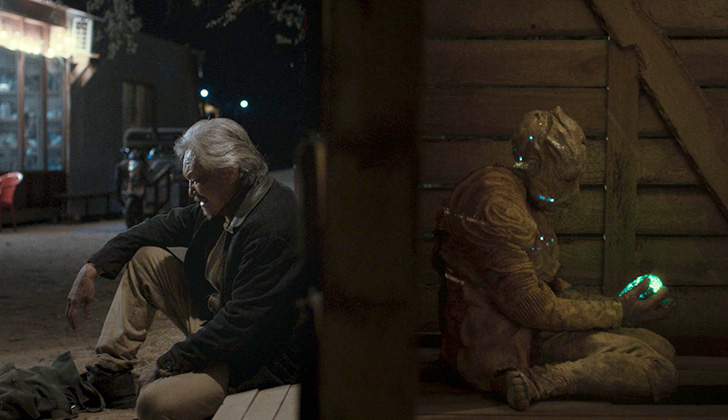
In Stinker, fascism and oppression are viewed through a sophomorically comedic and strangely heartwarming sci-fi lens. And somehow, it works. Yerden Telemissov’s comedy centers on a rural spot in Khazakhstan where a suicidal vagrant named Sadyk (Bakhytzhan Alpeis) observes the crash of a UFO outside the shop he hangs about, only to discover the alien (Chingiz Kapin) has taken refuge in the depths of the outhouse.
Sadyk strikes up a friendship with the alien and tries to help them find the technology they need to get home, with the shopkeeper Irka Abdulmanova) and her young granddaughter (Ailin Sultangazina) eventually helping. Their search is complicated by a government-sponsored motorcade that is set to travel through and the corrupt official and blundering cop trying to clear out undesirables from the motorcade’s view.
Telemissov’s film is tackling heavy topics – grief, loss, suicidal thoughts, class inequality, even police brutality. But it does so by putting the focus on those marginalized people ignored and left on the side of the road by society in a disarming and often quite funny way. Alpeis, Abdulmanova, Kapin, and Sultangazina bring an emotional depth to their performances that you might not expect at first, while the tone deftly switches between sharply satirical and authentically emotional – with occasional bouts into scatological humor that never feels forced or out of step with the rest of the film. The screenplay may stray into maudlin moments and the E.T. influence is clear, but it charts its own path into something quite enjoyable and with plenty to say without ever getting too preachy about it.
Rating: 7.5
Japanese Avant-Garde Pioneers

It would be an extreme understatement to say that post-war Japan a place where trauma came to stay. The country, decimated by its losses and being the victim of two atomic bombs, became ground for a new social upheaval, the kind that often gives birth to great avant-garde art.
The artists that grew out of that period and the decades that followed are the subject of Amélie Ravalec’s documentary Japanese Avant-Garde Pioneers. The film takes a look at the art movements that grew out of this turbulent time, a period of significant social unrest and activism, with a workmanlike visual essay featuring interviews with a number of the artists of the era like Miyako Ishiuchi, Keiichi Tanaami, and Eikoh Hosoe along with a number of historians and other scholars on the topic.
Ravalec separates the film into chronological chapters, starting by setting the stage for what postwar Japan was going through and then proceeding to explore particular movements like the dance style of Butoh or the many elements of Kinbaku (Japanese bondage). Other chapters focus on particular artists like photographer Kikuji Kawada – particularly his influential photo book Chizu (The Map) and Yukio Mishima, the author who modeled for Hosoe and became the subject of his photobook Barakei.
Japanese Avant-Garde is tackling an incredibly expansive topic, and it’s arguably more than any one documentary could properly encompass. It’s the kind of project that may have worked better as a part of larger series, allowing more focus on the gaps in-between. As a result, there are some topics that get brushed over, leading to a film that isn’t quite deep enough for those knowledgeable about the topic. But as a primer for those who might be interested in learning more about an incredibly influential time not just in Japan’s history but in world art as a whole, this presents a good jumping off point.
Rating: 6.5
The Fantasia International Film Festival takes place in Montreal from July 16th through August 3rd.


