
Movies & TV / Reviews
Overlook 2026: Mārama Review
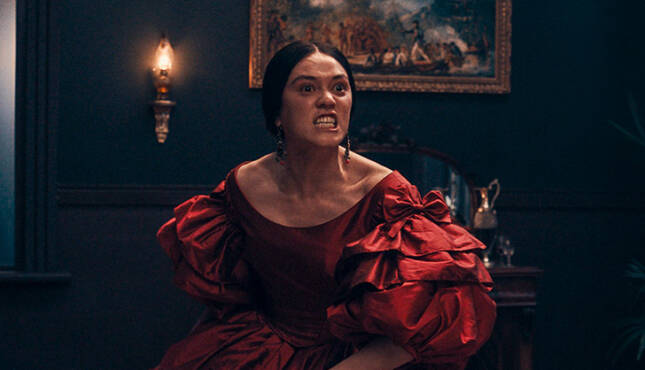 Image Credit: Dark Sky Films


 Loading...
Directed by: Taratoa Stappard
Written by: Taratoa Stappard
Starring:
Ariāna Osborne – Mary Stevens
Toby Stephens – Nathaniel Cole
Umi Myers – Peggy
Errol Shand – Jack Fenton
Evelyn Towersey – Anne
Jordon Mooney – Arthur Cole
Mihi Te Rauhi Daniels – Hinemoana
Turia Schmidt Peke – Arorangi
Running Time: 89 minutes
Not Rated
Gothic horror is such an evocative and storied genre that it’s often hard to get past the notion that it’s become creaky in the 21st century. Just the term alone conjures up visions we all know — austere manors with dark corridors, women in peril running in their nightclothes holding a lantern, dapper and charming men with sinister motives, and ghosts of the past, both real and imagined. It’s arguably one of the most formalized subgenres of horror, right up there with the slasher in that respect.
And yet, when put in the hands of a fresh perspective, gothic horror contains a potency that is hard to deny. Taratoa Stappard is one such filmmaker. The New Zealand filmmaker frames well-worn tropes of the subgenre in his own voice as a person of Māori heritage in Mārama, which was screened at the Overlook Film Festival on Friday ahead of its theatrical release on April 17th. Stappard flips the script to turn a world of dark houses with darker secrets into a story of Māori retribution and reclamation, centered around a captivating lead performance.
That lead performance comes from Ariāna Osborne, who plays a Māori orphan named Mary Stevens in 1859 England. Mary has traveled from New Zealand on a summons from a man who has promised by letter to reveal information on her parents. The journey there has been fraught and isn’t any better when she arrives — the carriage rider makes her walk the final stretch. When he arrives, she finds that the man is dead, leaving her alone in a foreign land without resources.
Mary ends up taken in by Nathaniel Cole (Toby Stephens), a man with impressive resources, a large country house, and a passion for Mary’s culture. He proposes that she take a position as governess to his granddaughter Anne (Evelyn Towersey), who is also of Māori heritage. Without many options, she accepts and comes to find in short order that Nathaniel’s obsession with her culture comes from his past as a whaler in the South Seas and extends to collecting Māori artifacts among other things.
As Mary takes to her work caring for Anne, she finds an increasing level of discomfort in the house. Nathaniel has a wharenui — Māori meeting house — that he had brought over in its entirety to put in his garden. His right-hand man Jack (Errol Shand) is an odious individual in the extreme, and maid Peggy (Umi Myers), a woman of color, suffers in her own ways as part of the household.
To top it all off, Mary starts to receive visions of something darker and more sinister that happened in the house. As she digs deeper, Mary finds herself on a course to reclaim her true identity as Mārama and confront the wrongs done to her people.
Mārama is the feature directorial debut of Stappard, who is himself of English and Māori heritage. Stappard clearly understands the language of horror, and gothic horror specifically. He keeps the dread high with visuals awash in the genre’s hallmarks of shadow and candlelight, accentuated via some gorgeous costuming work by Sarah Voon.
Amidst that dread, there’s plenty of room for the horror to play. The standout sequence puts the horrors of colonization on display, as Mary attends a party where Cole and his rich friends don Māori costumes in a garish, fetishized display complete with a mocking of the indigenous people’s traditions. It’s a deeply uncomfortable sequence that allows Osborne a thunderous reaction that feels both cathartic and traumatizing at the same time.
The biggest problem that Mārama has is that its dark secrets are, while certainly horrendous, not particularly surprising. It’s fairly clear where the film is going early on, and Stappard’s big reveals feel less like twists than they do inevitable conclusions given what we learn early on. The film and its director seem less interested in stunning reveals than they are in showing how that information brings Mary to where she needs to be.
And once that happens, it’s a chance for both Osborne and Stappard to let loose. Osborne’s transformation plays authentically, and Stappard gets her hands very bloody as she comes into who she’s supposed to be.
Mārama starts with a statement about how the film is grounded in the colonized history of Aotearoa (the Māori name for New Zealand) and that “to move into our future, we must understand our past.” Gothic horror is a genre often overflowing with ghosts, both literal and metaphorical. In not shying away from the specters of colonization, Stappard puts a liberating spin on what it means to reclaim where you came from in order to move forward.
Overlook Film Festival takes place in New Orleans, Louisiana from April 9th through the 12th. Mārama arrives in theaters on April 17th.


