
wrestling / Columns
Ask 411 Wrestling: How Many Minutes Did Hulk Hogan Wrestle During His Career?
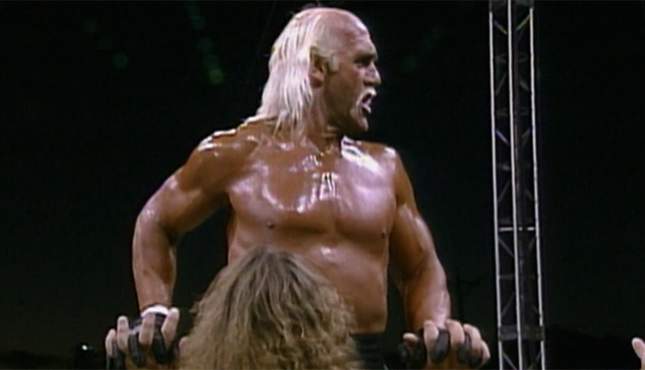 Image Credit: WWE

Welcome guys, gals, and gender non-binary pals, to Ask 411 . . . the last surviving weekly column on 411 Wrestling.
I am your party host, Ryan Byers, and I am here to answer some of your burning inquiries about professional wrestling. If you have one of those queries searing a hole in your brain, feel free to send it along to me at [email protected]. Don’t be shy about shooting those over – the more, the merrier.
Hey, ya wanna banner?

Thanks to Greg while others mourn their fallen childhood hero, I get to put together a friggin spreadsheet:
G’day from Finley, Australia. I was watching some wrestling video on YouTube and a Hulk Hogan and his lies came on. The usual, but with more on his wrapping on Mankind. Rubbish!
Then I had a thought, I was born way back in 1968, so I grew up, as a teen, during the Hulkamania years. I watched pretty much every sodding match, from the ‘Non-Title Only, Brother’ match to guarantee his title wasn’t on the line, to the fiasco that was the ‘Finger Poke of Doom’ and beyond.
Looking only at his singles matches, I believe his longest was a bit over 20 minutes. But if you added up all the match lengths, just how little time, into all was his actually working in the ring? With many match 2-5 min, it can’t be that huge an amount. His 1400 days as champ, how many defenses?
I don’t suppose you have figured this?
Well, I hadn’t figured it before, but I have now.
As far as ring time Hogan has logged, we can’t come up with a perfect number, but we can get some idea. Our friends over at Cagematch have record of 2,120 matches that the Hulkster wrestled over the course of his career. Of those, 538 of them are singles matches for which a match time has been recorded.
Over those 538 matches, the Immortal One wrestled 5,061 minutes and 47 seconds. That is roughly three-and-a-half days of solid ring time.
It also means the average length of a Hulk Hogan singles match was 9.4 minutes, which is shorter than I would have predicted. If I had to pick a number before doing this work, I would have guessed somewhere in the 12 minute range because, even though he wrestled shorter matches after achieving worldwide fame, he had matches in his early career and in Japan that I thought might have evened things out a bit more. They didn’t.
Also, though this was not part of the question, from compiling this data I can let you know that Hogan’s longest timed singles match ran 33 minutes, 36 seconds and featured the Hulk defeating Bob Backlund via count out in a match for Backlund’s WWF Championship on March 8, 1980 at the Capital Centre in Landover, Maryland. Backlund also got longer matches out of Hogan on July 5, 1980 in Springfield, Massachusetts running 29 minutes, 23 seconds and 29 minutes even on April 12, 1980 in Philadelphia, Pennsylvania. In fact, those are the three longest recorded matches of Hogan’s career, and they all come thanks to Backlund.
(Another off-topic piece of trivia is that Backlund is only four years older than Hogan, which just seems impossible – like the first time somebody told me Barack Obama is older than the Undertaker.)
Greg also asked about title defenses. Specifically, he asked how many defenses Hogan had in “his 1400 days as champ,” which has to be a reference to his first WWF Title reign, which lasted 1,474 days between January 23, 1984 and February 5, 1988.
During that reign, the Immortal One put his belt on the line a total of 467 times, meaning that he was defending it at a rate of once every 3.16 days.
Bryan took a midnight train goin’ anywhere:
When the Midnight Express tag team was formed was there any litigation from Columbia Pictures because not only did they did take the movie title but the soundtrack as well, I didn’t even know it was a movie and I was shocked to learn that soundtrack was from it. How did they avoid any legal issues?
I don’t know the precise reason, but there are a couple of probable explanations.
The first is that media companies just weren’t as litigious about this sort of thing 45 years ago. Go through any territorial wrestling footage that hasn’t been cleaned up for presentation on modern platforms, and you’ll hear all kinds of copyrighted music that promotions should have been paying royalties for but weren’t. The tide started to turn on this in the 1990s, with ECW being the last company of note to use so-called “real music” for wrestlers’ entrances without facing any repercussions.
The second is that Columbia Pictures didn’t necessarily own the phrase “Midnight Express.”
In January 2024, I wrote an edition of this column in which I addressed the origin of the tag team’s name. You can click the link and read the whole thing, but the short version is that the movie The Midnight Express was based on a book of the same name, which was based on a real life train of the same name.
Granted, that doesn’t explain the music side of things, but it’s a bit more difficult for the movie studio to take action against the tag team when the tag team can just say, “Nope, we’re not named after your movie. We’re named after this real world thing that you also happened to name your movie after.”
Tyler from Winnipeg is paying for clout:
If you showed up at a meet a greet would you stand in a line for Jeff Hardy or Raven?
No, not really. I’ve honestly never understood the appeal of these meet and greet events. If I were to have the chance to meet a wrestler organically, I’d think that would be cool, but spending a lot of money to stand in line and have a canned interaction with somebody for thirty seconds is not something that has ever appealed to me.
That’s not to knock anybody out there who does enjoy it. It’s just not for me.
Adam has a bad taste in his mouth:
As a younger fan, could you give an explanation of the angles that “won” the Wrestling Observer Newsletter’s Most Disgusting Promotional Tactic award for the 1980s?
1981: Tony Hernandez as “The Monster”: This was not a disgusting promotional tactic in the sense that it was tasteless. The issue was more that the character of the Monster was seen as insulting to fans’ intelligence. Tony Hernandez was a wrestler from Arizona who worked throughout the 1960s and 1970s, mostly in Texas and southern California. In 1977, Hernandez adopted a gimmick in which he was allegedly disfigured in a car accident and started to think of himself as a monster, causing him to wear a mask which looked like the classic depiction of Frankenstein’s monster. He used the name Frankenstein, and it was acknowledged that he was just a regular dude wearing a mask.
However, when Hernandez started wrestling for LeBell Promotions in SoCal in the early 1980s, the promoters decided that they were going to change up the gimmick. He kept the Frankenstein look, but LeBell started calling him “The Monster” and promoted him as though he was an actual creature built in a laboratory from reanimated corpse parts. Because that was his character, he didn’t sell anything and was otherwise booked as though he was indestructible. Fans probably wouldn’t bat an eyelash at it if it were booked in AEW today, but in the early 1980s “smart” fans were quite offended by it.
Andre the Giant wasn’t a fan, either. Legend has it that when LeBell booked Andre to come through the territory and have a match with the Monster, the Frenchman thought that it was just a masked man gimmick and decided that he would try to unmask him in the ring. However, Hernandez knew that he was legitimately supposed to be a monster, so he fought as hard as he could to keep his mask on so as not to destroy the illusion. Legitimately trying to prevent Andre the Giant from doing something he wanted to do did not work out well for Hernandez, and he left the match with several broken ribs.
1982: Bob Backlund as WWF Champion: Again, this was not really tasteless and it’s something that a lot of contemporary fans have questioned the Observer readership of the era about. I was not around back then, but from reading contemporary discourse on the subject, the consensus is that this award resulted from the fact that those who were in Meltzer’s audience were just tired of Backlund being in a top position. You have to keep in mind that he had been champion for going on six years at this point, he was not as beloved by the newsletter fans as his contemporary Ric Flair, and, even within the WWF, Jimmy Snuka was overshadowing him in terms of popularity.
Again, this probably strains the definition of the word “disgusting” a bit, but that is what the readers went with.
1983: Eddie Gilbert Broken Neck Angle: Now we are getting more in to a situation that more easily fits the definition of a “disgusting promotional tactic.” In 1982 and 1983, Eddie Gilbert was a midcard babyface in the WWF and was portrayed as a protege of Bob Backlund. Then, in May of ’83, he was reportedly on his way to Vince McMahon Sr.’s house for a dinner when he rear ended a truck and ended up with a cracked C5 vertebra. He returned to the ring earlier than he probably should have and wound up getting into painkillers, which would create problems for him for the rest of his life.
On September 13, 1983, Gilbert wrestled the Masked Superstar on a WWF television taping. (For younger fans who may not know, Masked Superstar was Bill Eadie, who would later be Demolition Ax.) As part of a plan to push Superstar as a major heel, he not just beat Eddie with a swinging neckbreaker but also gave him a second one on the concrete floor after the bell, while announcers Vince McMahon and Pat Patterson talked about the neck injury he previously sustained in the car accident and the cameraman zoomed in on the surgical scars that Gilbert had from his post-accident procedure. According to fans who were live in the building that night, they took 20 minutes to move Gilbert off the floor and very much played it up like he had been seriously re-injured.
I don’t find this one particularly disgusting because exploiting real life injuries has been part of pro wrestling for as long as there’s been pro wrestling. However, the heightened realism apparently didn’t play too well with fans of the time.
1984: Blackjack Mulligan’s Fake Heart Attack: In 1984, Blackjack Mulligan and members of his extended “Family,” which at points included Dusty Rhodes and Mulligan’s real life son, Barry Windham, were embroiled in a longstanding feud with Kevin Sullivan and his Army of Darkness stable. In May of that year, there was actually a pretty solid angle in which Sullivan debuted his infamous “Golden Spike” foreign object and stabbed Mulligan in the chest with it, then screaming “Kill the head and the body dies!” in reference to Blackjack being the “head” of the babyface faction.
Several months later, there was another incident in which Windham mysteriously had a heart ailment, and Sullivan was tied to it. Unfortunately, details are a bit sketchy because most sources that I’ve seen covering this talk around it. A good chunk of Florida TV from 1984 is available online, and I went and watched it to answer this question – but the episodes in which this incident would have occurred are missing. However, there is a promo up which shows Blackjack recovering at home in September of that year.
In any event, the biggest issue that Observer issues had with the angle seemed to be that it was one symptom of the Florida territory going from a pure sports presentation to more of a soap opera, with the heart attack being accompanied by multiple hanging angles, Kevin Sullivan’s Satanism, and the kidnapping and brainwashing of “Cindy Lou,” a.k.a. The Lock.
1985: WCCW Using Mike Von Erich’s Near Death to Sell Tickets: Mike was the fourth wrestling Von Erich son in birth order, following Kevin, David, and Kerry. He started wrestling in late 1983, and the death of David on February 10, 1984 pushed him into a high level position before he was ready for it. In 1985, WCCW ran a tour of Israel due to popularity that they achieved from their matches airing on Israeli television.
Unfortunately, Mike injured his shoulder while wrestling on the overseas trip, and it required surgery when he returned home. Though initially thought to be successful, Mike was shortly rushed back to the hospital and diagnosed with toxic shock syndrome, a condition caused by a bacterial infection that quite literally causes the body to go into shock. Mike was very near death, though he made an unexpected rally and survived.
For five years in the 1980s, WCCW promoted a major card at the Cotton Bowl, a large football stadium in Texas. Part of the promotion of the 1985 Cotton Bowl show was based around Mike Von Erich getting out of the hospital to be there, though not to wrestle. In his write-up of the event for the awards, Dave Meltzer was clearly disgusted by the promotion, claiming that Fritz Von Erich built it up as though Mike was being resurrected in a Jesus-like fashion.
The same show was also the debut of Lance Von Erich, but that’s a different story.
1986: Comparing Chris’ Adams Blindness Angle with the Death of Gino Hernandez: Yeah, World Class had a run of these. In 1986, Gino Hernandez and Chris Adams were feuding with one another, and during a hair versus hair match between the two on January 27 of that year, Hernandez got a container of of the infamous Freebird hair cream and threw it into Adams’ eyes. The match was immediately stopped, and Chris Adams was “blinded” in storyline.
On February 2, 1986 – less than a week after the aforementioned match – Gino Hernandez overdosed on cocaine and died. Even more grisly, Hernandez’s body was not found until February 4.
On World Class television immediately following the death of Gino Hernandez, they not only continued with the storyline of Chris Adams being blinded but actually said that Chris Adams’ blindness and supposed retirement from wrestling was just as tragic. I don’t agree with all these awards, but this one was definitely over the line.
1987: Exploitation of the Death of Mike Von Erich: And we sadly return to Mike Von Erich, who was never physically or mentally the same following his toxic shock syndrome. WCCW tried to return him to the ring, and, frankly, it was sad to watch. Mike didn’t handle the challenges of his limited abilities or the pressure of being a star all that well, and he took his own life on April 13, 1987.
In 1984, following the death of David Von Erich, World Class held the first annual Von Erich Memorial Parade of Champions in order to honor his memory. It became an annual event, and it was scheduled to occur less than a month following Mike’s passing. As a result, his name was attached to the show, and, just like the Cotton Bowl card two years earlier, critics felt that this was exploitative of real life tragedy.
Also, the show ended with a six-woman mud wrestling match, which seems like a weird way for a wrestling promoter to honor his dead son.
1988: Fritz Von Erich’s Fake Heart Attack: That’s the fourth straight WCCW “win” in this category and the second fake heart attack angle that has gotten the “victory.”
At World Class’s Christmas Star Wars show on December 25, 1987, then fifty-seven year old Fritz Von Erich was attacked by the Fabulous Freebirds. Initially, the old man seemed a bit beaten up but not that much worse for wear and got back up to his feet. However, moments later, he got shaky and collapsed, which was eventually explained as being a (kayfabe) heart attack.
The whole thing smacked of desperation, coming at a time when the promotion’s popularity was on the ropes thanks to the national expansion of the WWF. Plus, the promotion had so many actual deaths in recent years that Observer readers felt that this story was just too similar to real life to be allowed to go forward.
1989: WWC Pushes Jose Gonzalez as a Babyface One Year After Bruiser Brody Stabbing: Though never convicted, many allege that Jose “Invader 1” Gonzales is the person who stabbed Bruiser Brody in the showers at a Capitol Sports show on July 17, 1988, leading to Brody’s untimely death at the age of 42.
One would think that situation would result in Gonzales being blackballed from wrestling, but he actually went on to be pushed as an even bigger star than he ever had before. In fact, in 1989, he went on a run in which he won the WWC Tag Team Titles, the WWC North American Heavyweight Title, and the WWC Puerto Rico Heavyweight Title, all in the span of about a month.
Granted, Puerto Rican fans didn’t really seem to mind this push, but the “smart,” mostly mainland U.S. readership of the Observer at the time was still rightly appalled by Brody’s murder, and this push did not sit with them well at all as a result.
Triple T Ticking Time Bomb Tazz has a question that is only slightly longer than his name:
Why was Samu replaced by Sione in the Headshrinkers WWF tag-team in 1995?
According to an interview that Samu gave to the Two Man Power Trip podcast, he was dealing with a broken scapula (shoulder blade) at the time.
We’ll return in seven-ish days, and, as always, you can contribute your questions by emailing [email protected]. You can also leave questions in the comments below, but please note that I do not monitor the comments as closely as I do the email account, so emailing is the better way to get things answered.


