
wrestling / Columns
Ask 411 Wrestling: Why Did the Big Show Leave WCW?
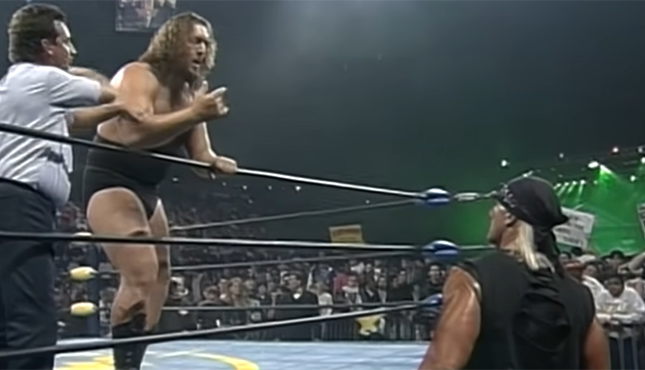 Image Credit: WWE

Welcome guys, gals, and gender non-binary pals, to Ask 411 . . . the last surviving weekly column on 411 Wrestling.
I am your party host, Ryan Byers, and I am here to answer some of your burning inquiries about professional wrestling. If you have one of those queries searing a hole in your brain, feel free to send it along to me at [email protected]. Don’t be shy about shooting those over – the more, the merrier.
Hey, ya wanna banner?

Dave A. also performs as Titan, the Corporate Giant:
Why did Paul Wight leave WCW for WWE? Was it money or something else?
Yeah, it basically boiled down to money. In late 1998, Wight was trying to figure out what to do about the fact that his contract with WCW expired in February 1999. By that time, the WWF’s business had turned around greatly compared to where it was when it bottomed out in 1996 and 1997. Generally speaking, WCW offered wrestlers contracts that had larger guaranteed payments than the WWF, but the WWF offered more incentive-based payment which allowed a wrestler to potentially earn more money than a WCW guarantee if business was going well and the wrestler was performing well.
Wight figured he could do better under the WWF contract structure and made the jump – though his guarantee from the Fed was likely nothing to sneeze at, either, with the Wrestling Observer reporting there were rumors that his downside was third-highest in the company at the time behind Steve Austin and the Undertaker.
Who can turn the world on with HBK’s Smile:
To the best of your knowledge, does footage exist for any of the King of the Ring cards prior to 1993?
For younger fans who may not know, before King of the Ring became a pay per view event in 1993, there were a series of KOTR tournaments held at WWE house shows in 1985, 1986, 1987, 1988, 1989, and 1991. The first two were in Foxborough, Massachusetts while the others were in Providence, Rhode Island.
As far as footage is concerned, officially there is none that I am aware of. In 2011, WWE put out a Best of King of the Ring DVD, and while they recognized the winners of the events from the 1980s and ’91, they did not show any full matches or even clips from the events, which is a pretty strong indication that there’s nothing out there.
However, note that I said “officially” there’s no footage. If you dig around on popular video sharing sites the names of which we all know, there is grainy, unofficial fan cam footage of most of the 1991 event out there.
Also, from researching this question, I learned that there is a not insubstantial community of people who love recreating old events like this using wrestling video games and posting the results to YouTube. (I would call them weird, but I’ve written a wrestling trivia column on the internet for almost ten years now, so I’m not much better.) So, if you want to watch the 1989 King of the Ring tournament as rendered in WWE 2K, that’s certainly something you can do.
Marcus from Alabama wants some board room drama:
Why weren’t members of the NWA’s board either removed or fired following their actions that lead to the organization losing prestige and viewership?
In 1993 the NWA terminated their relationship with WCW and I can understand their logic: they didn’t want WCW deciding who was the champion, where the title was defended and they didn’t like WCW having possession of the belt. But with that being said, why would you initiate the termination of your best partnership with no TV deal or any plan B lined up?
You could argue the board didn’t know what the consequences of their actions would be except they did the exact same thing with TNA in 2007. Nearly the same scenario happened: TNA got big, they didn’t want to pay the fees, the NWA didn’t want them having full control over the championship so they ended their partnership and the championship went back to obscurity.
Then the championship got some buzz in 2012 with the “Seven Levels of Hate” feud between Adam Pierce and Colt Cabana but the NWA pulled the plug on the feud, stripped Pierce of the Championship and put the title on Kahagas over politics.
So when your business model relies on the prestige of the NWA Championship, people wanting to see the NWA Champion in their territory and you actively make your title irrelevant, take your product off TV, put the title on wrestlers who don’t move the needle and hurt the company overall, how are you allowed to keep your job?
As to the 1993 situation, the NWA did not terminate its relationship with WCW. It was the other way around. The September 13, 1993 Wrestling Observer Newsletter documents the situation, reporting that for the vast majority of that year, WCW had been phasing out usage of the NWA initials on its television programming, referring to the person who held the belt representing the NWA World Heavyweight Championship as merely the “World Heavyweight Champion,” with the idea being that this would skirt the need for them to pay fees to the NWA. Then, in September, WCW actively withdrew its membership from the organization.
You can’t really remove an NWA board member for an action taken by a member organization. Even if you wanted to argue that the board was at fault because they created the conditions that lead to WCW ultimately withdrawing, the reality is that the NWA and consequently its board of directors had become so small at this point that actively removing anybody else likely would have killed the organization. Going back to the same issue of the Observer, you actually had four other members drop their affiliation at around the same time WCW, the most significant one of those being New Japan Pro Wrestling. This meant at the NWA board of directors’ annual meeting, there were only actually five individuals present, and none of them exactly represented power players in the industry at the time. The five were Jim Crockett (who legally couldn’t have a wrestling promotion because he was under a non-compete from selling his prior company to Turner), Paul Heyman (who was there not as a representative of a promotion but as an ally of Crockett), Steve Rickard (a promoter from New Zealand), Dennis Coraluzzo (long-time indy promoter from New Jersey), and Bob Trobich (not a promotoer at the time – the NWA’s lawyer).
So, the organization was not just losing WCW. It was dying overall, and I presume they didn’t want to put the final nail in their coffin by playing the blame game.
The situation with TNA in 2007 actually was an NWA call, but they weren’t just terminating the relationship on a lark. They were terminating the relationship because TNA breached the agreement between the two companies. According to the March 26, 2007 Observer, when the deal was inked, two of the terms were that: 1) TNA had to promote other NWA member shows on its television and 2) if TNA was going to run shows in the territories of other NWA members, TNA had to pay a nominal fee. However, TNA failed to ever pay the territorial fee, and they also didn’t promote other NWA shows beyond their weekly PPV era. Those factors gave the NWA the ability to terminate the agreement, which they were interested in doing because, even though this didn’t ultimately pan out, the Observer reported at the time that they were looking to establish their own television and/or switch to an ROH-style model in which they sold and heavily marketed DVDs of supercards. If that was their plan, regaining control of their titles did make some sense.
Regarding the issues with Pearce in 2012, that wasn’t really a result of action taken by the NWA board because, by that point, the structure of the organization had changed such that, though there technically would have been been a board, ownership and control was more or less in the hands of one individual, that being Bruce Tharpe, a former NWA promoter who gained control of the brand overall as part of the settlement of an insurance fraud lawsuit that he filed against the organization. It wouldn’t have been possible to remove him for a booking decision, whether you agreed with it or not.
Tyler from Winnipeg has some strange bedfellows:
I know you like to research things, can you give me a rough estimate on Mark Henry & Owen Hart as a team?
It’s a pretty easy history to give, because the two men only ever teamed together three times, one of which was on television and two of which were on house shows. Of course, all the matches came when they were both members of the Nation of Domination.
The sole televised bout was on the June 15, 1998 episode of Monday Night Raw when Hart and Henry got a disqualification victory over Dan Severn and Ken Shamrock.
The house show matches were both losses for the Nation, specifically against Shamrock and Steve Blackman on September 30 and October 1, 1998 in Grand Rapids, Michigan and Hampton, Virginia, respectively.
GRT is dynamite:
<bWhy was Kane vs Undertaker at Summerslam 2000 booked that way?
For those who may not remember the match, the two “brothers” started brawling before the bell even rang, with the ring steps coming into play. Ultimately, Taker got the upper hand and unmasked Kane, albeit in a way that his face was still largely obscured. Kane then slinked off to the back to protect his visage but there was never a start to the match and thus no official winner and no official loser.
So why book this non-finish . . . and really non-match?
The next month’s pay per view, Unforgiven, was headlined by a four-way match for the WWF Championship in which champion The Rock defended against Chris Benoit, the Undertaker, and Kane. The Taker/Kane booking at Summerslam appears to have been a mechanism to keep them strong headed into that championship match, which is in line with Benoit having been booked to win his Summerslam match against Chris Jericho.
Long-time question askers Night Wolf the Wise and Bruce A. both asked more or less the same question within a couple of weeks of each other, so let’s tackle them both at the same time. Here’s Bruce’s version of the question:
What things would you like to remove from pro wrestling? Here’s my thoughts:
Wrestlers working as the booker and planning their own matches.
Diving off the top rope to the outside.
Diving through the ropes to the outside.
The first because it is absolutely ridiculous.
The next two because they are done just too darn much with no impact on the match at all.
And here’s Night Wolf’s version of the question:
A cliche is an overused phrase or expression that has lost its original impact due to overuse. Now cliche’s don’t have to just pertain phrases or expressions. They can be used for anything that has been overused to the point they lose their original impact. Take wrestling for example. It is full of cliches. What would be your list of overused cliches in wrestling that need to disappear forever?
First off, thanks to Night Wolf for assuming that I have a limited vocabulary.
Let’s take Bruce’s comments from there. On the “wrestlers as bookers” issue, that certainly was a problem at one point in time, but I honestly can’t think of it having been an issue for quite a while, with the last real examples being Triple H in WWE (not the booker but close enough) and Jeff Jarrett in Impact. That’s been about twenty years now, so it’s not a huge issue.
On the subject of dives, I don’t mind them that much in the grand scheme of things, though using them as a setup to a commercial break has become a bit of a tired cliché.
So what would I get rid of?
I’ve been saying this on and off in columns for years, so I’m a bit leery of saying it again and boring people with a cliché of my own writing, but I’m tired of Money in the Bank and any other similar gimmick that allows a wrestler to “cash in” at any time for a title shot. I’ve never liked when faces do it (unless they specify a date long in advance) because it’s a cowardly move. However, an even larger problem is that I think just about every spin that can be done on this gimmick has been done before. It’s no longer novel.
I’m also tired of authority figures having a large role in wrestling shows. I would love it if WWE would adopt a more old school model like they one they had with Jack Tunney where we hear from the commissioner or president or whomever a couple of times a year as opposed to on every single show.
Over-serving fans with product also needs to go away. Wrestling shows from major promotions are too long and there are too many of them. I don’t want to try to keep up with ten-plus hours of televised wrestling from a single promotion each and every week. Being a fan of something shouldn’t feel like a part-time job, and the fact that I feel pressured to keep up with so much is a big part of the reason why I watch less wrestling now than I have at any other point in my life.
I’m surprised ”Triple T” Ticking Time Bomb Tazz isn’t asking about Sushi X:
Any idea what one of the first internet wrestling journals “Scoops” Al Issacs is up to these days?
Ole’ Scoops actually has a website that gives a fair amount of information about what he’s been up to after dropping out of the pro wrestling journalism game. Primarily, he’s worked in the comedy space, performing in improv shows and teaching improv as well. He’s also written a book, Mary’s Guitar, about his experience learning in his fifties that he was adopted and finding his birth mother thereafter.
He’s not completely given up on wrestling, either. According to his site, he has developed the concept for an animated series based on his experiences in the pseudo-sport, and he hopes it will be developed fully someday. He attempted a wrestling podcast in 2020, but that didn’t go too far.
Also, I can’t mention Scoops without mentioning Scoop This!, the wrestling journalism parody site from the 1990s that I loved, especially the Adventures of the nWo B-Team. Though predominantly active in the 90s, Scoop This has released content periodically through the years, most recently in 2023 to celebrate the 25th anniversary of the site being founded. I actually didn’t realize they’d published anything in 2023 until researching the answer to this question, so thanks to Triple T for helping bring that to my attention.
Jonfw2 says she’s his tootsie wootsie in the good old summertime:
With Seth Rollins now a legit top guy and Becky Lynch’s comeback, I wanted to ask: Who are the biggest real life “power couples” in wrestling history? Let’s assume Vince and Linda McMahon are number one. Who else should be on the list?
Well, the couple that immediately came to mind was the next generation of the McMahon family, namely Triple H and Stephanie McMahon.
Who are the other contenders?
Giant Baba and his wife Motoko Baba warrant consideration. Even though most people reading this will know Giant Baba as promoter of All Japan Pro Wrestling during its glory days, Motoko had a management role as well. The couple had a reputation for doing a good cop/bad cop routine with the wrestlers they employed, with Motoko always being the bad cop and taking hard stances with talent, earning her the nickname “Dragon Lady.” She also had a history of, ahem, favoring Johnny Ace when he wrestled there and giving him backstage responsibility, so we might not have John Laurinaitis as a pro wrestling executive without Motoko Baba.
Another couple that has made international headlines in wrestling lately is Marilsela and Joaquin Roldan. These two have been in charge of Lucha Libre AAA ever since the passing of Antonio Pena, who was AAA’s founder and Marisela’s brother. In addition to running the company for the last 19 years, they recently facilitated sale of a controlling interest to WWE, which will have some very interesting global implications for the wrestling industry.
Going back 80-90 years in pro wresting history, you’ve got Billy Wolfe and Mildred Burke, with Burke regularly being the most recognized Women’s World Champion in wrestling from the late 1930s through the early 1950s and Wolfe being the the promoter of the nationally-utilized troupe of lady grapplers that Burke belonged to thanks to his ties to the NWA.
If you’re talking about couples who were just on camera talent and not part of management, Randy Savage and Miss Elizabeth would like a word.
We’ll return in seven-ish days, and, as always, you can contribute your questions by emailing [email protected]. You can also leave questions in the comments below, but please note that I do not monitor the comments as closely as I do the email account, so emailing is the better way to get things answered.
More Trending Stories
- Killer Kross Reveals No One Was Allowed on Headset in Gorilla in WWE After He Listened In Once
- Killer Kross Was Initially Bothered That Triple H Didn’t Speak To Him After WWE Exit
- Latest WWE Ticket Sales Numbers For WWE RAW, SmackDown, NXT & House Shows
- Dark Side of the Ring Season 7 Full Episodic Schedule Released


