
wrestling / Columns
Ask 411 Wrestling: Which Wrestler’s Career Benefited the Most From the nWo?
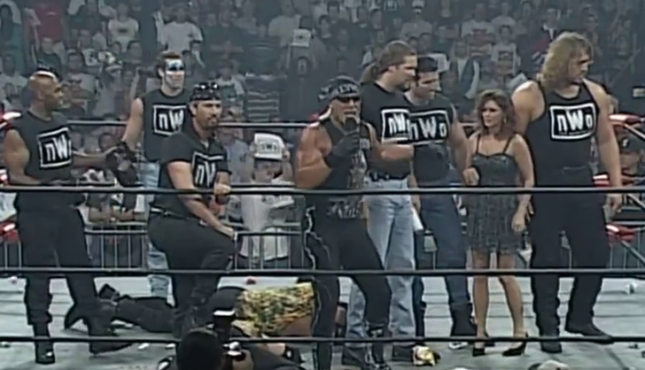 Image Credit: WWE

Welcome guys, gals, and gender non-binary pals.
Through Hel Stryer and brimstone . . . it’s Ask 411 Wrestling!
I am your party host, Ryan Byers, and I am here to answer some of your burning inquiries about professional wrestling. If you have one of those queries searing a hole in your brain, feel free to send it along to me at [email protected]. Don’t be shy about shooting those over – the more, the merrier.
Hey, ya wanna banner?

Rahil is a living legend:
Has Sting ever wrestled Larry Zbyszko?
Yes, quite a few times, actually.
If we’re just talking about one-on-one matches, they wrestled on a series of house shows that began in November 1987 and continued through May 1988, consisting of six matches in total in cities like Washington, D.C., St. Louis, Missouri, ant Atlanta, Georgia.
A few months later, they locked up on the 1988 Great American Bash tour, with Sting defeating Zbyszko on August 6 in Oakland, California.
It would be almost three years before the two men would lock up again, as they faced each other twice on February 12, 1991 in Anderson, South Carolina in matches taped for the WCW Main Event television show. In the first match, which aired on March 9, Zbyszko defeated Sting via disqualification. In the rematch, which aired on March 17, Sting came back and picked up the clean victory over his rival. This was the last-ever singles match between the two men.
It’s worth noting that those 1991 matches were actually aired as part of the fallout from that year’s WrestleWar pay per view, during which Zbyszko and Sting were on opposite teams, with Larry Z working alongside the Horsemen of Sid Vicious, Ric Flair, and Barry Windham to defeat the Stinger along with his partners, Brian Pillman and the Steiner Brohters.
Also, though the Living Legend and the Icon never faced each other one-on-one after ’91, they were involved in several tag team matches in 1992 due to Zbyszko being part of the Dangerous Alliance stable who feuded with WCW’s babyfaces that year. This culminated in another War Games at WrestleWar 1992 in which the two men were participants, with Sting, Barry Windham, Dustin Rhodes, Nikita Koloff, and Ricky Steamboat prevailing over the Dangerous Alliance of Zbyszko, Bobby Eaton, Arn Anderson, Rick Rude, and Steve Austin.
That 1992 War Games match was the last time Sting and Zbyszko shared the ring in any capacity.
APinOZ meant to send this question in to Ask 411 Linguistics:
I watched a lot of Japanese wrestling via the wonders of tape trading in the 1990s. However, it is only recently that I’ve seen Japanese wrestling referred to as “Puro” and “Joshi” for men’s and women’s matches. Where did these terms originate?
I’m surprised that you were tape trading in the 1990s and didn’t hear the terms “puro” and “joshi” back then, because I was also getting videos from tape traders during that era, and I heard those terms used quite regularly.
In any event, professional wrestling was introduced to Japan in the early 1950s as a result of American culture being imported into the country during U.S. occupation of the Land of the Rising Sun following World War II. It became popular almost immediately thanks to Rikidozan, the nation’s first wrestling star. But what would the Japanese people call the country’s new pastime?
Japan has a long history of taking words from other languages and tweaking their pronunciation and spelling so that they fit in better with Japanese. These borrowed words are referred to as “gairaigo.” For example, the English word “soccer” was adopted into Japanese and became “sakkā,” while the English word “animation” became “anime.”
Similarly, “professional wrestling” was taken into the Japanese lexicon, though it was blended into Japanese and turned into “puroresu,” with “puro” being an adaptation and shortening of the word “professional” and “resu” being an adaptation and shortening of the word “wrestling.” (Thus, a more literal translation of “puroresu” might be “pro wres.”)
In other words, puroresu is what they call pro wrestling in Japan. That has been the term for it since at least the 1960s. Because people love abbreviations, “puroresu” got shorted into “puro” as a nickname for the sport.
When fans began discussing pro wrestling on the internet (or, more accurately, Usenet), it became easier for Japanese fans to learn about American wrestling and vice versa. This lead to “puroresu” and “puro” being introduced to English-speaking fans, and they started using it to describe Japanese pro wrestling specifically, even though technically, to a Japanese person, all pro wrestling is “puroresu” regardless of where it originates.
Meanwhile, “joshi” is just a Japanese word for “woman,” particularly referring to younger women. This lead to women’s pro wrestling being called “joshi puroresu.” Over time, this was shortened to “joshi puro” and eventually just “joshi.” Again, to the Japanese, all women’s wrestling regardless of origin is “joshi puroresu,” but English-language fans will use “joshi” to refer to Japanese women’s wrestling exclusively.
Tyler from Winnipeg is an outsider:
Do you prefer Kevin Nash or Scott Hall?
If you make the assumption that we are considering both men at the respective peaks of their careers as performers, I would go with Hall, as he was more athletic, and I would say the two men were equals in terms of charisma and promos.
Even though I would prefer the former Razor Ramon as a performer, I will say that I’ve gained quite a bit of respect for Kevin Nash over the past couple of years, as he consistently has some of the best takes of the many retired wrestlers who currently comment on the business. He also seems like he would be a legitimately cool guy to hang out with.
Tim S. is a rare one:
I don’t know if this has already been asked before but is Lanny Poffo the only wrestler to be undefeated in a WWF Championship match? By which I mean any televised (or PPV) match for the top belt of either the brand or the company as of that time (so WWWF, WWF, WWE, World, World Heavyweight and Universal.)
For those of you who don’t know what Tim is referencing, on October 31, 1989 in Topeka, Kansas in a match taped for Saturday Night’s Main Event, “The Genius” Lanny Poffo defeated Hulk Hogan in a match for Hogan’s WWF Championship, thought he win was by count out, so the title did not change hands. This was the only shot at the WWF Championship that Poffo received during his career, so he is technically undefeated in WWF Title matches.
Are there others who also have this distinction?
Kind of.
First, let me say that I’m not the biggest fan of the qualifier that Tim put on the question of the match having to be on television or pay per view, particularly because the question encompasses the era of the WWWF Championship. During that period, major matches weren’t on TV or PPV and were saved for the company’s live events. It doesn’t make sense to hold matches from prior to Wrestlemania to the standard of “if it wasn’t televised it doesn’t count.”
For that reason, I did include non-televised bouts in my research, though obviously if you don’t want to consider them, you can pretend I left them off.
Without that television requirement, we get some old school names on the list. Chavo Guerrero, Sr. had exactly one WWWF Championship match, which came when Billy Graham defended the title against him on a show held by the old Los Angeles territory in the Olympic Auditorium on February 10, 1978. Chavo won the bout by referee’s decision but at a place and time when winning a match by decision would not win you the title.
Nick Bockwinkel also joins our list thanks to match taking place on March 25 of Billy Corgan’s favorite year, 1979. That match, which took place in the Toronto territory at Maple Leaf Gardens, included a title for title match between AWA Champ Bockwinkel and WWWF Champ Bob Backlund. As you can imagine, neither man won, as there was a double count out, effectively a draw that makes Bockwinkel undefeated in WWWF Title matches.
Similarly, on August 11, 1982, Billy Robinson and Backlund wrestled to a time limit draw imposed by city curfew in a match where Robinson’s International Heavyweight Title and Backlund’s WWWF Heavyweight Title were both on the line. This occurred in Montreal, Quebec on a card held by the International Wrestling territory that ran there. With no rematch, Robinson is undefeated in WWWF Title matches, which will thrill regular reader Bruce, who may be the world’s biggest Billy Robinson mark.
Two years later, a similar result occurred across the United States’ other land border, with El Canek facing Hulk Hogan in a WWF Title match in Mexico City for Canek’s UWA promotion on September 2, 1984. It was a two-out-of-three falls match in which the two wrestlers split falls but the third ended in a double count out, meaning neither was defeated in the end.
The last of this series of similar matches occurred on September 15, 1992, with WWF Champion Ric Flair defending against Genichiro Tenryu, also in a two-out-of-three falls match in which the first two falls were split and the third was a double count out. This was on a card jointly promoted by the WWF and Tenryu’s WAR promotion in Yokohama, Japan.
You can make a case that Vince McMahon is undefeated in WWF Title matches. On April 13, 1998 on Monday Night Raw, he and Steve Austin went to a no contest in a WWF Title match. On September 14, 1999 on Smackdown, he defeated Triple H for the WWF Title, later vacating it rather than dropping it in the ring. McMahon and Kurt Angle also had a WWF Title match, wrestling to a no contest on the December 18, 2000 episode of Raw.
Whether you consider Vinnie Mac undefeated in WWF Title bouts hinges on how you want to categorize an encounter that occurred on the King of the Ring pay per view in the year 2000. On that show, The Rock won the WWF Championship in a six man tag where he teamed with Kane and the Undertaker against Triple H, Vince McMahon, and Shane McMahon. Triple H came into the match as champion, and the stipulation was that if the babyface team won, whoever scored the fall would become the new champ. So, McMahon technically did lose in a WWF Championship match and he even got pinned, but it’s a match in which he never stood to gain the title, so it may or may not count for purposes of this question. You get to make your own decision.
Ken Shamrock would qualify if you apply all the rules set fort in Tim’s question. His televised WWF Title matches are a no contest with Bret Hart on October 21, 1997 for Raw, a DQ win over Shawn Michaels on December 7, 1997 at In Your House: D-Generation X, and a no contest with Steve Austin on September 14, 1998 for Raw. Shamrock has lost WWF Title matches, but they were either house show matches or dark matches after television tapings had concluded.
Two other surprising names you could potentially put on the list are Becky Lynch and Earl Hebner, whose circumstances are similar. On May 2, 2000 for Smackdown, Hebner teamed with WWF Champion the Rock to win a match against Triple H, Road Dogg, and X-Pac in which Rock would’ve lost the title if he was pinned. Hebner never could have won the title, but it technically was the only WWF Title match he ever participated in (as a wrestler) so you can say he is undefeated in WWF Title matches.
Similarly, on the Extreme Rules pay per view in 2019, Lynch and husband Seth Rollins were in a “winners take all” mixed tag against Lacey Evans and Baron “Why is WWE Considering Rehiring Me?” Corbin. At the time, Lynch was Raw Women’s Champion and Rollins was WWE Universal Champion, and the winning team would earn both belts. Like Hebner, Lynch never would have won the Universal Title, but it was her one and only match with Universal Title implications, and she did win it.
Donny from Allentown, PA is taking over:
I know the whole WCW company benefited from the NWO angle in 1996, but certain WCW superstars really benefited. I narrowed it down to five ranked from five to one. I will list them and give them my brief reason and then would love to hear your opinion on each. (Note: Kevin Nash and Scott Hall were not included on my list because they were not WCW superstars prior to the NWO).
Sounds like a plan. I’ll be responding to Donny’s list point-by-point rather than waiting until the end.
5. Marcus Bagwell: Since his debut in 1993 he did have some little flashes here and there but nothing to ever take seriously. Once he joined the New World Order in 1996 his stock and his name rose. He was more identifiable with the crowd. Never a serious world title contender, but his NWO defection really put him on the map.
I agree that Bagwell’s stock definitely rose during the time that he was in the nWo. However, I question whether it rose specifically because of the nWo or whether it rose more because he turned heel, regardless of the faction that he joined. Buff had basically done everything he could in WCW as an undercard babyface, and turning him was the next necessary step to freshening him up and letting him move to the next level. It also allowed him to tap into a different type of charisma that seemed more natural for him than playing “good guy.” I think it would be interesting to see if Bagwell would wind up in the same place if he turned heel without joining the nWo, but in 1996 that was pretty much impossible.
Because a non-nWo heel turn could have put him on the same level, I agree with Bagwell being placed on the list in the fifth position.
4. Scott Steiner: His turn on brother Rick Steiner in 1998 and defection to the NWO launched him as a huge singles superstar and quickly shed him of his tag team wrestler label. More people remember him as BIg Poppa Pump as opposed to that awesome tag team with Rick in the early 1990s.
Throughout the Steiners’ tag team run, various promoters had tried to split them up so that Scott could be made into a singles star. However, it was the nWo that finally got things to head in that direction. I agree that Scott should probably be on the lower end of this list, because if you watch his initial singles work with the New World Order, it’s actually not that great. He took some time to grow into the Big Poppa Pump persona, and I would argue that, though the bleached blond hair and bicycle shorts were there in the early days, the version of that gimmick we remember really found its footing after the original iteration of the nWo disbanded. You still have to credit the faction for building the foundation, though.
3. Sting: The whole NWO angle was able to give top babyface Sting a chance to reinvent his character in a cool dark way that made fans go absolutely nuts when he would make his rare appearances.
Sting was already to the top babyface among WCW fans in the pre-Hulk hogan era. What the nWo story did for him was make him into a crossover star among all wrestling fans, because prior to this point people who were following the WWF and people who were following WCW were really separate camps, and the massive popularity of the nWo lead to people who were historically WWF fans checking out WCW and learning to accept Sting as a top guy. So, as much as the nWo increased Sting’s popularity as the angle was ongoing, it helped cement his long-term legacy even more.
2. Diamond Dallas Page: Although Page was never an NWO member, he was recruited by the organization, and when he turned them down in dramatic fashion he instantly became a huge superstar and a top foil to the NWO’s antics on every show. The NWO helped his career.
Because I think the nWo had more long-term benefit for the Stinger, I might flip DDP and Sting on Donny’s list, but I concede that an argument can be made either way. However, Page still deserves to be listed because this angle did turn him from c-level heel to a believable babyface World Champion. While Donny’s blurb focuses on DDP’s rejection of the nWo as a turning point (and it certainly was), I think the even bigger shot in the arm for him came from his feud with Randy Savage when Savage was part of the nWo, as mixing it up with and even beating the Macho Man greatly elevated the King of Badda Bing in fans’ eyes.
1. Hulk Hogan: By 1996 the whole Hulk Hogan babyface red and yellow persona had gone totally outdated. Fans were bored with his same old gimmick. The fresh NWO angle was the chance for Hulk to flip the script on his character and write a whole new legacy for the Hulkster. And he rode that out like a champ. He played the part well. The whole NWO angle not only saved Hulk Hogan’s career but it also resurrected it.
This is indisputable. No single wrestler benefited from the nWo story more than Hogan did, for all the reasons Donny mentioned.
All in all, Donny’s list is pretty solid. I would also give out three honorable mentions. The first is Scott Norton. The nWo did not turn him into a huge star, but it gave him consistent work and exposure in the U.S. that I don’t know he would have gotten otherwise. The second is Konnan. He had previously been just a generic babyface luchador in WCW, but adopting a more “street” look (which admittedly started in the Dungeon of Doom) and cutting catchphrase-laden promos in the nWo got him more of a footprint. Third is “nWo Sting” Jeff Farmer. Farmer had already been in WCW as the military-themed job guy Cobra, but the nWo gave him a regular gig and a paycheck for years from New Japan that he probably wouldn’t have gotten otherwise.
We’ll return in seven-ish days, and, as always, you can contribute your questions by emailing [email protected]. You can also leave questions in the comments below, but please note that I do not monitor the comments as closely as I do the email account, so emailing is the better way to get things answered.


