
wrestling / News
Eric Bischoff On How WCW Recruited Talent Through the Power Plant, Developmental Contract Details
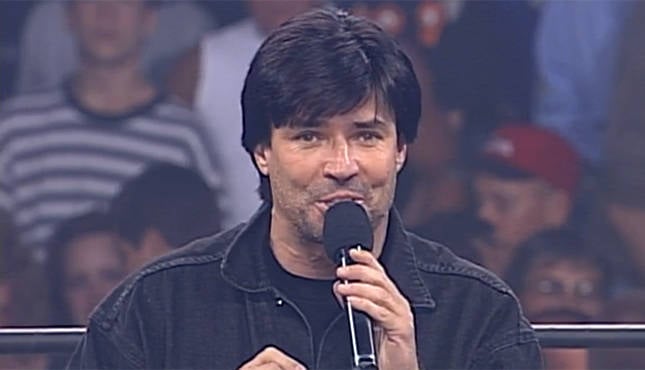 Image Credit: WWE

On a recent episode of 83 Weeks, Eric Bischoff discussed the Power Plant. Eric talked about how they recruited talent and the difference between recruiting wrestlers versus athletes. Some highlights are below.
On how WCW recruited talent: “Under my watch there was an attempt to create revenue because of again going back to pre-95, pre-96 revenue was still a big issue for WCW so we were looking for ways to make money any way, any how, anywhere possible. The Power Plant was one of those attempts where we would advertise and promote and people would we would charge them right? It was a commercial transactional endeavor as well as trying to develop our own talent. That was one way. Then, the other way was just recruiting you know someone who wasn’t necessarily looking to become a professional wrestler for whatever reason but yet someone whether it be Terry Taylor, Kevin Sullivan, myself in the case of Ernest Miller, whoever saw somebody they believed had really interesting potential then they would be recruited into the Power Plant and there wasn’t a charge for that because they were recruited and we would hope that we could develop them and eventually put them under a developmental contract, which we did.”
On details of WCW’s developmental contracts: “I think they ranged, I think they started at about fifty grand a year if I’m not mistaken could be wrong. Somebody will prove me wrong on that one, I’m sure. They were, you know, they were minimal but they were there was enough to live on. You know you’re asking somebody to give up their day job or forgo getting a day job and usually these people were, you know, adults that had responsibilities and car payments and apartments or houses or whatever kids in some cases. So, you had to pay them enough to survive and be able to continue to train. A lot of this I guess you call that a scholarship, right?
On when he got involved in the Power Plant: “I think context is really important here. Because back in the ’90s — certainly in ’95 — the indie scene as we know it today didn’t exist. There just wasn’t.. there was still indie wrestling around. Not saying it didn’t exist. I’m saying it didn’t exist to the extent that it does today. So, there wasn’t a lot of indie wrestlers. There wasn’t the volume of independent wrestlers sending in tapes sending in headshots and I remember.. I’m going to go back and forth in the timeline here just a little bit, so bear with me.
“When I first got to WCW maybe, after about a year or two actually after I moved to Atlanta, which is not until about a year later. So maybe by ’92 when I was spending more time in the office, even before I was executive producer or any of that, I just spent more time in the office because I was in Atlanta. I would often listen to Dusty, Ole Anderson, different people, Jody — certainly a lot of different people who had been in the industry for so much longer than I had who I had a lot of respect for — talk about how difficult it is to develop new talent at that time. Because guys like Ole, Dusty, and Jody and guys that really spent the largest percentage of their careers in the territory system, right? We’re all now looking at looking forward into the future, going, ‘Where do we get that talent from?’ Because the territories no longer exist, and the independent scene didn’t exist to the extent that it did today. So, that created a vacuum in their minds, which they were right about.” I don’t know whose first idea it was to really embrace the Power Plant concept and bring Jody in and support us. I don’t know, I wasn’t there at the time, or certainly not part of the discussions. I was part of discussions even before I got into management about the need for that talent.”
On recruiting athletes vs. wrestlers: “I spent enough time teaching martial arts as a black belt to recognize that when someone would come into our dojo and say ‘I want to train here,’ and I’ve had three years experience or I’ve had two years experience, and I moved from one city, and I moved here and I want to continue my training. That would typically happen a lot. It was way more difficult to train someone in martial arts that has had previous experience for another instructor because martial art — you know, every style, Japanese style martial arts is different than Korean style is different than this style is different than that style, and the technical aspect of each one of those styles can sometimes conflict… The physical characteristics and technical process of teaching someone martial arts is different from each style.
“So, when someone would come in and say ‘I’m training in Chicago and I want to, I’ve moved to Minneapolis and I want to train under you.’ I spent more time un-training them for the first year than we did training them. I’ve never been a golfer but for those who have it’s probably like you know you learn to golf maybe you taught yourself, watch some YouTube videos or maybe you’ve even had some instruction and just like golf or martial arts I’m guessing that golf has its own teaching golf, teaching someone to become a golfer everybody that teaches it probably has a little bit different technique. But, when you have somebody that’s been training under a golfing coach they develop bad habits just like martial arts. Students that come in and they want to train them and have previous training, I would consider it a bad habit but they have been trained in certain fundamentals that are completely different than what we would believe in or teach and you have to unlearn that and it would be like trying to unlearn a golf swing after you’ve been doing it for five years it’s much more difficult. I would have always preferred somebody who had no training because that’s a kind of a that’s a big piece of clay and you can start to mold it the way you believe it should be molded. Whereas, somebody coming in from the indie scene that clay has probably already been molded and you kind of have to start from scratch and that’s a tougher process sometimes.”
If you use any of the quotes in this article, please credit 83 Weeks with a h/t to 411mania.com for the transcription.


