
wrestling / Columns
Ask 411 Wrestling: When Should Roddy Piper Have Retired?
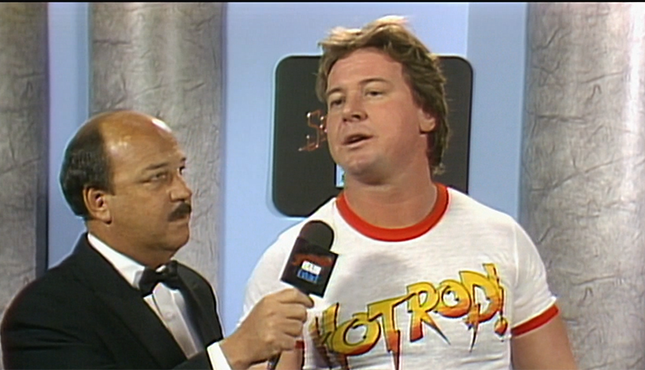 Image Credit: WWE

Welcome guys, gals, and gender non-binary pals, to Ask 411 . . . the last surviving weekly column on 411 Wrestling.
I am your party host, Ryan Byers, and I am here to answer some of your burning inquiries about professional wrestling. If you have one of those queries searing a hole in your brain, feel free to send it along to me at [email protected]. Don’t be shy about shooting those over – the more, the merrier.
Hey, ya wanna banner?

Lee isn’t going to overstay his welcome:
In retrospect, which of their matches would you have liked to have seen these guys retire after?
Hulk Hogan
Andre the Giant
Roddy Piper
Randy Savage
Ric Flair
Bret Hart
Though there are exceptions to every rule, I believe in the old mentality that a wrestler should go out on their back, handing things off to the next generation.
With that said, it should not come as a surprise that most of my answers will involve one wrestler passing the torch to another. Andre should have retired after Wrestlemania III. Hogan should have called it quits after Wrestlemania XVIII. Though not as well remembered as the first two, Savage should have gone out putting over Diamond Dallas Page at Spring Stampede 1997.
Regarding Ric Flair, I’m going to go with Wrestlemania XXIV against Shawn Michaels. You can’t really call that passing the torch because HBK was already well established, but Flair contributed so much during his late career and the bout between he and Michaels at Mania packed so much emotional oomph that I would hate to get rid of it.
The remaining wrestlers, Roddy Piper and Bret Hart, are a bit more difficult for me, probably because they don’t have a match that feels like the culmination of their life’s work; one after which everything else feels superfluous.
For Piper, I suppose my choice is WCW Superbrawl VII on February 23, 1997 when he was defeated by Hollywood Hulk Hogan in a match for Hogan’s World Heavyweight Title. Though some of the booking was goofy and the matches weren’t particularly good, the Hogan/Piper rivalry in WCW actually WAS over and made a lot of money. However, it took a turn for the worse after Superbrawl with their next match occurring at October’s Halloween Havoc and being derided by a large part of the fanbase as “age in the cage.” Cutting it off after Superbrawl gets you two main matches in the feud with one man winning each and with Hogan winning the second, which makes sense because he’s the one who was sticking around longer.
And now for Bret Hart. This is really hard because you don’t want to end it with the Montreal Screwjob, which is the conclusion of his WWF run, but you also don’t want to end it at most points of his WCW career, because there were very few highlights in that run. I suppose that I will settle on October 4, 1999 in the Kemper Arena on Monday Nitro, when the Hitman wrestled Chris Benoit in what was billed as the Owen Hart tribute match. The match was specifically requested by Hart as a means of paying homage to his deceased brother, and moreover he requested that it be nothing but pure wrestling with no hyjinx or even references on commentary to current storylines. The result is one of the better pro wrestling matches in the history of free television and a reminder of just how emotional our favorite pseudo-sport can still be if you strip it down to its barest components.
Nate is at the top of the heat:
What is your favorite way to determine a No. 1 contender for a championship(s)? Ex: One on one match, multi-person match, (triple threat, fatal 4-way, etc.), battle royal, “beat the clock”, tournament, etc.
My favorite way is for a wrestler to win every match that they have for several months and then for the announcers to note that, because of his dominance, the championship committee (or whatever other off-screen authority exists) has named him number one contender. This is, in my opinion, the most effective method, because you’ve got a championship contender going into his title bout on a hot streak and therefor have a greater chance of fans buying into the notion that he is going to unseat the champ when they meet.
I don’t think that any of the methods that Nate mentioned are ideal, as I feel a lot of them are used as shortcuts when a promotion needs a number one contender but they haven’t invested the time or effort into properly building somebody and instead have to do something quickly.
If I had to choose one of them, I would go with the tournament, because that gives the winner multiple victories en route to their title match. I also don’t mind beat the clock, because it hasn’t been as overused as some of the options and can help create a good show-long storyline for whatever program it’s occurring on.
Now that I’m thinking about it, these days you could actually do an interesting bit where you put the WWE Speed Champion in to a beat the clock challenge for a more mainstream belt, with the announcers playing him up as the odds-on favorite since he’s used to having to win quickly whereas that’s not something most wrestlers have to worry about.
Tyler from Winnipeg is hitting a dead end:
I’m asking about a wrestler named Road Block, a giant wrestler, bigger than Vader! What was his claim to fame not including his match vs Goldberg?
Road Block, also known as the Rochester Road Block, is probably best known for his unique entry into the professional wrestling business. Real name Joe D’Acquista, he was a huge man who was an amateur wrestler throughout his time in school, and he wanted to break into the pro ranks. He heard that the WWF was going to be running a show in his area and managed to track Hulk Hogan and Brutus Beefcake down to a local gym. D’Acquista asked them how he could get into the business and they basically blew him off, leading the future Road Block to come up with another plan.
An early match on that day’s WWF show, held on October 28, 1987 in Rochester, New York at the War Memorial Arena, was Hogan versus the One Man Gang. As Hogan was making his entrance, D’Acquista, who had purchased a ticket, jumped the rail and blindsided OMG. Eventually, Slick jumped Road Block and provided enough of a distraction that Gang was able to get loose from the interloper, and Block backed down when he saw Gang coming after him. D’Acquista admits to being arrested for pulling that stunt.
Not long after the Hogan incident, Road Block learned of Larry Sharpe’s Monster Factory and got some initial training, eventually wrestling on New England indies for a few years before getting an opportunity to work in Puerto Rico for the World Wrestling Council. While there, he got to mix it up with top star Carlos Colon and also made a connection with manager/promoter Victor Quinones. Quinones always had good connections with Japan as well, and he used those to get Road Block booked with Super World of Sports, the short-lived attempt to start a new major promotion in the early 1990s built around Genichiro Tenryu. Block actually moved to Japan and trained with SWS, becoming a regular on their shows. Block stayed with SWS from December 1990 through August 1991.
Though his run in SWS ended in ’91, Road Block may have had the biggest year of his entire career in 1992. He started off the year by going back to Puerto Rico, where he wrestled Colon again in addition to other big names like Buddy Landel, Robert Gibson, and The Patriot. After that, he got a couple of dark match tryouts with the WWF, which Block has claimed in shoot interviews didn’t lead to anything more because of bad blood over his 1987 run-in. From there, he went back to Japan for the deathmatch promotion W*ING, where he adopted the persona of the Masked Inferno. In W*ING, he wrestled Kevin Sullivan, El Canek, and Mil Mascaras, connections that would help him out in his career.
In fact, very shortly after this latest Japanese run, Canek brought Road Block to Mexico as a top heel for UWA, the promotion that was built around Canek as the main star. While in UWA, Block was known as Torre Infernal (“Towering Inferno”), a variation on his Masked Inferno gimmick. After being pushed as a monster heel for a few months, Torre Infernal main evented against El Canek in a mask versus mask match, which Infernal lost to the surprise of absolutely nobody. However, that wasn’t the blowoff of his character as you might expect, as he got to hang around for a while longer and feud with Los Villanos, who were also main event acts for the promotion.
For the next few years, Road Block didn’t do much other than bouncing around U.S. independents, and then in 1996 he learned his old friend from W*ING, Kevin Sullivan, was the head booker for WCW. So, he picked up the phone and got himself a gig with World Championship Wrestling, which is where he got the most U.S. exposure of his career. Block was mostly used as an enhancement wrestler, particularly when guys like Lex Luger, Goldberg, or the Giant needed to show off how strong they were by lifting up his massive frame.
Block wrestled with WCW through the summer of 1998, though he claims he never signed a contract with the company. After departing, there was a brief rumor that he was being considered for a role in the WWF as the brother of Golga (John Tenta) of the Oddities, but that never came to fruition. Road Block did a couple more years on the indies, and I have seen no record of him wrestling after 2000.
Road Block’s name did briefly resurface in 2022, when a small company called Rush Collectibles put out a line of pro wrestling action figures. Their first wave of figures consisted of Road Block, Larry Zbyszko, and “French Angel” Maurice Tillet, which sounds like a lineup selected by drawing wrestlers’ names out of a hat at random.
To the best of my knowledge, Road Block is still living and would be in his mid-60s now. He doesn’t seem to have any sort of online presence and is totally out of the limelight.
Bryan is a fashionista:
Do you think it’s hypocritical to criticize Kevin Nash for taking the finger poke of doom but no one has a problem with Batista dying from a dude snapping his fingers (that’s a joke btw)
The main question is, do you think it hurts kayfabe to have wrestlers competing in jeans, suspenders, correction officer uniforms etc? Most fitness centers won’t let you exercise in street clothes, how can we honor the illusion that pro wrestling is a sport when you have someone in jorts? If my gym teacher won’t allow it why is the WWE allowing it?
Yes, there are aspects of this that have always bothered me. If you are going to have people wearing nontraditional outfits in the ring, you should also have people taking advantage of those outfits. John Cena is wearing jorts with a hammer loop on them? Somebody better be grabbing that loop for extra leverage when hooking his leg. A wrestler is wearing a necktie? He’d better get choked with it at some point. Mr. Hughes is wearing freaking sunglasses in the ring? People better be trying to break those things into his eyes. (And yes, I know it happened once, but if his opponents were really trying to beat him, they should’ve been a perpetual target.)
The one that bothers me more than anything else is piercings. If I’m in a knock down, drag out fight and I see that somebody’s got an earring hanging off them, there’s no way I’m not trying to rip that thing out to distract them and get an advantage. Again, that has happened in pro wrestling before but not nearly often enough considering how many people have worn ear/eyebrow/tongue piercings into the squared circle.
Ron is my squire:
This questions is in regards to the 1993 Survivor Series and specifically Shawn Michaels’ knights. I’ve always heard rumored that the knights were going to be three “legends” in masks that would be unmasked over the course of the match in what I guess would have been a much more competitive match. One of them was probably always supposed to be Greg Valentine (who Vince accidentally calls by name during the match). The second was rumored to be Terry Funk who (according to the rumor) decided not to do it at the last minute forcing a change of plans. Any truth to this rumor and if there is, who would’ve been the third knight? I don’t think Barry Horowitz at that time could have been considered a legend.
I had never heard this rumor before reading Ron’s email.
However, just because I’ve never heard it before doesn’t mean it’s not true, so I decided to do a bit of research. After doing that research . . . I don’t think the rumor is true.
I am saying this mainly based on the Wrestling Observer Newsletter, which was reporting on the potential identities of the knights for several weeks before the Survivor Series, and nothing mentioned was remotely like what Ron described.
The Observer first reported that the Harts/Knights match would be taking place in its October 18, 1993 issue, where it just stated that the Knights would be “apparently three masked wrestlers.”
The Knights were next mentioned in the November 1, 1993 issue. That issue included a report on an October 25, 1993 show run by Jerry Lawler’s USWA, which featured a tag team tournament in which Lawler teamed with the Red Knight. The Observer said that the Red Knight would be one of Lawler’s partners at Survivor Series but that the person who wrestled under the hood for USWA “was nobody of note.” The same issue also said that the Black Knight would be Glen Jacobs (the future Kane) and that he debuted under that gimmick on an October 19 WWF house show in Glens Falls, New York, interfering in a Bret Hart/Lawler cage match. (Yes, Glen Jacobs debuting in Glens Falls is pretty cute.)
The November 1 Observer also referred to Jacobs as a Sid Vicious clone, which is a pretty stiff shot by Uncle Dave.
The Observer that came out on November 8 followed up on the previous week’s issue by reporting that the Red Knight from the October 25 USWA show was Del Rios, who also wrestled in Spellbinder in Memphis and Phantasio for a cup of coffee in the WWF. Meltzer wrote that he would “suspect” this meant Del Rios was headed to Survivor Series, but obviously that wound up not being the case. Lawler/Hart cage matches were also continuing on WWF house shows in Detroit and the Nassau Coliseum, which the same finish as the Glens Falls show.
Moving on to the November 15 installment of everybody’s favorite dirt sheet, it advised that Indiana-based wrestler Brian Costello, who was an enhancement talent on many shows in the Midwest from the mid-1980s through the early 1990s was under the hood as a Blue Knight on an Indianapolis WWF house show. Meltzer then recapped the fact that Costello, Jacobs, and Rios had all been Knights at various points, though he went on to say that this was no guarantee that they would be at the Survivor Series. The same issue also mentioned that Greg Valentine was potentially returning to the Federation.
Speaking of Valentine, in the November 22 Observer, it was reported that the Hammer was telling indy promoters interested in booking him that his upcoming “return” to the WWF was just going to be one match, leading Meltzer to correctly speculate that this meant he was likely to be one of the Knights.
In the November 29 issue, one of the news items revolved around Jeff Gaylord telling people he was going to be one of the Knights (accurate) while another again said that Glen Jacobs was likely to be one of the Knights (inaccurate).
So, you’ve got the biggest “insider” publication of the era not reporting on any such plan for the masked Knights to be legends, with alternative plans for relatively unknown wrestlers (aside from Valentine) to be under the hoods. Plus, if you look at Bret Hart’s autobiography, he discusses putting the match together, and he never once mentions the possibility of the Knights being anybody other than who they actually were.
I think the source of Ron’s rumor may actually be Terry Funk’s autobiography, in which the Funker claims he was supposed to be a Knight only for Bret to beat him, unmask him, and then beat him again. Funk would also take a role with the WWF backstage as part of this deal. Terry said he disliked this finish so much, in addition to generally not liking New York, that he backed out at the last minute by telling Vince McMahon that he had to go home because his horse was sick. (Causing Vince to greet Terry with, “So how’s your horse?” when he returned to the company in 1997.)
However, Terry’s account of events doesn’t make much sense, because as Bret says in his autobiography, the entire point of the match was to let Owen shine before he was eliminated due to Bret getting in the way, setting off the younger brother’s heel turn. A finish putting Bret over Funk strongly wouldn’t meet that goal.
We’ll return in seven-ish days, and, as always, you can contribute your questions by emailing [email protected]. You can also leave questions in the comments below, but please note that I do not monitor the comments as closely as I do the email account, so emailing is the better way to get things answered.
More Trending Stories
- Bully Ray Weighs In On How AEW Was Unable To Book Danhausen
- The Rock’s Daughter Ava Raine Addresses Backlash Over Charlie Kirk Post
- Will Ospreay Fires Back in Debate Over AEW’s Partnership With NJPW, NJPW’s Inability To Create New Stars
- Backstage Update on CM Punk to AEW Rumors and Punk’s Standing in WWE


