
wrestling / Columns
Ask 411 Wrestling: Why Did Ronda Rousey Use Roddy Piper’s Nickname?
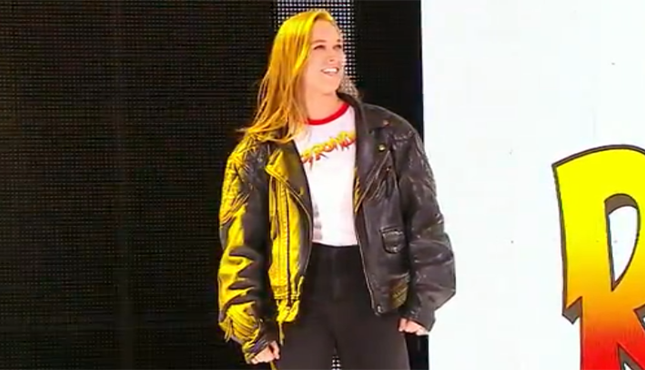 Image Credit: WWE

Welcome guys, gals, and gender non-binary pals.
Through Hel Stryer and brimstone . . . it’s Ask 411 Wrestling!
I am your party host, Ryan Byers, and I am here to answer some of your burning inquiries about professional wrestling. If you have one of those queries searing a hole in your brain, feel free to send it along to me at [email protected]. Don’t be shy about shooting those over – the more, the merrier.
Hey, ya wanna banner?

Jose is getting into the pit:
Why was Ronda Rousey presented as a sort of tribute act to Roddy Piper? I think this was a key reason for her lack of sustained success in WWE – not only was she being directly compared to a legendary performer, but a performer who was legendary for the specific thing, wrestling promos, that she had no experience with not coming from a pro wrestling background. This seemed like the inversion of the Paul Heyman tactic, emphasizing the performer’s weaknesses and hiding their strengths.
The answer is that, early in her combat sports career, Rousey wanted to use the “Rowdy” nickname, in part because she was a Piper fan and in part because, whether you like the gimmick or not, “Rowdy Ronda Rousey” really rolls of the tongue.
As some readers may recall, Rousey was involved in judo before breaking in to MMA, and her mother, AnnMaria De Mars, was also a judo champion. Through her judo career, AnnMaria worked with the legendary “Judo” Gene LeBell, himself a legendary judoka and later professional wrestler. Due to the connection with her mother, Rousey also wound up being mentored by LeBell.
(And, yes, this is the man who lends his name to Bryan Danielson’s LeBell Lock.)
LeBell also had a hand in training Roddy Piper to be a wrestler back in the late 1960s, so he was able to make a connection between Rousey and Piper so that she could officially ask for his blessing to use the “Rowdy” nickname, which he granted. This also lead to a bit of a mentoring relationship between Piper and Rousey.
Of course, she then used that name during her meteoric rise in UFC. When she crossed over into WWE, it then made sense based on the nickname for the folks in the marketing department to theme her gear and her logos around what the Hot Rod had used in the past – and his famous leather jacket was even given to her to wear to the ring in early appearances, though she eventually had a replica made that was better fitted to her body.
Miley Too Hotty is coming in like a wrecking ball:
I remember watching WWF Superstars back in the day, and one day Ted DiBiase bought Hercules to be his slave. Immediately, he got pissed and Herc turned face. No build up or anything. Even as a kid I thought that was lame, why am I supposed to all of a sudden cheer for Herc? Were the fans asking for a face turn?
With that, what do you consider would be the worst face turn? One where no one was asking for it and all of a sudden with no build your supposed to love said former heel?
Some people might call me out for recency bias on this one, but I legitimately do think that John Cena turning back face prior to Summerslam 2025 should go down as one of the worst face turns in wrestling history. They basically came right out and said, “Hey, we made a mistake when we turned this guy heel. Let’s just hit the reset button.” I get that we’re living in a post-kayfabe world, but that felt like a step too far in admitting that wrestling storylines are fake in the middle of a wrestling storyline.
Other than that, my least favorite type of face turn is one where you have a tag team or stable of heels and one guy winds up turning face by default just because his heel partners kick him out of the group and beat him up. (For an example, see Faarooq’s face turn upon leaving the Nation of Domination.) In my opinion, a face turn needs to have its roots in the wrestler who is turning actively doing something rather than having something done to him, because a face is the hero of the story, and people want their heroes to be active and not passive.
Tyler from Winnipeg is a purist:
As a fan of wrestling since 1985, one thing I am almost clueless about is pertaining to Ring of Honor. I think the company had a secondary title called either the Pure or Honor Rules Title. What’s the history of that belt?
Yes, Ring of Honor started promoting “pure wrestling rules” matches in 2004, and eventually they decided to create a championship that would be defended exclusively in those bouts. I won’t list them here, but generally the pure wrestling rules were designed to create more “technical” matches, and the biggest change from standard wrestling rules was that each competitor would only be able to use rope breaks three times in any one match. This did lead to some interesting storytelling opportunities, as a wrestler would be in trouble if he ran out of rope breaks.
However, the initial incarnation of the championship didn’t last long at all. AJ Styles became the first champ on Valentine’s Day 2004, defeating CM Punk in the finals of a tournament. There were six champions and then, on August 27, 2005, titleholder Nigel McGuinness put the Pure Title on the line against ROH World Champion Bryan Danielson in a unification match, which Danielson won to force its deactivation.
ROH did bring the belt back during the pandemic era, with Johnathan Gresham beating Tracy Williams in another tournament on October 30, 2020 to win the revived title. Josh Woods was the champion when Tony Khan purchased Ring of Honor, and the championship carried over to the AEW version of ROH. Counting Woods, there have been seven champions during the AEW era, though three of them have been Wheeler Yuta. Currently, Lee Moriarty is the champion and has been since July 26, 2024.
AEW/ROH also introduced a Women’s Pure Championship last year, with Deonna Purrazzo going over Billie Starkz in a tournament final on December 5, 2025. Purrazzo has been the champion ever since, though she also hasn’t wrestled a match since December 21, 2025. At this point, the WCW Women’s Cruiserweight Championship is more prestigious.
Stromi missed the birth of his daughter to send in this question:
I’m well aware of the Mid-South angle with the Freebirds “blinding” JYD with hair removal cream. My question is, was there ever a major blowoff for all of the parties involved, and how did they explain the Dog getting his sight back?
There were two major matches that came out of the blindness angle. On August 2, 1980, the Junkyard Dog faced Michael P.S. Hayes of the Freebirds in a dog collar match inside of a steel cage. This was held at the Superdome in New Orleans and drew about 28,000 people. Dog was still “blind” in storyline at the time, and the idea behind the dog collar stipulation was that binding the two men together helped level the playing field in light of his disability.
After that match, JYD’s vision did return. There was no magical explanation as to why. It was just explained that he healed over time.
Once the Dog had his sight back, we got the second major match off of the angle, with JYD and Terry Orndorff defeating Buddy Roberts and Terry Gordy for the Mid-South Tag Team Titles on September 15, 1980 at the St. Bernard Cultural Center in Chalmette, Louisiana.
After that, the Freebirds were headed out of the territory to start up in Georgia, so they had a series of “loser leaves town” matches with Dog, Orndorff, and Bill Watts defeating all three Freebirds in six man tags in the Louisiana cities of Shreveport, Monroe, and Baton Rouge. They were able to do the loser leaves town matches in multiple cities due to the lack of match reports circulating to most of the fanbase in the pre-internet era.
And eventually, JYD joined the Freebirds in Georgia, where they did a repeat of the blinding angle.
Arfan is sipping a viscous substance:
Could you tell us some stuff about Gangrel, the WWF wrestler, because all i know about him is that he had good theme music but nothing about his wrestling.
Sure.
The man we would eventually come to know as Gangrel was born as David Heath. He was a Florida native and, in the late 1980s, he started training to be a professional wrestler in his home state under the tutelage of Boris Malenko. He was mostly a Florida indy guy during his first couple of years in the wrestling business, but he also occasionally popped up on WWF and WCW television as an enhancement wrestler under his real name, including matches against the Big Boss Man, the Midnight Express, and Abdullah the Butcher.
In 1989, Heath’s career started to build some momentum when he teamed up with another Florida indy wrestler named Tom Nash. They put on masks and started wrestling as The Blackhearts, with Heath adopting the name Destruction and Nash adopting the name Apocalypse. They were also managed by Nash’s wife, a female wrestler who I’m sure the vast majority of you have heard of: Luna Vachon.
The Blackhearts were initially an indy act, but eventually they gained enough notoriety that they got a push in Stampede Wrestling (or what was left of it at that point) even winning that promotion’s International Tag Team Championship over a team that included a young Kensuke Sasaki, who New Japan Pro Wrestling had sent to North America on a learning excursion.
Speaking of Japan, after Stampede the Blackhearts got a couple of tours of All Japan Pro Wrestling in 1991, where they mixed it up with absolute legends like Jumbo Tsuruta, Kenta Kobashi, Toshiaki Kawada, and Mitsuharu Misawa. They even got an All Asia Tag Team Title match against champs Doug Furnas and Phil LaFon, though it turned out to be a losing effort. In between trips to Japan, they worked in the infamous short-lived UWF promotion run by Herb Abrams.
In 1993, towards the end of their run, the Blackhearts popped up on WCW television and appeared to be in line for a push, winning quite a few squash matches. However, the team fell apart, in large part because Luna and Heath became romantically involved, effectively putting an end to her marriage to Nash.
Nash tried to keep the Blackhearts alive by recruiting a new partner (Dave Johnson a/k/a Blackheart Devastation), while Heath decided to make his mark as a singles wrestler. It was at this time, in mid-1993, that he developed what was essentially the Gangrel character, though at the time he used the ring name of the Vampire Warrior. The Warrior had a run in the USWA, wrestling Jerry Lawler and also having a feud with Jeff Jarrett over the Southern Heavyweight Title, which Heath held for a time. During his time in the USWA, he also had the displeasure – I can only assume – of having a singles match against the Giant Gonzalez.
In an odd footnote of David Heath’s career, between October 28 and November 1, 1993, the WWF did a loop of five shows in Heath’s old stomping grounds of Florida. On all five of those shows, Heath (using his real name) teamed with “Cuban Assassin” David Sierra and little person wrestler Little Louie to face the Bushwackers and their own little person partner, Tiger Jackson. About a year later, Jackson would be better known as Dink the Clown and Louie would be Queasy, the miniature version of Jerry Lawler.
In early 1994 our man became a regular enhancement wrestler with the WWF, wearing his old gear from the Blackhearts tag team but being called the Black Phantom. According to the March 24, 1994 Wrestling Observer Newsletter, Heath intentionally wore the Blackhearts gear on WWF television to be a jobber as a means of undermining Tom Nash, who was still doing the Blackheart gimmick on the indies. This stemmed from the bad blood that still existed between the two men as a result of the situation with Luna.
Heath continued to work indies as the Vampire Warrior during this stint on WWF television, with one notable run being an August ’94 tour with IWA Japan, the promotion that the next year would put on the infamous Terry Funk/Cactus Jack “King of the Deathmatch” show. Vampire Warrior did not participate in any deathmatches, but it’s interesting to note that the IWA was obsessed with monsters around this time, as on the same tour they featured characters based on Jason, Freddie Krueger, Leatherface, and even Lucifer himself.
In 1995, the Vampire Warrior got extreme, heading to ECW, though he didn’t have much success there. He did form an odd tag team with Dudley Dudley, the connection being that the two men were both Florida guys who trained with Boris Malenko, albeit at different times.
1996 and 1997 saw Dave Heath become Blackheart Destruction again, reviving the gimmick for additional tours of IWA Japan in June and August. He teamed with another Blackheart Apocalypse. Some sources, like Cagematch, say this was a reunion between Heath and Tom Nash, though others, like the Observer, say it was Dave Johnson, the guy who Nash started teaming with Nash after the Nash/Heath split. I’m more inclined to believe it’s Johnson, but this one might be lost to history.
The Vampire Warrior also returned to the USWA in ’96, again getting built up as a USWA Heavyweight Title contender before losing in the championship match, this time to Brian Christopher. VW also headed to Puerto Rico in August 1997, getting a couple of Universal Championship matches there against Ray Gonzalez but always coming up on the losing end.
The summer of 1998 was a big one for Dave Heath, as he returned to All Japan Pro Wrestling for the first time in seven years, working under his real name again. He was put in a regular team with Bobby Duncum Jr., though they had limited success.
Summer ’98 got even better from there, because in August it was time for Gangrel to debut in the WWF, giving David Heath the most exposure of his career by far. I won’t go into great detail on that run because many reading here are familiar with it, but in short he was mostly an undercard wrestler but always seemed to remain more over than the level the company pushed him at because he had an amazing entrance, with a custom elevator lifting him up from the stage into a ring of fire and entrance music that is among the best Jim Johnston creations of all time.
However, creative eventually ran out of things for Gangrel to do, and he was taken off television in November 2000 before eventually getting released altogether in June 2001. He joined up with the WWA, the upstart group that mostly relied on former WCW talent to run international tours. On a WWA tour of the UK from October through December 2001, he regularly wrestled his own wife, Luna, in a series of hardcore bouts billed as “Black Wedding” matches. He also popped up on the first ever TNA show where he participated in the gauntlet match to crown a new NWA Worlds Heavyweight Champion which was ultimately won by Ken Shamrock. A long relationship with TNA was not in the cards, though he did pop up a couple more times in the early days of the promotion.
For most of the 2000s, Heath went back to the indies and actually did a ton in Europe, including for All Star Wrestling in England, European Wrestling Promotion in Germany, Nu Wrestling Evolution in Italy and Spain, and American Wrestling Rampage in Ireland. He also popped down to northern Africa in 2009, joining a pro wrestling tour of Egypt that included names like D-Lo Brown, Al Snow, and Sonjay Dutt.
In late 2006 and early 2007, our favorite vampire showed up in an odd place, that being WWE developmental territory Deep South Wreslting. He didn’t have any classic matches or memorable angles there, but I mention it because the run lead to several matches I never would have imagined taking place, including Gangrel (actually billed as Dave Heath) versus Heath Slater, Gangrel versus Zack Ryder, and Gangrel versus Kofi Kingston.
Something else happened for Gangrel in 2007, and it’s a bit unusual. For reasons I don’t quite understand, it was reported that year that the Vampire Warrior had signed with a pornography production company to direct twelve adult films. His time in that industry did not last long, and he has subsequently done interviews saying that he regrets getting mixed up in that sort of work.
In 2009, Gangrel’s most significant appearances in the wrestling world were for Hulk Hogan’s Hulkamania: Let the Battle Begin tour of Australia. Back under his Vampire Warrior moniker, he helped fill out the undercard of the shows, interacting a lot with the Nasty Boys.
In the 2010s, Mr. Heath switched things up and moved from focusing on his career on Europe to focusing his career on Canada. He was on shows in virtually every province, though he would also pop down to the United States from time-to-time.
2017 saw Gangrel try his hand at promoting and training, as he launched an independent promotion and wrestling school called Gangrel’s Wrestling Asylum, which was based in the Miami, Florida area. Gangrel was often the biggest star on these shows (no surprise there), but he would occasionally bring in some other former WWE talent, including Billy Gunn, the Headbangers, Scott Steiner, and MVP. Unfortunately, all good things must come to an end, and GWA wrapped up its run in 2021.
And, aside from that, it’s really just been a standard indy wrestling career for Gangrel these last several years, punctuated by the occasional nostalgia appearance in WWE, AEW, or even ROH on one occasion. At 56 years old and 38 years as a pro wrestler, Gangrel had 27 recorded matches in 2025, making it look at though he is not going to stop anytime soon.
We’ll return in seven-ish days, and, as always, you can contribute your questions by emailing [email protected]. You can also leave questions in the comments below, but please note that I do not monitor the comments as closely as I do the email account, so emailing is the better way to get things answered.


